49 works in this view — arrow keys or swipe to move between them.
Dance in Art
Fanny Elssler
Unknown artist
- Collection:
- Prints depicting dance
- Source:
- New York Public Library
- Rights:
- Public domain — free to use, share and adapt.
- Recorded as:
- Public Domain
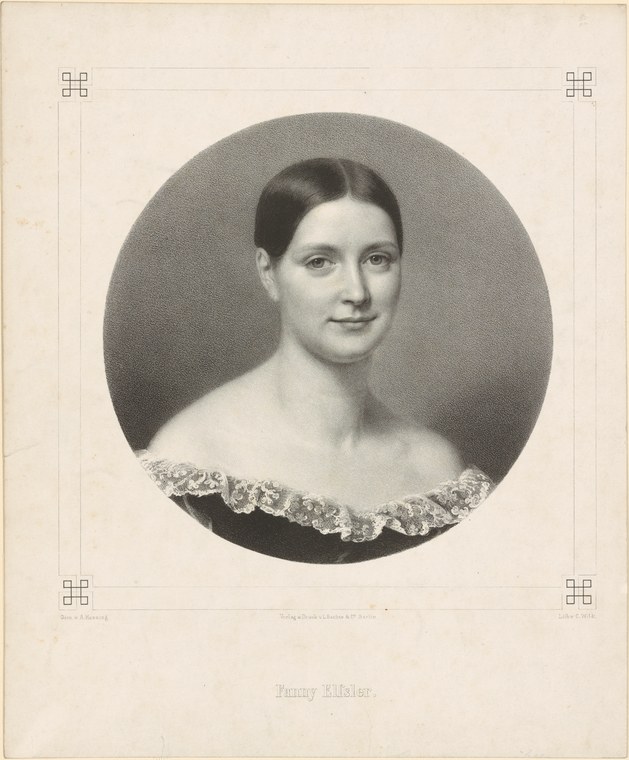
Fanny Elssler's dominance of the stage in the 1830s and 1840s challenges the familiar narrative that Romantic ballet was the domain of ethereal, otherworldly femininities; she was celebrated for her athleticism, her Spanish-inspired character work, and her theatrical command. This print, circulated in thousands, shaped public memory and desire around her body and her fame, making it essential evidence for understanding how nineteenth-century dance culture worked.
What you are looking at
This is a portrait print of a woman shown in bust-length format within a circular frame, set against a mottled gray background. She faces slightly to the left with a serene, subtly smiling expression. She wears a white off-shoulder dress with a deep décolletage trimmed with delicate lace gathered into a decorative ruffle. Her dark hair is parted in the center and swept back smoothly in the fashion of the 1830s–1840s. The oval vignette and refined execution suggest this is a theater or dance world promotional print. The woman's poised bearing and the elegance of her presentation indicate she was a notable performer of the era.
The dancing
The figure is presented in a formal, still pose characteristic of portrait prints rather than a representation of active dance. Her shoulders are relaxed and held back slightly; her gaze is composed and forward-directed. There is no visible footwork or dance hold—this is portraiture, not a scene of movement. The posture conveys the trained carriage and bearing expected of a stage performer of the period.
The dance depicted
The subject is Fanny Elssler, one of the most celebrated ballet dancers of the Romantic era (1810–1884). She was renowned for her technical virtuosity and her commanding stage presence, and was particularly celebrated for her performances of character dances, notably the Cachucha, a Spanish-inspired solo that became her signature role. This print documents her as a public personality rather than capturing her in performance, but it served as a promotional image circulating among audiences who knew her work. Elssler's popularity spanned Europe and North America, and prints like this were essential tools for maintaining her celebrity.
How it was made
This is a steel or copper engraving with hand-tinted or printed gray tone, a technique that allowed fine detail and relatively economical mass production. The oval vignette format—a circular or oval frame that fades into white at the edges—was the standard for portrait prints of theatrical celebrities in this period. This technique was ideal for circulation in newspapers, playbills, sheet music covers, and as standalone souvenirs. The quality of the engraving and the sophistication of the presentation indicate this was produced by a professional theater print publisher for a wide audience.
About this work
Fanny Elssler was a transformative figure in nineteenth-century dance, embodying the technical brilliance and dramatic power of Romantic-era ballet while also championing character dances rooted in European folk traditions. This portrait print is a document of her fame at its height, when she was as recognizable to audiences across Europe and America as any performer of her time. The image belongs in a dance history collection not as documentation of her choreography or technique—for that we must look to dance manuals and reviews—but as evidence of how dancers of this rank were commodified, recognized, and celebrated in their own moment.
How to look at it
The portrait is still and formal, offering no movement to interpret, but the viewer should attend to the details of her dress and carriage—the bare shoulders, the precision of the lace trim, the composed facial expression—as markers of her rank and professionalism. The oval vignette format was a convention of celebrity portraiture, used to frame and elevate the subject. The quality of the engraving itself—the subtlety of the gray tone, the precision of the line work—signals that this was a premium product, not a cheap woodcut, and thus a mark of Elssler's prestige.
The artist
The engraver is not recorded in the catalogue. The style and format suggest it was produced by one of the commercial print houses specializing in theatrical portraiture—firms like N. Mendal Shafer or other major American or European publishers of the period. Such prints were often unsigned or bore only the publisher's name, and attributing them to individual engravers is difficult without additional documentation.
The period
This portrait dates to the height of the Romantic ballet era, when dancers became international celebrities and their images circulated widely in print form. Fanny Elssler's career (1830s–1850s) coincided with the emergence of photographic processes, but prints remained the dominant medium for her image during her performing life. She was a contemporary of Marie Taglioni, her great rival, and both dancers benefited from—and drove—the explosion of dance-related visual merchandise: prints, lithographs, playbills, and illustrated newspapers. The 1830s–1840s also saw the rise of Romantic ballet proper, with works like *La Sylphide* (1832) and *Giselle* (1841), though Elssler was equally renowned for her character dances, which drew on Spanish, Italian, and other European traditions outside the ethereal aesthetic associated with Taglioni.
Where it lives
This print is held in the New York Public Library's collection of prints depicting dance. It is one of thousands of such promotional and biographical prints from the nineteenth-century theater world, the majority now housed in institutional collections after having circulated commercially during their subjects' lifetimes.
Questions about this work
Who was Fanny Elssler and why was she famous?
Fanny Elssler (1810–1884) was an Austrian-Italian dancer who dominated the European and American stage from the early 1830s until the 1850s. She was celebrated for her technical mastery of ballet, her powerful stage presence, and especially for her signature character dances, notably the Cachucha, a Spanish-inspired solo that became inseparable from her identity. Her rivalry with Marie Taglioni defined the Romantic ballet era and split audiences and critics between two competing aesthetics: Taglioni represented ethereal, otherworldly femininity, while Elssler embodied earthly grace, athleticism, and dramatic intensity.
What is a character dance, and why did Elssler perform them?
Character dances are theatrical dances rooted in or inspired by folk traditions of specific regions—Spanish, Italian, Hungarian, Polish, and so on. They typically involve faster footwork, sharper articulation, and more theatrical costume than classical ballet. Elssler's signature Cachucha was a character dance, and it allowed her to showcase technical brilliance, personality, and stage command in a way that the ethereal vocabulary of classical ballet did not. Character dances were considered earthy and dramatic as opposed to spiritual and transcendent, and they allowed her to define a distinct artistic identity.
Why are there so many prints of Fanny Elssler?
Prints were the primary medium of celebrity in the nineteenth century before photography dominated. Dancers relied on engravings, lithographs, and eventually photographs to maintain their image and fame between performances. A celebrated dancer's image would be published in playbills, sheet music covers, newspapers, and as standalone souvenirs sold to fans. Elssler was one of the most famous performers of her age, and her image was a commercially valuable commodity; thousands of copies of prints like this one were produced and circulated, making her face one of the most familiar images in the nineteenth-century theater world.
More dance artwork





