49 works in this view — arrow keys or swipe to move between them.
Dance in Art
Valse des bohémiens de Paris
Unknown artist
- Collection:
- Prints depicting dance
- Source:
- New York Public Library
- Rights:
- Public domain — free to use, share and adapt.
- Recorded as:
- Public Domain
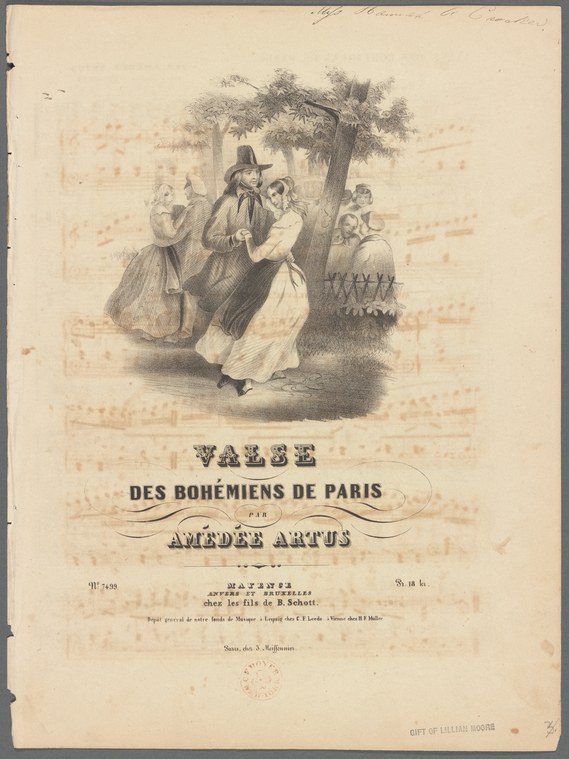
The waltz was still controversial in some circles when this print was made, yet here it is celebrated as a natural expression of Parisian life, danced not by aristocrats in a formal ballroom but by ordinary people in the street. The image is a historical record of how a once-shocking innovation became an everyday social practice—and it captures the actual physical form of the waltz, the closed embrace and turning action that defined the dance.
What you are looking at
A Parisian street scene under a large tree depicts a social gathering centered on dancing couples. In the foreground, a woman in a pale dress with a fitted bodice and full skirt dances with a man in dark coat and top hat; her skirt is caught mid-turn, creating a dramatic swirl. To the left, another couple is visible, the woman in darker dress, and to the right a group of onlookers—men, women, and children—observe the dance. The setting suggests an outdoor promenade or public garden, with the tree's foliage creating a canopy overhead. The lithograph's soft gray tones and delicate rendering give the scene an intimate, leisurely quality despite the public setting. A street lamp or post is visible in the background, anchoring the Parisian locale.
The dancing
The principal dancing couple stands in a closed ballroom position, the man leading with his right arm extended and his left arm at the woman's waist; her left arm rests on his shoulder, her right hand in his. Both dancers' bodies are inclined slightly forward into the movement. The woman's posture shows relaxed engagement rather than rigid formality—her weight appears to follow the man's lead. Their feet are not clearly rendered, a common limitation of the lithographic medium at this period, but the forward-leaning frame and the woman's swirling skirt suggest a turning step rather than a stationary pose. Surrounding dancers and spectators create layers of social interaction across the composition.
The dance depicted
The title identifies this as a waltz—*Valse des bohémiens de Paris*—and the image supports that identification. The closed embrace, the slight forward inclination of both partners' frames, and the woman's skirt caught in mid-rotation are all consistent with the waltz as danced in 19th-century Paris. The waltz had been controversial when it arrived from Vienna earlier in the century, but by the mid-1800s it was the dominant social dance of the European ballroom and public garden. The term 'bohémiens' (bohemians) may refer either to Romani dancers or to the artistic underclass of Paris; either way, the image positions the waltz as a dance of urban Paris rather than aristocratic Vienna, shared across social boundaries in a public space.
How it was made
This is a lithograph, identifiable by its characteristic soft tonal range, the way line and wash merge without sharp contrast, and the slight grain visible across the surface. Lithography allowed the artist to work with crayon or ink directly on the stone, creating images that could be printed in large numbers at moderate cost. This technique was ideal for mass-market popular prints—sheet music covers, theater programs, popular scenes—and the format and style suggest this was likely the cover or an illustration for a piece of sheet music. The soft medium suited the romanticized vision of Parisian street life that appealed to the middle-class audiences who bought such prints.
About this work
This is a sheet music cover (or concert program illustration) celebrating the waltz as a Parisian social dance of the mid-19th century. It depicts not a ballroom performance but a public moment—a man and woman dancing under a tree while neighbors and passersby gather to watch, a scene that captures how the waltz had become woven into the daily life of the city. The image documents both the dance itself and the social conditions of its performance: the closed embrace, the turning motion, the outdoor setting, the mixing of classes and generations. It belongs in a dance gallery both for what it shows of waltz technique and for what it reveals about how nineteenth-century Parisians imagined their own leisure.
How to look at it
Notice the precise moment the artist chose: the woman's skirt caught mid-rotation, which tells you the dancer is executing a turn and reveals the fullness of her dress in motion. Observe how the man's frame and posture guide the eye—his left arm and torso lead the woman's movement. The composition places the dancing couple at the center but surrounds them with spectators, reminding us that this dance was as much about being seen as about the movement itself. The tree, the lamp, the urban setting all confirm this is Paris—waltz as city dance, not court ceremony.
The artist
The artist is not recorded. The print carries a printer's mark crediting publication to Aubert et Chéreau in Paris, with distribution through the Rue de Richelme, suggesting it was produced and sold by a commercial music or theater publisher. This was standard practice for such popular prints; artistic attribution was often secondary to the commercial success of the subject.
The period
The waltz arrived in Europe from Vienna around 1800 and provoked fierce opposition—its close embrace and rotating motion were considered morally dangerous and physically improper. But by the 1830s and 1840s, it had become the dominant social dance across Europe, and Parisian popular culture celebrated it in prints, songs, and literature. At the same time, theatrical dance was developing in parallel: the Romantic ballet was at its height (Taglioni, Elssler, Cerito), but the social dances of ordinary Parisians were equally worthy of artistic attention. This print sits at that intersection, treating a street dance with the same visual care that history painters applied to grand historical scenes.
Where it lives
The print is held in the New York Public Library's collection of prints depicting dance. The publication information printed on the stone credits Aubert et Chéreau (a major Paris music and theater publisher) and gives a printer's address on Rue de Richelme, Paris. This indicates it was a commercial print, likely sold as sheet music cover, theater program, or popular souvenir.
Dance in this work
Questions about this work
Why is this called a 'waltz of Bohemians'?
The term 'bohémiens' could refer to Romani dancers, who were associated with street performance in Paris, or to the artistic lower classes of the city. Either way, the print claims the waltz for ordinary Parisians rather than for aristocrats or Vienna. It suggests that this once-scandalous court dance had become a dance of the street and the people.
When was the waltz invented?
The waltz developed from German country dances in the late 18th century and arrived in Vienna around 1800. It spread to Paris during the Napoleonic era but met fierce resistance—the close embrace was considered indecent. By the 1830s-1840s, when this print was made, it had become respectable and wildly popular.
Could ordinary Parisians actually dance the waltz?
Yes. By the mid-19th century, the waltz was the dominant social dance across all social classes in France and across Europe. It was taught in dance schools, performed at balls and public garden dances, and celebrated in popular songs and prints. This print is evidence of how completely it had entered everyday culture.
Why is the woman's skirt so full?
In the 1840s-1850s, when this print was likely made, women's dresses had large skirts supported by multiple petticoats. The fullness of the fabric created a visual drama when a woman danced and turned—the skirt swirled outward, creating the illusion of lightness and grace. The artist captured this effect, which was a central attraction of the waltz for its audiences.
More dance artwork





