49 works in this view — arrow keys or swipe to move between them.
Dance in Art
Grand polka di bravura: pour piano
Unknown artist
- Collection:
- Prints depicting dance
- Source:
- New York Public Library
- Rights:
- Public domain — free to use, share and adapt.
- Recorded as:
- Public Domain
The polka di bravura is a direct historical link between social dance and concert music in the 19th century: it shows how a folk and popular dance form entered the drawing room and concert hall as subject matter for elite musical composition. For historians of dance, it demonstrates the polka's remarkable cultural penetration across Europe and America in this period, and the appetite of the educated middle class for music that captured the spirit and motion of contemporary dance.
What you are looking at
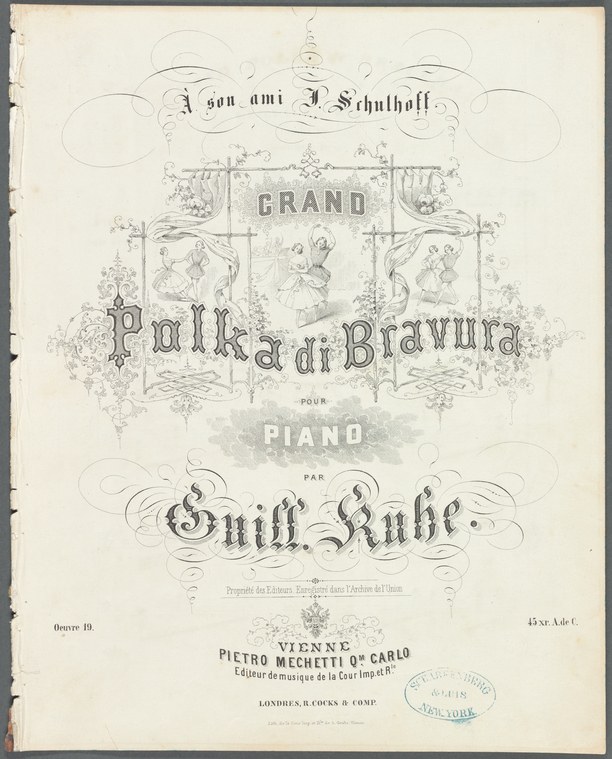
This is the ornamental title page of a published piano score for a Grand Polka di Bravura, a virtuosic dance work popular in the 19th century. The composition is dominated by elaborate rococo-style decorative frames and scrollwork, with the title and attributions arranged within ornamental cartouches. At the center, a vignette depicts a ballroom or theatrical scene with multiple figures in elaborate dress, though the print's fine hatching and distance make precise action difficult to discern. The overall visual weight is carried by the frame rather than the dancing: sweeping curves, floral garlands, and architectural elements create a sense of luxury and spectacle appropriate to a work intended for piano virtuosi and drawing-room performance. The publication information—"Vienne: Pietro Mechetti ᶜ° Carlo, Éditeur de musique de la Cour Impériale" and London house—situates this as a mid-to-late 19th century international music publication.
The dancing
The central vignette is too small and lightly rendered to permit confident analysis of hold or footwork. Multiple figures are visible in what appears to be a formal social or theatrical setting, arranged in a composition that suggests synchronized or coordinated movement rather than individual action. The dress—evident from silhouettes—is consistent with 19th-century ball gowns and formal wear, with full skirts suggesting movement or twirling. Without magnification or a higher-resolution image, precise choreographic reading is not possible.
The dance depicted
A polka di bravura is a virtuosic piano solo inspired by the polka, a Bohemian couple dance that swept European ballrooms and concert halls in the mid-1800s. These compositions were not typically danced to in concert; rather, they were concert-hall pieces for accomplished pianists that captured the rhythmic energy and sparkle of the dance. The title's reference to 'bravura' signals technical display and brilliance, both in the music and in the dance that inspired it. The vignette appears to show a ballroom or theatrical context, consistent with the polka's role as both a social dance and a subject for fashionable musical composition.
How it was made
This is a lithographic title page, recognizable from the characteristic fine tonal gradations and ornamental penwork typical of 19th-century music publishing. Lithography allowed rapid, economical production of illustrated covers and scores in multiple colors and tones, making music accessible to the growing piano-owning middle class. The elaborate decorative apparatus—scrollwork, frames, and vignettes—is characteristic of publisher's design in this period and served both aesthetic and marketing purposes, signaling the work's sophistication and fashionable status. The piece bears a library stamp (lower right, appears to read "NEW YORK"), indicating it was accessioned into a public collection.
About this work
This is a printed title page from a 19th-century published score for a virtuosic piano composition inspired by the polka, a dance that captivated European and American audiences after its emergence in the 1840s. The polka di bravura represents a particular moment in music and dance history when fashionable dances inspired concert music, and when that music in turn fed back into ballroom and theatrical practice. The work circulated internationally, published simultaneously in Vienna and London, and passed into the collection that is now the New York Public Library. As visual evidence of how dance and music were marketed and consumed, and as a record of the polka's cultural reach, it documents both artistic ambition and popular taste.
How to look at it
Attend to the ornamental framing rather than seeking narrative in the small central vignette, which is more icon than illustration. The true subject of this image is luxury, spectacle, and fashionable taste—the title and publisher's name are given equal visual weight to the dancing figures. The style of the frame, the quality of the printing, and the bilingual publication all signal that this was an expensive, sought-after object in its time. The small ballroom scene, however faintly rendered, serves to remind the buyer that the music inside captures the joy and motion of a living social practice.
The artist
The composer is not recorded in the catalogue. The publisher, Pietro Mechetti & Co. of Vienna, was a significant mid-19th-century music publisher with imperial patronage (as noted on the title page: 'Éditeur de musique de la Cour Impériale'—publisher of music for the Imperial Court). Mechetti published many fashionable dances and concert pieces for piano, both original compositions and arrangements, contributing significantly to the dissemination of polka and other popular dances in written form.
The period
The polka emerged in Bohemia in the 1830s and became one of the dominant social dances of the 19th century, rivaling the waltz in popularity. By the 1850s–1870s, when this score likely dates, the polka had moved from ballroom novelty to concert-hall material. Composers wrote polkas both as dances and as character pieces and concert works, while pianists performed them as displays of technique. The elaborate title-page design reflects the mid-Victorian fashion for ornamental book and music design; the rococo revival frames and flourishes signal luxury and taste. The simultaneous publication by Mechetti in Vienna and by the London house indicates how quickly fashionable music moved between European capitals.
Where it lives
This object is held in the Prints depicting dance collection at the New York Public Library, as indicated by the institution's stamp. It represents the library's holdings of printed music and dance ephemera, materials that document how dance was circulated, marketed, and consumed in the 19th century.
Dance in this work
Questions about this work
Was a polka di bravura actually danced?
Not in concert. These were virtuosic piano pieces inspired by the polka dance, written for accomplished pianists to perform in salons and concert halls. They captured the polka's rhythm and spirit in musical form, but the score itself was not a dance notation. Dancers performed the polka in ballrooms and theaters to live music; composers then created concert works that the pianist could showcase as a brilliant, fashionable piece of display.
Why did 19th-century composers write so much music based on the polka?
The polka was enormously popular across Europe and America, especially among the rising middle class. Composing polkas for piano allowed composers to be commercially successful while appearing to participate in contemporary culture. It was also a genre that permitted technical display—fast footwork in the dance translated to brilliant passage work for the piano.
What does 'bravura' mean in this context?
Bravura refers to brilliant, showy technical display. A polka di bravura is a polka written to showcase the pianist's virtuosity: fast runs, rapid hand-crossing, dramatic dynamic contrasts, and other technical effects that impress an audience. It promises excitement and accomplishment from the performer.
More dance artwork





