49 works in this view — arrow keys or swipe to move between them.
Dance in Art
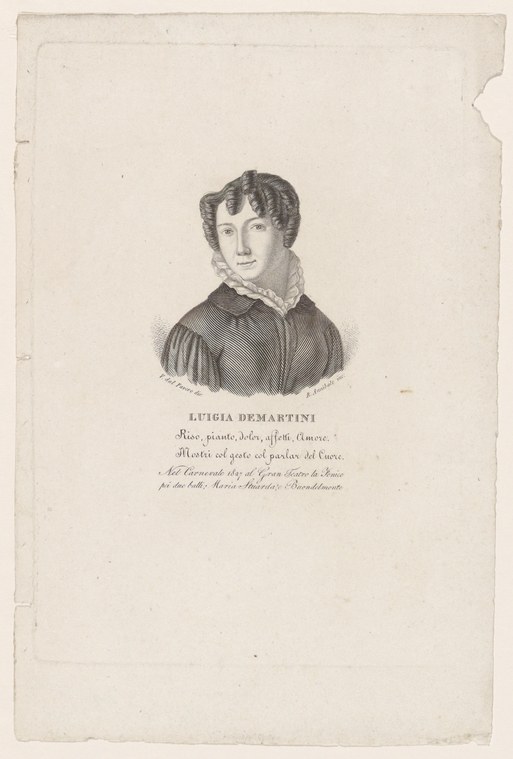
Nel carnevale 1827 al gran teatro la Fenice per due balli, Maria Stuarda e Buondelmonte
Unknown artist
- Collection:
- Prints depicting dance
- Source:
- New York Public Library
- Rights:
- Public domain — free to use, share and adapt.
- Recorded as:
- Public Domain
This print documents the professional status and public visibility of a female ballet dancer in the Italian Romantic theater—a moment when ballet was becoming a major art form and dancers were emerging as named, celebrated performers rather than anonymous entertainers. The inclusion of specific ballet titles and the care taken in the engraving shows that dance companies and dancers invested in their own representation and that the theater-going public was interested enough in individual performers to purchase portraits of them.
What you are looking at
A bust-length portrait engraving of a young woman presented against a plain background. She is shown from approximately the shoulders up, her head turned slightly to the viewer's left and angled downward with a contemplative or modest expression. Her dark hair is styled in the fashion of the 1820s, parted in the center and arranged in braided or plaited loops over the ears, framing her face. She wears a dark garment—likely a theatrical costume—with what appears to be a draped or pleated neckline and shoulder treatment typical of Romantic-era stage dress. The engraving is executed in fine crosshatching and line work, with careful attention to the modeling of her face and the texture of her hair and clothing. Beneath the portrait is an italicized inscription identifying her as 'LUIGIA DEMARTINI' with performance credits.
The dancing
The figure is stationary and posed rather than captured in movement. Her posture is upright and dignified, with shoulders relaxed and squared. Her gaze is directed downward and away, suggesting an introspective or melancholic mood appropriate to Romantic theatrical convention. The portrait captures no dance movement or position—this is a formal identification portrait of a performer rather than a document of her dancing.
The dance depicted
The inscription states that Demartini danced at the Gran Teatro la Fenice in Venice during Carnival 1827 in two ballets: 'Maria Stuarda' and 'Buondelmonte.' Both are Romantic-era narrative ballets, though the specific choreography is not recorded here. The print serves as a theatrical portrait of a professional dancer whose name and performance credits were deemed worth recording for the public, but it documents her identity and status rather than her technique or the character she portrayed.
How it was made
This is a fine-line engraving, likely a steel or copper engraving given the delicate crosshatching and the precision of the work. The technique allowed for mass reproduction and wide circulation, and such prints were standard promotional material in theaters and sold as souvenirs and collectibles to the theater-going public. The inscription and formatting suggest this was part of a series—likely a 'collection of performers' or theatrical portfolio common to the period. The quality of the engraving and the care taken with the portrait indicate this was a commercial product intended for an educated, theater-attending audience.
About this work
This is a theatrical portrait engraving of Luigia Demartini, a professional dancer at Venice's La Fenice opera house during the Carnival season of 1827. She is documented here as a performer in two Romantic-era ballets—'Maria Stuarda' (likely based on the tragedy of Mary, Queen of Scots) and 'Buondelmonte' (a Florentine historical subject)—both typical of the dramatic, story-driven ballets of the 1820s. The print is part of the documentary record of Romantic ballet and its performers, showing how dancers were promoted and commemorated in the theatrical culture of the period. Rather than capturing Demartini in the act of dancing, it preserves her professional identity and links her name to the specific ballets in which she achieved recognition.
How to look at it
Look at the care taken in rendering Demartini's face and the specificity of her costume detail—the pleated neckline and draped shoulder—which situate her as a particular performer in a particular theatrical tradition rather than an abstract type. Note the downward, introspective gaze, which reflects Romantic aesthetic values about emotion and inwardness. The inscription below anchors the image firmly in the commercial and promotional apparatus of the theater: her name, her theater, her roles, and the date all work together to certify her professional identity. This is not a work of fine art about dance but a functional document of the theater industry, yet it reveals much about how dancers were valued and how they wished to be seen.
The artist
The engraver is not recorded. Such theatrical portrait engravings were typically produced by commercial workshops serving the opera houses and theater companies of major cities. The style and execution suggest a competent professional practitioner working in the early 19th-century Venetian or North Italian theater-print tradition, but individual engravers of such portraits often went unattributed in contemporary publications.
The period
The 1820s were the height of the Romantic ballet era in Europe. Ballets were increasingly dramatic and narrative-driven, drawing on European history, literature, and legend for their subjects. Venice's La Fenice, one of the great opera houses of Italy, regularly commissioned new ballets and cultivated a star system around named dancers. This engraving was produced during Carnival season, when Venice's theaters staged elaborate productions for an international audience. The theatrical portrait print was at its height as a commercial and promotional medium—a precursor to the mass-produced celebrity photographs of the later 19th century.
Where it lives
The print is held in the New York Public Library's prints collection on dance. It is part of a larger holding of 19th-century theatrical engravings, many documenting performers and productions from Italian opera houses. Such prints were often collected and bound into albums or series.
Questions about this work
Who was Luigia Demartini?
Demartini was a professional ballet dancer who performed at Venice's Gran Teatro la Fenice during Carnival 1827. Beyond these credits on the engraving, little is documented about her career or life. She is one of many dancers from the Romantic era whose names survive in prints and playbills but whose artistic legacy and biographical details have been lost to time.
What were Maria Stuarda and Buondelmonte?
These were Romantic-era narrative ballets based on European history. 'Maria Stuarda' likely drew on the tragic life of Mary, Queen of Scots, a popular subject in Romantic drama and opera. 'Buondelmonte' drew on Florentine medieval history. Both represent the dramatic, historically themed ballets that dominated European ballet in the 1820s.
Why is this a portrait rather than an action scene?
Theatrical portrait engravings served a different purpose than narrative scenes—they functioned as promotional materials and souvenirs, allowing the public to own an image of a celebrated performer. This formal portrait format was conventional for theater stars. The inscription transforms the image into a record of professional achievement.
What does the engraving technique tell us?
Fine-line engraving allowed for high-quality reproduction and relatively wide circulation. This print could be mass-produced and sold affordably, making theater stars' images available as collectibles. It represents the intersection of theater, commerce, and print culture in the early 19th century.
More dance artwork





