49 works in this view — arrow keys or swipe to move between them.
Dance in Art
Schéhérazade
Unknown artist
- Collection:
- Prints depicting dance
- Source:
- New York Public Library
- Rights:
- Public domain — free to use, share and adapt.
- Recorded as:
- Public Domain
The work documents the orientalist fantasy that shaped 19th-century dance and performance, revealing how European artists imagined non-European movement and leisure. For historians of dance and visual culture, it offers evidence of the aesthetics, costume, and spatial arrangements that defined orientalist spectacle in the era before cinema standardized such imagery. It also demonstrates how printmaking circulated and democratized exotic fantasy across European middle-class collectors and audiences.
What you are looking at
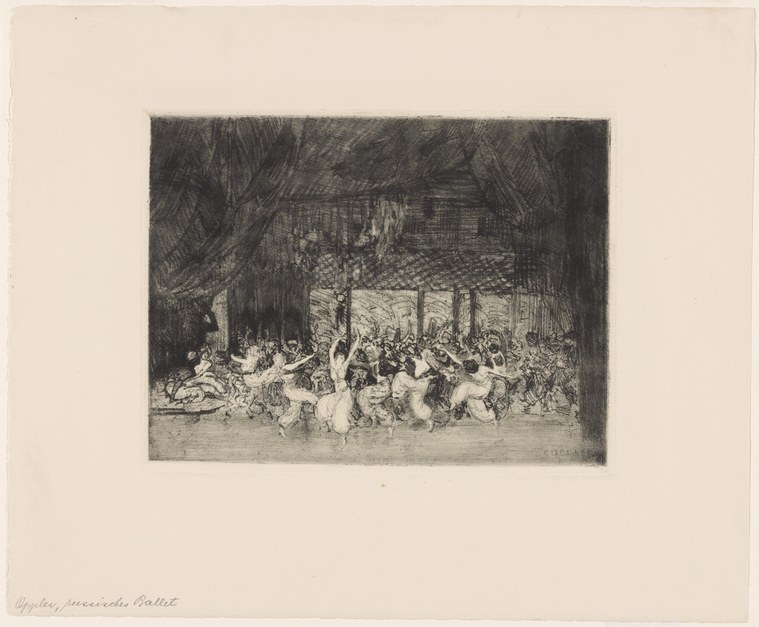
A theatrical interior crowded with figures in a moment of revelry or celebration, rendered in dense cross-hatching and fine lines characteristic of engraving. The setting appears to be a draped interior space—perhaps a harem or palace chamber—with elaborate textile furnishings creating deep shadows and spatial depth. Multiple figures fill the composition in varying attitudes of movement and repose: some standing, some seated or reclining, creating a layered, almost chaotic energy. The foreground shows several figures in loose, flowing garments engaged in dance or physical interaction, while the background recedes into atmospheric shadow. The work captures a moment of orientalist fantasy—exoticized leisure, sensuality, and spectacle—rendered with the technical precision and romantic drama that characterizes 19th-century European printmaking.
The dancing
The dancers occupy varied positions without apparent formal geometric arrangement. Several figures in the foreground display relaxed, improvisational postures rather than the rigid vertical alignment of classical ballet—bodies twist, bend, and angle toward one another. Clothing is voluminous and draped, allowing limbs to move with apparent freedom. The composition does not suggest the closed holds, upright carriage, or lifted épaulement of European ballroom or classical dance; instead, the bodies seem grounded and the movement intimate and informal. Approximately a dozen figures are visible at various depths, clustered and overlapping rather than distributed across a stage.
The dance depicted
This print depicts a scene from or inspired by the orientalist fantasy of *Schéhérazade*—the legendary storyteller of the Arabian Nights. While no specific dance technique is identifiable, the image presents an imagined harem or seraglio interior populated by dancers in loose, exotic dress in attitudes suggesting improvisation and sensuality rather than codified technique. The work belongs to the 19th-century orientalist tradition in which European artists romanticized Middle Eastern and North African life as spectacular, erotic, and free from European social constraint. Whether this illustrates a specific theatrical production (orientalist ballets were popular in the late 19th century) or a more general orientalist fantasy remains unclear from the image alone.
How it was made
This is an engraving or etching on paper, executed with fine parallel lines and dense cross-hatching to create tonal richness and atmospheric effect. The technique allows precise rendering of fabric texture and spatial recession while maintaining the linear clarity characteristic of printmaking. The fineness of the line work and the subtlety of the tonal gradations suggest a skilled practitioner, and the composition's ambition indicates the work was intended for circulation as a fine print—for collectors, connoisseurs, and illustrated periodicals rather than as a rough study. The print medium made the image reproducible and therefore accessible beyond a single wealthy patron.
About this work
This engraved or etched print represents a 19th-century orientalist fantasy inspired by the legend of Schéhérazade, depicting an interior crowded with figures in flowing garments engaged in loose, improvisational movement. The work captures the European romantic imagination of Middle Eastern life as exotic, sensual, and theatrically spectacular—a fantasy reinforced through technique: the engraver's precise and delicate line work renders luxurious textiles, shadowed depths, and atmospheric mystery. The image sits within a long tradition of orientalist art that shaped European understanding of (and desire for) non-European bodies and spaces, and within the more specific history of 19th-century theatrical exoticism, where tales from the Arabian Nights inspired ballets, operas, and dramatic spectacles.
How to look at it
Attend to the lack of formal geometric arrangement or rigid posture: unlike the upright, vertical dancers of neoclassical ballet or the symmetrical couples of ballroom dance, these figures are clustered, twisted, and informal. The engraver has chosen a moment of mingled movement and repose—neither a grand ensemble formation nor an individual virtuoso moment, but rather a scene of intimate, improvisational play. The dense shadows and the layering of figures create an atmosphere of enclosed, private spectacle, inviting the viewer into a fantasy of privileged access to an erotic interior. Note how the elaborate drapery and textile patterns consume nearly as much visual attention as the bodies themselves, suggesting that costume and setting are as important to the orientalist fantasy as the dancers.
The period
The 19th century saw an explosive European fascination with the Middle East and North Africa, driven by colonial expansion, Romantic aesthetics, and the explosive success of works like Byron's poetry and later Delacroix's paintings. Ballet and theatrical spectacle embraced orientalist subjects: *Scheherazade* itself was famously produced as a ballet by the Ballets Russes in 1910 (with sets and costume by Léon Bakst), but orientalist dance and dramatic works were popular throughout the 19th century. Engraving and etching, though older techniques, remained primary media for fine-art reproduction and circulation well into the 19th century, making them vehicles for distributing romantic and exotic imagery to educated European audiences. The density and precision of this print's technique suggests it was made for an affluent print collector or as an illustration for a luxury book or periodical.
Where it lives
The print is held in the New York Public Library's collection of prints depicting dance. The catalogue record identifies it only by title and holding collection, with no attribution, date, or medium recorded.
Questions about this work
Is this illustrating a specific theatrical production?
Not certainly from the image alone. *Schéhérazade* was the subject of numerous 19th-century theatrical works, including operas and ballets, and this could illustrate one of them. The most famous is Fokine's *Scheherazade* for the Ballets Russes (1910), but the work could predate that or illustrate another production entirely. The style and technique suggest a mid-to-late 19th-century date, but without artist attribution or a publication mark, a specific source cannot be confirmed.
What is an orientalist fantasy and why does it matter?
Orientalism refers to how European artists and writers imagined the Middle East and North Africa as exotic, sensual, and fundamentally different from (and inferior to) Europe. These fantasies, while aesthetically beautiful, justified European colonial expansion and reinforced racist stereotypes. In dance, orientalist works depicted non-European bodies as more sensual, flexible, and available than European women—a stereotype that shaped both how non-European dancers were cast and how European dancers were trained. Understanding orientalist imagery is essential to understanding both 19th-century dance aesthetics and the colonial politics embedded in them.
Could this be by a famous artist?
Without a signature or publication mark visible in the image, or attribution in the record, the artist is unknown. The technical skill and the scale of the ambition suggest a trained printmaker of some standing, but the work may have circulated without attribution, been made for a publication that credited artists collectively, or simply had its attribution lost over time.
More dance artwork





