49 works in this view — arrow keys or swipe to move between them.
Dance in Art
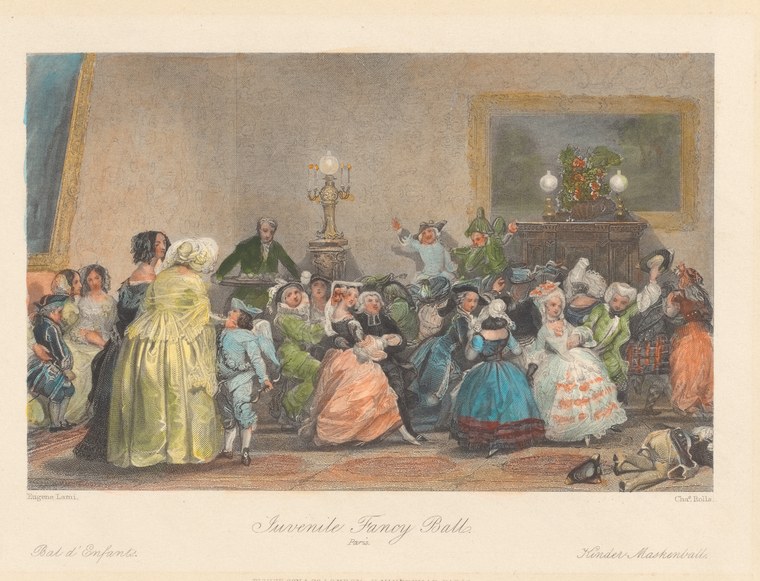
Juvenile fancy ball, Paris
Unknown artist
- Collection:
- Prints depicting dance
- Source:
- New York Public Library
- Rights:
- Public domain — free to use, share and adapt.
- Recorded as:
- Public Domain
The image documents the social machinery of nineteenth-century urban courtship and the role of formal gatherings in training children—especially girls—in the codes of ballroom behavior and display. It shows that the 'ball' was not primarily a dance event but a social ritual; dancing was one activity among many within a larger ceremony of dress, observation, and hierarchical mingling. Understanding such scenes complicates the narrative of ballroom dance as performance and reveals it instead as embedded in the everyday rituals of bourgeois life.
What you are looking at
A crowded indoor ball in a formal Parisian salon, rendered in hand-colored engraving or lithograph. Dozens of fashionably dressed children and young people fill a neoclassical room with a coffered ceiling, ornate wall panels, and a fireplace mantel adorned with garland and candelabra. The composition is dense and bustling: children in elaborate silks and satins—the girls in full skirts of yellow, pink, coral, and white, the boys in jackets and breeches—stand in animated clusters or move through the space in social groupings rather than formal sets. The lighting is warm and even, suggesting gaslight or candlelight. In the left foreground, a girl in a striking yellow dress stands prominently; throughout the room, children interact in poses suggesting conversation, observation, and the social choreography of a formal children's gathering rather than structured dance performance.
The dancing
The bodies are dressed rather than dancing: upright, standing, socially posed rather than in motion or formal hold. No closed ballroom frame is visible, and no synchronized group movement. Instead, the figures are scattered in loose groupings—some facing each other in conversation, others at the periphery observing. A few children gesture with raised arms or turned bodies, but these suggest animated social behavior rather than dance technique. The sheer number of small, delicately rendered figures means individual footwork or arm positions are not legible.
The dance depicted
The image is titled *Juvenile Fancy Ball*, a nineteenth-century social gathering for children of the haute bourgeoisie or aristocracy. Such balls were occasions for display, courtship training, and social initiation, not performance. While dancing would have occurred at such an event, this image captures the social scene rather than active dance: the promenade, the greeting, the watching. The formal dress—the girls in full skirts, the boys in tailcoat silhouettes—matches the fashion plates and social chronicles of 1830s–1860s Paris. No specific dance form is identifiable because the image does not depict dancing in progress, but rather the ball as a social ceremony.
How it was made
Hand-colored engraving or lithograph, a technique that allowed rapid reproduction and wide circulation among the middle-class and aristocratic families for whom such balls were aspirational or lived experience. The precision of line, the density of detail, and the small scale suggest a commercial print, likely issued as a souvenir or in a series of fashionable-life scenes. Hand coloring accounts for the soft palette and the individualized tinting of each dress, a labor-intensive finish that placed such prints in the middle market—neither luxury one-offs nor cheap woodcuts. This technique was well suited to capturing the texture of silk and the variety of a large social gathering.
About this work
This is a document of nineteenth-century Parisian social life, specifically the ritual of the children's ball or juvenile fancy ball, a ceremonial gathering of the urban upper and upper-middle classes. The work sits at the intersection of fashion history, social documentation, and dance historiography—not because it depicts dance technique, but because it records the context in which children were introduced to ballroom culture, propriety, and courtship. It belongs in a gallery of dance in art because it shows the pre-dance moment: the dressing, the gathering, the social frame within which dancing and partner-selection took place. For historians of childhood, manners, and bourgeois aspiration, it is invaluable; for dance historians, it raises the question of what counted as dance instruction and initiation in this period and class.
How to look at it
Attend to the composition: the way the artist has compressed dozens of small figures into a unified, legible scene. Notice that no couple is dancing; instead, observe the social choreography—the clusters, the directions of gaze, the positioning of adults (chaperones, presumably, in the background) relative to children. The prominence of dress—the architectural detail of each child's silks, the careful differentiation of color—signals that appearance and display are the work's true subject. The moment frozen is not a step or turn, but the social presentation: the before-and-after of dance, the frame within which ballroom behavior was learned.
The artist
The artist is not recorded. The style and subject matter suggest a Parisian commercial engraver or lithographer active in the mid-nineteenth century, likely producing fashion and society scenes for reproductive distribution. The technical refinement and the specificity of social detail indicate a professional workshop accustomed to working from live observation or from contemporary fashion plates and social descriptions.
The period
The 1830s–1860s were the height of the European quadrille and waltz in ballroom society, and also the period in which bourgeois childhood became a subject of explicit training and display. The juvenile fancy ball was a distinct genre of social event: neither children's play nor adult ballroom, but a formal, supervised arena in which children learned deportment, dress, and the visual language of class. The full skirts and formal silhouettes visible here place the image in the Romantic era, when ball culture was central to urban social life and when such events were frequently documented in fashion journals, novels, and satirical prints. Lithographic reproduction had made such imagery accessible and affordable, so scenes of fashionable life circulated widely as documents of aspiration and instruction.
Where it lives
Held in the NYPL Prints collection under the general heading 'Prints depicting dance.' The catalogue record provides no artist, date, medium, or accession number. The title and the inscription visible on the print itself are the only firm anchors for identification.
Dance in this work
Questions about this work
Is anyone actually dancing in this picture?
Not visibly. The image shows the social gathering before, during, or after dancing—the dressing, greeting, and observation that framed ballroom culture. Dancing was one element of the ball, but this print captures the event as a social ceremony, not a dance performance.
What was a 'juvenile fancy ball'?
A formal gathering for children and young adolescents of the urban upper classes, typically held in a private mansion or hired hall. It served as a training ground in deportment, dress, and social hierarchy, and as an occasion for families to display their children's refinement and eligibility. It was both a rite of passage and a social market.
Why is this in a dance collection if there is no dancing?
Because the ball is inseparable from ballroom dance: it is the institution within which dance was learned, practiced, and given social meaning. Understanding the visual and social context of the ball is essential to understanding ballroom dance in this period.
Who would have owned or seen this print?
The families of the urban bourgeoisie and lower aristocracy, who either attended such balls or aspired to do so. The print circulated as a document of fashionable life, in fashion journals, gift collections, or as a souvenir. It served as instruction in dress and decorum as much as as entertainment.
More dance artwork





