49 works in this view — arrow keys or swipe to move between them.
Dance in Art
Le tourbillon (No. 1), La foudre (No. 2): galops composé pour les bals de 1838
Unknown artist
- Collection:
- Prints depicting dance
- Source:
- New York Public Library
- Rights:
- Public domain — free to use, share and adapt.
- Recorded as:
- Public Domain
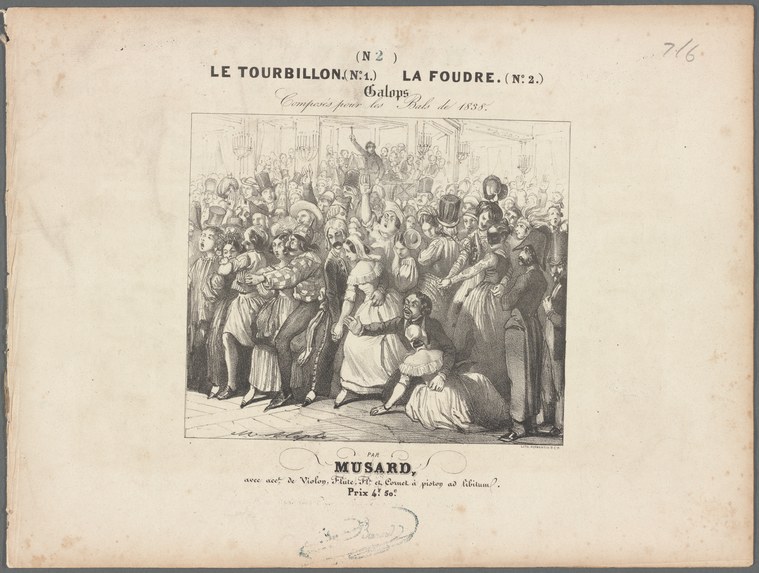
The galop was the democratic counterpart to the waltz—easier to learn, more playful, and practiced by a far broader social group. This engraving is evidence of how social dances were documented and taught in the pre-photographic era, and it preserves the moment when ballroom dancing was shifting from courtly ritual toward modern recreational entertainment. It is also one of the few images that captures a genuine ballroom scene—not a staged theatrical moment—with all its crowding, variety, and informal pleasure.
What you are looking at
This is a lively ballroom interior crowded with dancers and spectators in Regency-era dress, rendered as a black-and-white engraving. The scene depicts a galop in full swing—a fast, energetic couple-dance that was fashionable in the 1830s. The composition is densely packed: couples rotate and leap across the floor while observers line the walls and margins, some seated, others standing in clusters. The women wear high-waisted dresses with full skirts and bonnets or turbans; the men are in tailcoats and trousers. The architectural setting—a large room with tall windows or doorways visible in the background—suggests a ballroom or assembly room. The artist has captured the chaos and exuberance of the moment: bodies at various stages of the galop's characteristic bouncing, hopping motion, some mid-leap, others in conversation or watching. The density of figures and the layering of depth across the floor convey the crowded, energetic atmosphere of a fashionable ball.
The dancing
Couples are primarily in closed position—the man's right hand on the woman's waist, her left hand on his shoulder or around his neck, their other hands clasped to the side. Bodies are upright and animated, with legs in motion: the characteristic galop involves a hop, step, and close action, and several figures show the forward-driving weight and bent knees this requires. The hopping action is suggested by the positioning of some dancers slightly off-ground. Arms are relatively loose and gestural rather than tightly held. A few figures in the background appear to be mid-rotation or preparing the next phrase of the step.
The dance depicted
This engraving illustrates the galop (or galope), a couple-dance in 2/4 time that became one of the most popular ballroom dances of the 1830s–1840s. The title names it explicitly: 'Galops composé pour les bals de 1838' (Galops composed for the balls of 1838). The galop combined rapid, almost comedic hopping with rotational movement, requiring considerable energy and producing a sense of reckless fun—quite distinct from the measured elegance of the waltz or quadrille. The image shows the dance as a participatory social activity, not a staged performance: the crowd of onlookers and the informal positioning suggest a real ball rather than theatrical display. The composition captures what made the galop appealing: its accessibility (simpler mechanics than a waltz), its speed, and its infectious, playful energy.
How it was made
This is a hand-colored engraving or etching, likely produced by wood or steel engraving to allow multiple impressions. The fine parallel lines and cross-hatching create tone and shadow, particularly visible in the women's skirts and the depth of the room. The print technique allowed for rapid, inexpensive reproduction and wide circulation—essential for a dance instruction or ballroom fashion publication aimed at a growing middle-class audience. The hand-coloring (applied after printing) is subtle: tints of yellow and pink warm the paper. This combination of technique and distribution suggests the work was part of a commercial dance or fashion publication, designed to document and promote current ballroom fashions and practices.
About this work
This engraving documents the galop, one of the defining social dances of the 1830s. It preserves not only the mechanics of the step but also the social context—the ballroom, the mixed crowd of dancers and spectators, the fashionable dress—that gave the galop meaning. The title's explicit reference to 1838 suggests this was part of a contemporary publication, likely a dance manual or fashion periodical that instructed and inspired ballroom dancers. The work is valuable precisely because it is neither a theatrical nor an elite artifact: it is a snapshot of ordinary fashionable entertainment, rendered with clarity and humor. It shows how social dances circulated: through images that could be purchased, studied, and imitated.
How to look at it
Look first at the frozen moment the artist chose: most dancers are captured mid-motion, legs bent and bodies rising or falling, which conveys the bouncy, rollicking energy of the galop far more effectively than a static pose would. Notice how the artist differentiated the dancers by dress, posture, and stage of the step—not all couples are synchronized, which is realistic and adds liveliness. Pay attention to the margins and background: the spectators watching, gossiping, and sitting are as much part of the scene as the dancers, reminding us that ballroom dance was a social spectacle, not just a partner activity. The composition, despite its crowding, has a clear sense of circular motion, with couples rotating around the room—the artist understood the galop's rotational structure.
The period
The 1830s saw an explosion of new couple-dances in European ballrooms, particularly in Paris and Vienna. The waltz, which had scandalized the previous generation with its close hold and rotational movement, was now established and refined. The galop emerged as its livelier, more democratic complement. This was also a moment of rapid social change: the European middle class was growing, and ballroom dancing became a central form of social display, courtship, and entertainment. The market for dance instruction and ballroom fashion was booming; publishers produced dance manuals, fashion plates, and illustrated accounts of famous balls. This engraving sits within that boom: it is commercial, topical, and designed to circulate widely among people aspiring to fashionable knowledge.
Where it lives
The work is held in the NYPL Prints collection. It is one of two galops in a series (No. 1 and No. 2: 'Le tourbillon' and 'La foudre'), suggesting it was part of a published set of dance or ballroom scenes. The series format and the explicit dating in the title (1838) indicate this was a commercial, topical publication, likely a dance manual or fashion periodical.
Dance in this work
Questions about this work
What is a galop?
A galop is a fast, energetic ballroom dance in 2/4 time that became hugely popular in the 1830s and 1840s. It consists of a hopping, bouncing step with a characteristic rotational motion, and couples dance it in a closed hold. It was simpler and more playful than the waltz, and it was danced by a much broader social group—from aristocrats to the middle classes.
Why would someone have wanted this engraving?
This engraving was likely published as part of a dance manual, fashion periodical, or illustrated account of fashionable ballroom life. It served to document current dance practices and inspire people to learn and perform the galop themselves. Ballroom dance was a crucial social skill and marker of respectability, and images like this helped people understand what the dance looked like and how to dress while performing it.
How was this made?
This is an engraving—a print made from a carved or etched metal plate. The fine lines and cross-hatching you see are the engraver's hand. The plate could be used to print many copies, making this an inexpensive and widely distributed image. The colors were applied by hand after printing, which was a common and cost-effective way to add color to popular prints.
Is this from an actual ball?
Probably not in literal detail. The engraving is a stylized representation designed to convey the spirit and mechanics of the galop in a ballroom setting. But it is based on real social practice—the dress, the room, the spectators, and the dance itself are all historically accurate to fashionable 1838 ballroom culture.
More dance artwork





