49 works in this view — arrow keys or swipe to move between them.
Dance in Art
John Strauss! John Strauss! The girls are all mad
Unknown artist
- Collection:
- Prints depicting dance
- Source:
- New York Public Library
- Rights:
- Public domain — free to use, share and adapt.
- Recorded as:
- Public Domain
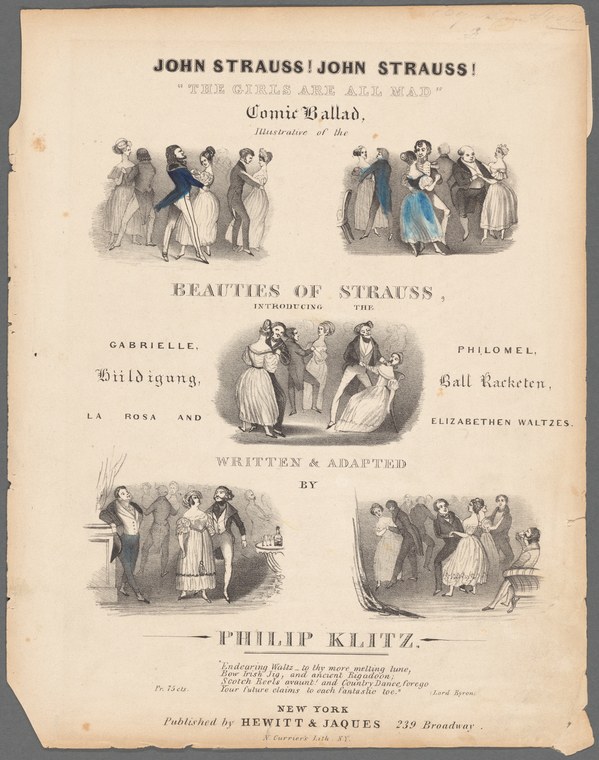
This print is primary evidence for how the waltz was experienced and understood as a social phenomenon rather than merely a technical accomplishment. It shows that by the 1840s–50s, the waltz had ceased to be transgressive and had become culturally dominant—so dominant that satirists could invoke it as a symbol of contemporary fashion and female desire. The image also documents the celebrity of John Strauss as a composer and the marketing of dance through theatrical ephemera.
What you are looking at
This is a comic ballad illustrating the popular success of the Strauss waltzes, specifically celebrating John Strauss and his music's power over young women. The print is divided into six vignettes arranged around a central title and character introductions. The upper panels show groups of fashionably dressed women and men in 19th-century attire; the figures gesture animatedly, some with arms raised or gesturing toward one another, capturing the excitement and social fervor surrounding Strauss's music. The women wear full skirts with fitted bodices typical of the 1840s–50s, while the men are in tailcoats and formal dress. The lower panels similarly depict social scenes, with dancers and onlookers in interior settings. The overall composition emphasizes the social phenomenon of "Strauss fever"—the documented craze among young women for his waltzes. The central section introduces four character figures: Gabrielle, Philomel, La Rosa, and Elizabethen Waltzes, positioning this as a satirical commentary on the waltz's cultural dominance.
The dancing
The figures throughout are rendered in the comedic illustrative style of mid-19th-century satirical prints, with exaggerated postures and expressive gestures that emphasize emotional response rather than precise dance technique. Several figures display the characteristic upright posture and arm positions associated with the waltz—bodies in three-quarter profile, arms held at the side or extended in a frame—but the artist prioritizes caricature and humor over anatomical or technical accuracy. The compositions show both paired figures (suggesting dance partners) and groups of onlookers, capturing the social spectacle of the waltz as much as the dance itself. Skirts are rendered with flowing lines suggesting movement and the full volume of period costume.
The dance depicted
This is a representation of the Viennese waltz as it dominated social dance and popular culture in the mid-19th century, specifically during the period of John Strauss Sr. and Jr.'s theatrical and concert success. The title "The Girls Are All Mad" directly references the documented phenomenon of public enthusiasm—often satirized—for Strauss's compositions. The waltz was the dominant partner dance of the era, performed in ballrooms, at public dances, and increasingly at concert venues where orchestral performances of Strauss compositions drew massive crowds. The image captures not the technical execution of the dance but its cultural phenomenon: the fervor it inspired, particularly among women, and its position as a marker of modernity and fashion. The print is an artifact of the waltz's transformation from scandalous novelty (early 19th century) to respectable social institution.
How it was made
This is a hand-colored engraving or lithograph, as indicated by the fine line work, the serial arrangement of vignettes, and the printed text integrated into the composition. The technique is typical of mid-19th-century popular satirical and theatrical ephemera—the kind of broadside or sheet print that would have been sold separately or included in periodicals. The use of six distinct illustrated scenes arranged around a central text and character roster follows the convention of narrative or thematic illustration common to theatrical and entertainment publicity of the 1840s–50s. The hand-coloring (visible in the blue dress in the right vignette) indicates this was a commercial print meant for a broad audience, not an expensive art object. The publisher credit—Hewitt & Jacques, New York—confirms this as American theatrical ephemera, likely distributed as publicity for a theatrical adaptation or performance of Strauss music.
About this work
This is a mid-19th-century satirical print celebrating and mocking the craze for John Strauss's waltz compositions among young women in the Anglophone world. It functions as both theatrical publicity and social commentary, using multiple vignettes and exaggerated comic figures to capture the phenomenon of 'Strauss fever'—the documented public enthusiasm for his orchestral and dance music. The work sits at the intersection of dance history, musical history, and print culture, documenting the waltz's status as the dominant social dance form of its era and the celebrity of its most successful composer. Published in New York, it testifies to the rapid transatlantic circulation of European dance crazes and their commercial exploitation in the mid-19th-century entertainment industry.
How to look at it
Examine the multiple vignettes as a narrative sequence: they progress from initial excitement (top left) through increasing frenzy and social spectacle (middle sections) to the conclusion (bottom right). Note how the artist uses gesture—raised arms, animated conversation, physical proximity—to convey emotional intensity rather than dance technique. Look at the central character introductions (Gabrielle, Philomel, La Rosa, Elizabethen Waltzes) as the print's key: these represent types or personifications rather than individual dancers, suggesting that the print is about the waltz as a cultural force, not as a technical practice. The hand-coloring (particularly the blue dress) was a common way to make such prints visually striking for sale.
The artist
The print is written and adapted by Philip Klitz, credited on the sheet. Klitz is otherwise not well documented; he appears to have been a writer and adapter of theatrical and entertainment materials for the American market in the mid-19th century. The actual illustrator is not credited, which is typical for commercial theatrical ephemera of the period.
The period
This print dates to the height of the waltz's popularity in Europe and North America. John Strauss Sr. (1804–49) was the dominant dance musician of the 1830s–40s, and his son, John Strauss Jr. (1825–99), inherited and extended his fame from the 1840s onward. The waltz had evolved from a slightly scandalous innovation (its close embrace was criticized by conservative commentators) to the dominant ballroom dance by the 1830s. By mid-century, it was so culturally entrenched that it could serve as the basis for satire and theatrical comedy. The period also saw the rise of the orchestral concert waltz—Strauss compositions performed in concert halls rather than dance halls—which gave the form a new legitimacy and broader audience. This print reflects that shift: it celebrates Strauss as a celebrated composer whose music drives social behavior, not merely as a dance musician.
Where it lives
Published by Hewitt & Jacques of New York, this is a piece of theatrical ephemera from the mid-19th-century American entertainment industry. It is part of the NYPL's print collection documenting dance and popular culture. Such prints were typically distributed as promotional materials for theatrical performances or dances, or sold separately as topical satire for a broad audience.
Dance in this work
Questions about this work
What does 'The Girls Are All Mad' mean?
The phrase refers to documented public enthusiasm (often satirized in period commentary) for John Strauss's waltz compositions. Particularly young women were noted as devoted attendees at Strauss concerts and balls. The title is a comic exaggeration of this phenomenon, presenting it as a kind of collective mania. By using the phrase, the print both celebrates and mocks the waltz's cultural dominance.
Who was John Strauss?
John Strauss Sr. (1804–49) was an Austrian composer and violinist who dominated the dance music scene of the 1830s–40s, particularly known for his waltz compositions. His son, John Strauss Jr., became even more famous and extended the family's dominance into the second half of the 19th century. Both composed orchestral waltzes that were performed in concert halls as well as dance halls, elevating the waltz from a ballroom form to a concert form.
What dance is actually shown here?
The Viennese waltz, the dominant partner dance of the mid-19th century. However, this print is not primarily about the technical execution of the dance; it is about the waltz as a cultural phenomenon and as the marker of contemporary fashion and modernity. The vignettes show social scenes—dancers, onlookers, and the spectacle of Strauss concerts—rather than precise representations of waltz technique.
Why was the waltz controversial?
The waltz was initially criticized for its close embrace (the partners danced in a hold that was considered intimate for the period) and its rapid, spinning movement. By the time this print was made (mid-19th century), however, the waltz had become socially respectable and was the dominant ballroom dance across Europe and North America. Satire about it was no longer moralistic but rather playful commentary on fashion and celebrity.
More dance artwork





