49 works in this view — arrow keys or swipe to move between them.
Dance in Art
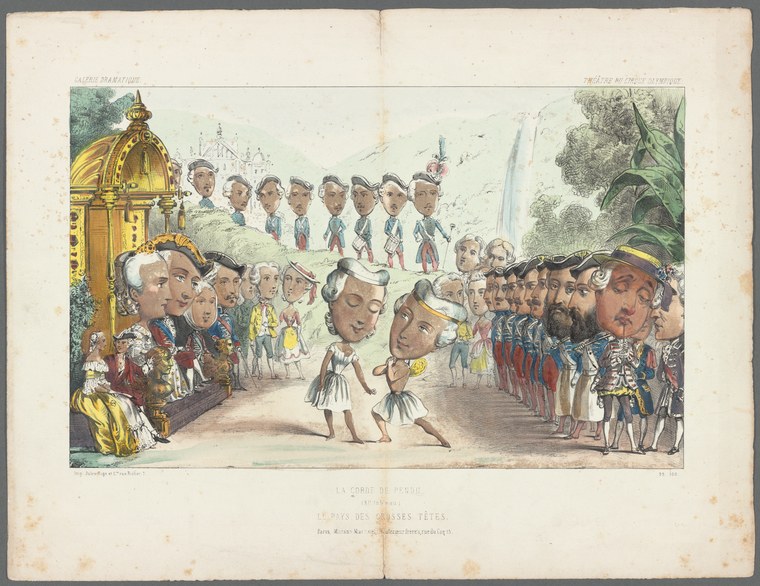
La corde de pendu. (XII tableau). Le pays des grosses têtes
Unknown artist
- Collection:
- Prints depicting dance
- Source:
- New York Public Library
- Rights:
- Public domain — free to use, share and adapt.
- Recorded as:
- Public Domain
The work is valuable as evidence of 19th-century theatrical spectacle and satirical print culture, showing how allegorical fantasy was staged and circulated to popular audiences. For dance history, it documents the formal conventions of ceremonial gesture and courtly bearing in theatrical contexts, even if it does not depict recognizable dance technique. It reminds us that 'dance' in historical collections often included theatrical performance, pantomime, and ritual gesture that did not constitute formal dance training.
What you are looking at
A fantastical procession unfolds in what appears to be a caricatured court or ceremonial setting. At left stands an enormous golden domed structure—possibly a throne or reliquary—topped with an ornate finial, before which stands a figure in elaborate dress with exaggerated features rendered in caricature. A line of figures with grotesquely enlarged heads processes across the middle distance in the background, while in the foreground two figures with comically swollen heads face each other in what may be a dance or ceremonial gesture. To the right, a crowd of uniformed soldiers or guards in military dress stands at attention, their heads rendered in normal proportion but their faces marked with caricatural expression. The entire scene is rendered in hand-colored engraving or lithograph, with pale washes of color across the composition. The title references 'La corde de pendu' (the hangman's rope) and 'Le pays des grosses têtes' (the land of big heads), suggesting this is a satirical fantasy or allegorical tableau.
The dancing
The two central figures with enlarged heads stand roughly symmetrical to one another, facing inward, their bodies angled in what could be a courtly bow or reciprocal gesture of deference or greeting. Their arm positions are not fully clear from the rendering, but their posture suggests formal interaction rather than vigorous movement. The figures in the background procession appear to walk in a deliberate line, though their gait is obscured by distance and the caricatural style. None of the figures display the turned-out legs, pointed feet, or elevated carriage associated with ballet; all movement appears grounded and processional.
The dance depicted
If this depicts dance at all, it is neither recognizable as any historical dance technique nor as modern ballroom or theatrical form. The setting and costume suggest a European context, possibly 19th-century, and the allegorical or satirical nature—with its grotesque heads and fantastical throne—suggests this may be a political or social satire rather than documentation of actual dance practice. The formal facing-off of the two central figures could represent a courtly greeting or ceremonial interaction staged as spectacle for the uniformed witnesses, but the evidence for this being 'dance' in any technical sense is weak. The image is more likely a theatrical or carnival scene, a print meant for amusement through visual distortion and allegory.
How it was made
The work is a hand-colored engraving or aquatint, characteristic of 19th-century satirical and theatrical print production. The technique allows fine detail in the architectural elements and military uniforms while the hand coloring in gouache or watercolor adds tonal variety—yellows for the gilt dome, flesh tones, and blue accents for uniforms. This medium indicates circulation through print shops and popular collections; such works were affordable, collectible, and often commissioned for political or social commentary. The combination of fine engraving with crude caricatural distortion of human heads is typical of mid-to-late 19th-century French or European satirical art.
About this work
This is a satirical or allegorical print, probably French, depicting an absurdist ceremonial scene in 'the land of big heads.' Two grotesquely caricatured figures with enlarged heads meet in formal gesture before a golden throne or shrine, while uniformed guards witness the scene. The work's relationship to dance is tangential at best: it may record a theatrical performance, court spectacle, or carnival scene, but it does not depict recognizable dance technique. Instead, it uses the language of ceremonial gathering and formal gesture—the processional line, the facing-off posture, the uniformed attendance—to construct a satirical fantasy. The print's inclusion in a dance imagery collection likely rests on its theatrical setting and the formal, ritualized movement of its figures, rather than on any identification of a specific dance form.
How to look at it
Attend first to the architectural frame: the enormous golden dome and the processional space establish a formal, ceremonial context. Then observe the graduated sizes of the figures—normal heads in the military ranks, grotesquely swollen heads in the procession and at center—which drive the satirical effect. The facing posture of the two central figures is the closest thing to 'dance movement' in the print; note how their stance is formal, symmetrical, and directed toward each other rather than toward any external goal. The hand-coloring is sparse and selective, emphasizing the gilt dome and military dress while leaving flesh and background pale—a technique that guides the eye to the ceremonial staging.
The period
The work dates to the 19th century, when satirical prints and theatrical caricature were major forms of social and political commentary in Europe. The style and hand-coloring suggest production in the second half of the century, when lithography and engraving were being supplanted by faster processes but remained favored for fine satirical work. Theatrical spectacle at this period often incorporated grotesque masks, elaborate costume, and allegorical narrative; the print may document or parody such performances.
Where it lives
The work is held in the New York Public Library's collection of prints depicting dance. Its catalogue record is sparse, with neither artist, date, nor medium recorded; the attribution and dating offered here derive entirely from visual analysis. It was likely acquired as part of a broader collecting effort focused on theatrical and dance imagery.
Questions about this work
Is this actually a dance?
Probably not in any technical sense. The print depicts a formal ceremonial or theatrical scene with grotesque figures, and the facing-off posture of the two central figures could represent a stylized greeting or ritual interaction. But there is no evidence of ballet, social dance, or any other recognized dance form. The work belongs in a dance collection because it documents theatrical spectacle and the formal movement conventions of ceremony.
What is the 'land of big heads'?
The title suggests an allegorical or fantasy setting—possibly a political satire, a carnival scene, or a theatrical performance meant to entertain through grotesque distortion. The enlargement of the heads is a caricatural technique meant to mock or exaggerate some quality of the figures, but without more context or knowledge of the artist, we cannot identify the specific target of the satire.
Why is this in a dance collection?
The work documents theatrical spectacle and the formal, ritualized movement conventions of 19th-century staged performance. Even though it does not depict recognizable dance technique, it shows how dance, ceremony, and theatrical gesture were intertwined in popular entertainment and ceremonial display.
More dance artwork





