49 works in this view — arrow keys or swipe to move between them.
Dance in Art
Le miroir de Pierrot
Unknown artist
- Collection:
- Prints depicting dance
- Source:
- New York Public Library
- Rights:
- Public domain — free to use, share and adapt.
- Recorded as:
- Public Domain
This image is evidence of how Pierrot—a character rooted in commedia dell'arte—was still an active presence in theatrical performance in the print era, and how performers embodied and audiences understood this role. For dance historians, it illustrates the porous boundary between theater, pantomime, and dance in the period before modern dance redefined these categories. The print also documents the costume and physical language of character performance, making visible what the text of a play could not convey.
What you are looking at
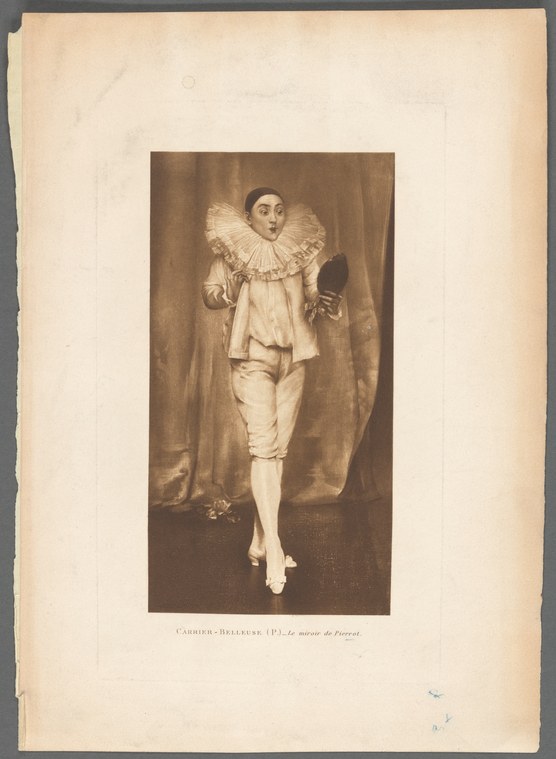
A single figure in theatrical costume stands center stage against a rich brown curtain. The dancer wears a voluminous white tunic or loose breeches gathered at the knee, a flowing cloak or cape draped from the shoulders, and a striking large white collar that stands upright in a wide frill around the neck—the costume of Pierrot, the classic commedia dell'arte character. The figure's posture is animated and slightly forward-leaning, with one arm extended or gesturing expressively. The face is pale and exaggerated, with a pointed or melancholic expression typical of Pierrot. The lighting is warm and concentrated on the figure, which emerges from the dark background with theatrical presence. The composition emphasizes the isolation and pathos of the character: a solitary performer, caught in a moment of gesture or appeal, suspended against emptiness.
The dancing
The dancer's body is slim and elongated, positioned in a slight contrapposto with weight shifted forward, creating a sense of yearning or vulnerability. The limbs appear to reach or gesture outward with theatrical expressiveness rather than technical precision. The posture reads as emotional and gestural rather than balletic—it is the language of pantomime and character rather than classical dance technique. The white collar dominates visually and frames the head, making the face and upper body the focal point of the composition.
The dance depicted
This is a theatrical representation of Pierrot, the white-clad melancholic servant from commedia dell'arte and 18th–19th-century pantomime and féerie (spectacular fantasy theater). Pierrot was a stock character across European popular entertainment, performed in theaters, pantomimes, and later in ballet and music-hall contexts. The title *Le miroir de Pierrot* (Pierrot's Mirror) suggests a narrative moment from a performance—possibly a scene in which the character gazes upon his own reflection or contemplates himself. This image documents the costume and gestural language of Pierrot performance in theater, showing how the character was actually embodied on stage. The character became deeply embedded in French entertainment and art from the 18th century onward and figures prominently in Romantic-era theater and visual culture.
How it was made
This is a print—most likely a photogravure, heliogravure, or hand-colored engraving produced in the late 19th or early 20th century, on the basis of the warm sepia tone, the subtle modeling of light and shadow, and the refined detail. The technique preserves the theatrical photograph or portrait from which it derived, allowing for tonal gradation and atmospheric effect impossible in wood engraving. The warm monochromatic palette and the soft edges suggest photographic reproduction. This would have been a relatively expensive print, distributed to theater enthusiasts, collectors of theatrical imagery, or as a record of a particular production or performer.
About this work
This print records a theatrical performance or portrait of Pierrot, the classic commedia dell'arte character, frozen in a moment of emotional gesture against a stage curtain. The image belongs to the tradition of theatrical documentation—the capture of costume, posture, and character type in a medium that could be circulated and collected. Pierrot performance combines elements of pantomime, gestural narrative, and physical comedy rather than formal dance technique, though it sits at the intersection of theater and dance practice. This work documents how a canonical character was visually and physically understood in the theater of the late 19th or early 20th century, a moment when Pierrot imagery permeated European and especially French culture.
How to look at it
Attend to the posture and arm gesture, which convey emotional rather than technically virtuosic content—this is character acting through the body, not ballet. Notice how the costume dominates and defines the figure: the large collar frames the face, the cloak extends the silhouette, and the white tunic draws the eye downward. The print captures a single frozen moment of performance, likely a moment of appeal, self-awareness, or pantomimic narrative. The dark background concentrates all visual energy on the figure, making the character the sole subject of regard—a loneliness or isolation that suits Pierrot's melancholic role.
The period
Pierrot became a symbol of Romantic melancholy and theatrical pathos in 19th-century European culture, particularly in France and Italy. The character appeared across multiple performance modes: pantomime, comic opera, féerie, and later in early modern ballet (such as works by Michel Fokine). By the late 19th century, Pierrot imagery had moved beyond theater into visual art, literature, and fashion, becoming an emblem of artistic sensibility and worldly disappointment. The print medium allowed such theatrical imagery to be disseminated to a middle-class collector audience hungry for records of stage performance and costume history. This print likely dates to a period when Pierrot was experiencing a second wave of cultural prestige through Symbolist and fin-de-siècle artistic movements.
Where it lives
This print is held as part of the New York Public Library's collection of prints depicting dance. It is catalogued under the broad heading of 'dance' within theatrical and performance documentation, though it represents a theatrical character performance rather than a formalized dance form.
Questions about this work
What is Pierrot?
Pierrot is a character originating in commedia dell'arte, the improvisational Italian theater tradition of the 16th–18th centuries. In commedia, Pedrolino (from which Pierrot derives) was a witty, acrobatic servant. By the 18th century, Pierrot had become a stock figure in French pantomime and theater, reimagined as a white-clad, melancholic, often hapless character—a symbol of romantic disappointment and artistic sensibility. He appeared in pantomimes, ballets, opera, and féerie spectacles.
Is this a dance?
Pierrot performance occupies the space between theater, pantomime, and dance. The character was performed by actors and dancers alike; the practice involved gesture, movement, acrobatic skill, and physical comedy rather than the codified technique of ballet. This particular image shows an actor or performer in character, frozen in a gestural moment rather than in a technical dance position. The boundary between theater and dance in this period was much more fluid than it is today.
When was this made?
The catalogue record does not provide a date. On the basis of the print technique (likely photogravure or hand-colored engraving), the styling of the costume, and the theatrical conventions visible, this print was probably produced in the late 19th or early 20th century, during a period when Pierrot imagery was particularly popular in European visual and performance culture.
What does the title mean?
*Le miroir de Pierrot* translates as 'Pierrot's Mirror.' The title suggests a narrative moment from a performance—possibly a scene in which the character regards his own reflection, contemplates himself, or is shown in a moment of self-awareness. In Pierrot traditions, such moments often carry both comic and melancholic resonance.
More dance artwork





