49 works in this view — arrow keys or swipe to move between them.
Dance in Art
Maria Conti
Unknown artist
- Collection:
- Prints depicting dance
- Source:
- New York Public Library
- Rights:
- Public domain — free to use, share and adapt.
- Recorded as:
- Public Domain
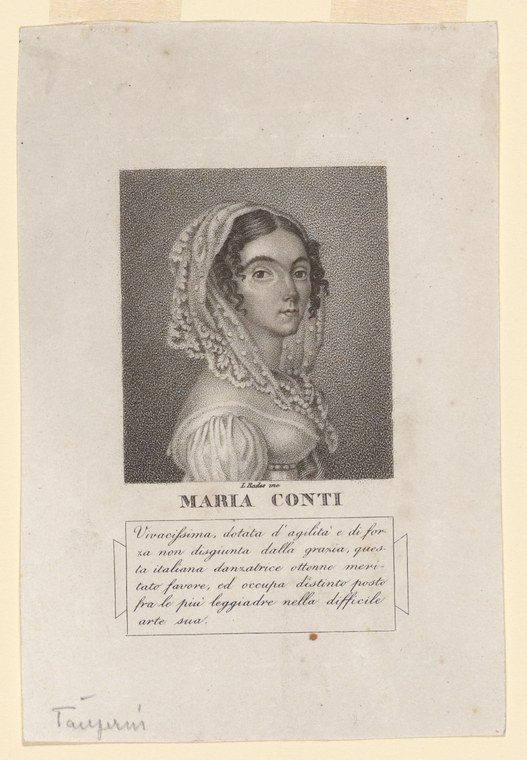
Maria Conti's portrait is a historical record of a performer whose name and achievements were considered significant enough to circulate in print, yet whose actual technique and repertoire are now largely lost to history. The engraving demonstrates how early 19th-century dance culture created and distributed images of celebrity, establishing the dancer's face and identity as a commodity worth publishing. For scholars of theatrical history, women performers, and print culture, the work raises questions about what kinds of dancers left behind visual records and how their legacy was constructed.
What you are looking at
A portrait of a woman in three-quarter view, shown from the shoulders up against a plain background. She wears an elaborate headdress of white lace or linen arranged in deep folds that frame her face and neck—characteristic of early 19th-century fashion. Her dress is a high-waisted white or cream gown with a rounded neckline and short puffed sleeves, typical of the Regency or early Romantic era. The woman's expression is contemplative, her gaze directed away from the viewer. The engraving technique creates fine cross-hatched shadows that model the face and suggest the rich textures of the fabrics. Below the portrait, a caption identifies the subject as 'Maria Conti' with a brief italic inscription in Italian praising her abilities as a dancer and her skill in executing difficult movements.
The dancing
The figure is stationary and posed for portraiture rather than captured in motion. The woman's shoulders are relaxed and level; her neck is elongated and graceful. There is no visible gesture or dynamic positioning—this is a commemorative portrait, not a dance scene. The artist has chosen to represent her in a moment of quiet dignity, not during performance.
The dance depicted
Maria Conti was an Italian dancer of the early 19th century, and the inscription beneath the portrait—which praises her as a 'vivacissima' dancer of eagles and fire who executed difficult steps in Italian dance—suggests she was known for technical brilliance and dramatic intensity. The reference to 'eagles' and 'fire' may allude to specific movements or theatrical roles. However, this is a portrait, not a depiction of her dancing. The work serves as a record of her identity and celebrity rather than as evidence of her actual technique or style.
How it was made
This is a stipple or fine-line engraving, a reproductive printmaking technique that was standard for theatrical and celebrity portraits in the late 18th and early 19th centuries. The delicate cross-hatching and subtle tonal gradations allowed engravers to render the soft modeling of flesh and the luminous quality of white textiles—crucial for capturing the elegance expected in portraits of performing artists. Engravings of this quality were distributed to theaters, collectors, and print shops, making them a primary means of circulating images of celebrated dancers across Europe.
About this work
This is a commemorative portrait engraving of Maria Conti, an Italian dancer of the early Regency era, presented as the kind of celebrity print that would have circulated among theater-goers and collectors of performing arts memorabilia. The inscription in Italian establishes her reputation for technical difficulty and dramatic execution, though the portrait itself shows her in repose rather than in the act of dancing. The work belongs in a dance history collection as evidence of how dancers were promoted, remembered, and valorized in print culture—as much as a document of her fame as of her actual movement or style.
How to look at it
Look at the balance between the formal portraiture conventions and the small details that mark this as a dancer: the graceful elongation of the neck, the poised posture, and especially the inscription that tells us she is not merely an elegant woman but a celebrated artist. The whiteness and delicacy of the headdress and dress are rendered with particular attention—these were markers of elegance and refinement that a dancer of Conti's status would have worn both on stage and in public. The artist has chosen not to show her dancing, but to show her as she would have appeared in the theater lobby or in the pages of a theatrical journal.
The artist
The engraver's name is not recorded in the caption. The style and quality of the work suggest a professional printmaker working within the established conventions of theatrical portraiture in Italy or German-speaking Europe in the early 1800s. The signature 'Forganni' or similar appears to be inscribed at the lower left, though it is difficult to read with certainty in reproduction.
The period
The early 19th century saw the rise of Romantic ballet and the cult of the individual dancer as a celebrity figure. Engravings of famous performers—particularly women—became a major genre of print production, feeding a popular hunger for images of stage stars. In Italy and the German lands, this coincided with the growth of urban theater culture and the standardization of dance as a professional, respectable art form worthy of commemoration. The Regency-era fashion and the Italian language of the inscription place Conti in a moment when dance was becoming increasingly nationalized and when individual performers were achieving international fame.
Where it lives
The work is held in the New York Public Library's collection of prints depicting dance. It is the kind of single-sheet engraving that would have been sold individually to theater patrons and collectors, making it a mass-produced object of popular culture rather than a unique artwork. The NYPL collection gathers such prints as primary sources for the history of performance.
Questions about this work
Was Maria Conti a famous ballerina?
The inscription suggests she was a celebrated Italian dancer known for technical virtuosity and dramatic presence, but little else about her career is widely documented now. The fact that her portrait was engraved and distributed indicates she had achieved sufficient fame to be commercially viable as a print subject, which was a significant marker of status in early 19th-century theater.
What does the Italian text say?
The inscription praises Conti as a 'vivacissima' (most lively) dancer of 'eagles and fire,' and notes her skill in executing 'difficult steps' in Italian dance. The language is typical of theatrical publicity of the era—hyperbolic, poetic, and designed to convey both her technical brilliance and her dramatic intensity.
Why is this a portrait rather than a dance scene?
By the early 19th century, engravings of famous dancers were primarily portraits meant for consumption as celebrity memorabilia, not as documentary records of their performances. Showing the dancer in elegant repose, dressed in fashionable Regency attire, made the print appealing to a broader market and positioned the dancer as a refined cultural figure, not merely as a body in motion.
More dance artwork





