49 works in this view — arrow keys or swipe to move between them.
Dance in Art
American fashion plates
Unknown artist
- Collection:
- Prints depicting dance
- Source:
- New York Public Library
- Rights:
- Public domain — free to use, share and adapt.
- Recorded as:
- Public Domain
The dress itself is a primary source for understanding how dancing bodies moved in the 1890s. The enormous sleeves and long train were not incidental decoration but structural features that governed posture, arm carriage, and footwork in waltzes and other ballroom dances. Without seeing how the period dressed its dancers, a choreographer or historian reconstructing these dances is working blind.
What you are looking at
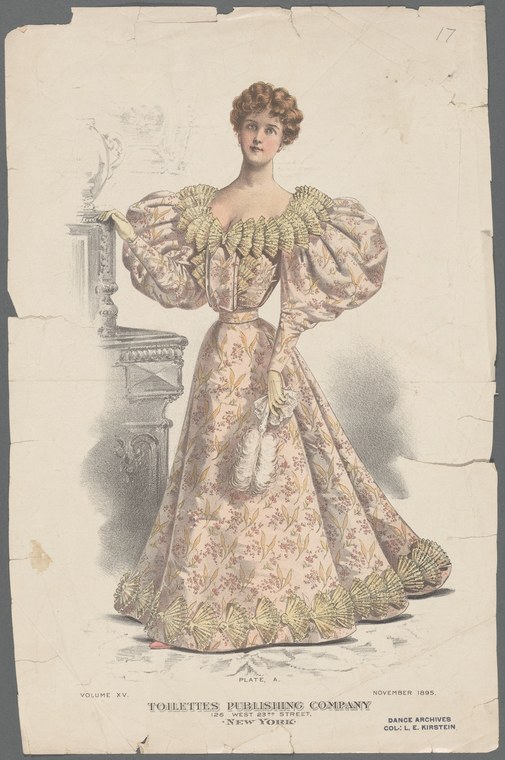
A single figure in elegant late-19th-century dress stands in a three-quarter pose against a neutral background, her body angled to display the costume to full advantage. She wears an elaborate gown of cream silk or similar lustrous fabric, densely patterned with pink and rose floral motifs and ornamental scrollwork. The dress's most striking feature is its enormous leg-of-mutton sleeves, gathered and voluminous at the shoulder and upper arm, tapering sharply at the wrist—a signature silhouette of the 1890s. The skirt is floor-length with a pronounced train, trimmed at hem and cuff with contrasting yellow-green striped or pleated silk bands that frame the hem dramatically. Her pose is poised and frontal, with one arm resting lightly and the other gesture subtle, displaying the garment rather than depicting movement. Her hair is swept up in the high, Gibson-girl style of the period. She stands beside a classical stone plinth or column, suggesting a studio or gallery setting. The image is a hand-coloured print—the flesh tones and fabrics rendered in soft pastels, the linework precise and delicate.
The dancing
A single standing figure in profile-three-quarter view, her weight evenly distributed and posture upright and formal. Her arms are held close to the body in a static, display-like pose rather than one suggesting active dance movement. The figure's frame is tall and elegant but entirely still; there is no indication of weight transfer, rise, or the dynamic repositioning of limbs that would suggest actual dancing or even the pause within a phrase of movement. This is a fashion plate, not a dance image in the conventional sense.
The dance depicted
While the image depicts a woman in the formal dress of the 1890s and is catalogued as dance-related, it does not depict active dancing. The figure stands in a static, presentational pose typical of fashion illustration of the Gilded Age. However, the dress itself—particularly the exaggerated sleeves and the trained skirt—represents the costume silhouettes within which ballroom and social dances of the period were performed. The voluminous sleeves would have constrained and shaped arm movement in waltzes, polkas, and other dances of the era, while the weighted train required specific carriage and footwork. This is a document of the material culture of Gilded Age dancing rather than a depiction of dance itself.
How it was made
A hand-coloured lithograph or chromolithograph, one of a series of American fashion plates published by Toilettes Publishing Company, New York, in November 1895. The technique involved a printed base (established through the fine linework visible in the face, hair, and fabric detail) to which colour was applied by hand or in successive lithographic passes. This medium was the standard for fashion journalism of the period, allowing rapid, affordable distribution to a broad readership of pattern-buyers, dressmakers, and women following fashion. The hand-colouring lends an immediacy and a slight variation between impressions; each print is thus subtly individual. The publication details printed at the base situate this within the commercial infrastructure of American fashion.
About this work
This is a hand-coloured fashion plate from the 1890s depicting a woman in a formal gown of the Gilded Age. Although catalogued as dance-related, it does not show active dancing; rather, it documents the silhouettes, fabrics, and construction details of women's dress in an era when formal ballroom dancing and social dancing were central to upper-class social life. The exaggerated proportions of the sleeves and the weight of the trained skirt are the material constraints within which the dances of this period were performed.
The image belongs in a dance archive as evidence of how costume shaped the body and movement of dancers during this era. A historian of waltz, cotillion, or other Gilded Age social dances needs to understand the physical reality of these garments—their weight, their volume, their resistance to movement—to understand how those dances were actually performed and how they felt.
How to look at it
Observe the extreme proportions of the sleeves and the architectural construction of the dress—how tightly they must have constrained the shoulders and arms. Notice how the fabric is arranged and supported; the sleeves stand out from the body in a way that suggests boning and internal structure. Imagine wearing this dress through a waltz or a quadrille: how would you have had to hold your arms? How would the weight of the skirt and train have affected your balance and footwork? The pose is static, but the costume tells a dynamic story.
The artist
Unknown. The image is credited to Toilettes Publishing Company, a New York-based fashion publication. Such plates were typically drawn by commercial fashion illustrators whose names were rarely recorded. The consistent style and refined hand-colouring suggest a professional atelier rather than a single named artist.
The period
The 1890s were the height of the Gibson Girl era and the Gilded Age, when women's formal dress reached its most structurally complex and physically constraining form. The silhouette of this gown—tiny waist, enormous sleeves, heavy skirts—required specific posture and movement to wear gracefully. Ballroom dancing remained the primary site of social interaction and courtship for the upper and middle classes in America and Europe. Fashion plates such as this one were mass-produced and distributed through magazines and pattern companies, making them central to the way women understood and aspired to fashionable dress. Simultaneously, the corset and structured garments of the period were beginning to face critique from reformers concerned with women's health and freedom of movement.
Where it lives
Published by Toilettes Publishing Company, 251 West 23rd Street, New York, in November 1895. This is part of a series of American fashion plates held at the New York Public Library as prints documenting dress of the Gilded Age. The collection is catalogued under dance because such plates are primary sources for understanding how ballroom dancers dressed and moved.
Dance in this work
Questions about this work
Why is a fashion plate in a dance archive?
Because costume is inseparable from dance history. The weight, structure, and proportions of a dancer's dress determined how they could move, hold their body, and perform. Fashion plates are documents of the material reality of dancing in a given era. To understand how a waltz or cotillion was actually danced in the 1890s, you must understand the dress the dancers wore.
Could a woman actually dance in this dress?
Yes, but with significant constraints. The enormous sleeves limited arm movement and required the arms to be held in a specific, high position. The long train required careful footwork to avoid treading on it or entangling a partner. The tight waist and heavy skirts affected balance and required strong core control. These dresses were designed to display wealth and status, not comfort or ease of movement.
Is this dress typical of the 1890s?
Yes. This silhouette—the leg-of-mutton sleeve, the tiny waist, the trained skirt—is characteristic of the 1890s, particularly the mid-to-late 1890s. The floral patterning and the yellow-green trim are period-appropriate decoration. This is not an exaggeration for effect; it is a relatively conservative example of high-fashion dress of the time.
More dance artwork





