49 works in this view — arrow keys or swipe to move between them.
Dance in Art
Folk and ethnic dancing in wood engravings
Unknown artist
- Collection:
- Prints depicting dance
- Source:
- New York Public Library
- Rights:
- Public domain — free to use, share and adapt.
- Recorded as:
- Public Domain
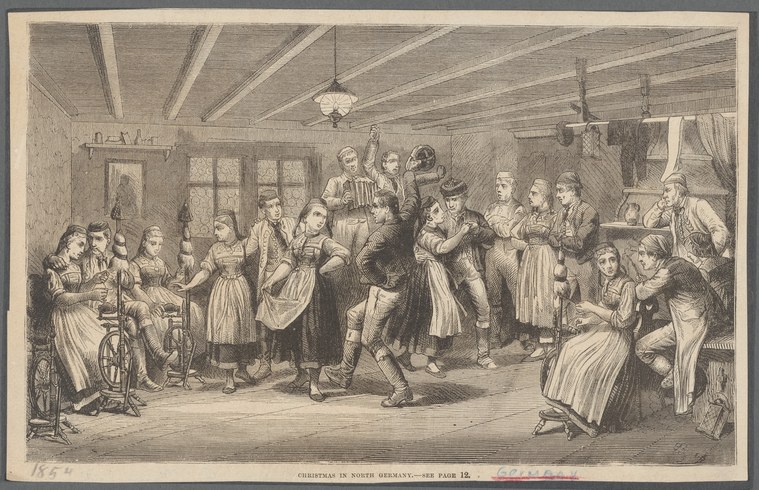
This image documents the participatory, social form of folk dance at a moment when rapid industrialization and urban migration were transforming European rural culture. For historians of dance and culture, it provides evidence of how and where ordinary people actually danced together, away from theaters and formal instruction. It also captures a particular 19th-century middle-class fascination with folk authenticity and picturesque rural custom.
What you are looking at
A crowded interior scene of rural merriment, rendered in wood engraving. The setting is a simple wooden barn or hall with exposed ceiling beams and a single hanging lamp, its walls lined with small windows. A mixed gathering of men, women, and children fills the space in various states of activity: some stand in clusters talking and watching, others actively dance. The figures wear simple country dress—the women in long skirts and aprons, the men in work clothes and hats. The composition is dense and layered, with figures overlapping across the depth of the room, creating a sense of crowded, unplanned festivity. The mood is one of spontaneous celebration, captured in a moment of active merrymaking.
The dancing
Most figures stand or shift weight casually rather than in formal dance positions. Those actively dancing show loose, informal movement: some couples appear to be in a simple close embrace or side-by-side configuration, others gesture with arms raised or extended. The postures are relaxed and natural rather than technically composed—weight shifts, slight bends, the kind of movement that comes from folk participation rather than trained technique. Children and onlookers are interspersed among the dancers, and the overall impression is of simultaneous, overlapping activities rather than coordinated performance.
The dance depicted
This depicts European folk or country dancing, almost certainly from the Germanic or Central European tradition based on the rural interior setting and dress. The style is consistent with 19th-century village celebration dances—informal, participatory, community-based rather than theatrical. The dancing appears to be couple-based with flexible formation, possibly Ländler, Schottische, or similar regional country dances where partners move together in a loosely choreographed way. The setting and composition emphasize the social and celebratory function of dance rather than technical display.
How it was made
This is a wood engraving, a relief printing technique that creates prints by carving away the surface of a hardwood block. The fine parallel lines (hatching and cross-hatching) visible throughout create tone and volume, typical of the wood-engraving aesthetic. This technique allowed for mass reproduction and wide circulation in print collections and periodicals, making such images accessible to middle-class audiences. The formal composition and skilled handling suggest this was made by a practiced engraver, likely from a drawn or painted original, for publication rather than as a unique work.
About this work
This is a 19th-century wood engraving depicting a scene of rural European folk dancing and celebration in a village gathering space. The image captures the social dimension of traditional dance—the mixing of dancers, musicians, children, and spectators in shared festivity—rather than isolated technical performance. The crowded, informal composition and the simple dress and setting make clear that this documents how ordinary people danced together in their own communities. As a widely reproduced print, it would have circulated among educated viewers as a picturesque record of folk custom and rural life.
How to look at it
Attend first to the composition's refusal of a single focal point: the artist has distributed figures and action across the entire space, making no one couple or moment the clear center. This is a deliberate choice that conveys the democratic and social nature of folk gathering rather than the hierarchical focus of theatrical dance. Notice also how the artist distinguishes dancers from onlookers through gesture and positioning, revealing how dancing and watching were interwoven activities in village celebration. The technical precision of the wood engraving—particularly the fine hatching in faces and fabrics—suggests this was made from careful study or observation, not mere convention.
The period
The 19th century saw a surge of romantic interest in folk culture and rural tradition among educated European and American audiences, as industrialization accelerated. This period also witnessed the codification of formal ballroom dances (waltz, polka, quadrille) in urban centers, which made folk practices increasingly appear as quaint or antiquarian. Wood engraving was at its technical and commercial peak in this era, serving as the primary means of reproducing images in books, journals, and popular prints before photographic halftone processes displaced it in the 1890s. Scenes of folk celebration and village dancing were popular subjects in this market, appealing to nostalgia and ethnographic curiosity.
Where it lives
The work is held in the Prints collection of the New York Public Library, catalogued as a wood engraving depicting folk and ethnic dancing. The catalogue record indicates it is part of a broader holdings of dance-related prints but provides no artist attribution, date, or publication information beyond what can be inferred from the image itself.
Dance in this work
Questions about this work
What country or region is this dance from?
The style of dress, the wooden interior, and the character of the gathering suggest Central or Northern Europe, most likely German-speaking territories or Scandinavia. The dance forms visible appear consistent with Ländler, Schottische, or similar Alpine and Germanic folk dances of the 19th century. However, without documentary evidence, regional attribution remains uncertain.
Is this a real scene or an artistic fantasy?
It is almost certainly a composed scene rather than a direct documentary record, but likely based on real observation or knowledge of village customs. The 19th-century wood engraver working from artistic study would have aimed for plausibility and recognizable regional character. It represents how educated audiences understood and imagined folk celebration rather than a photograph-like record.
Why did 19th-century audiences care about folk dancing?
Rapid industrialization and urban migration made rural practices appear endangered and nostalgic. Folk culture became a subject of romantic and ethnographic interest, associated with authenticity and national character. Images like this allowed middle-class city dwellers to imagine and consume rural tradition as a picturesque alternative to modern life.
More dance artwork





