49 works in this view — arrow keys or swipe to move between them.
Dance in Art
American fashion plates
Unknown artist
- Collection:
- Prints depicting dance
- Source:
- New York Public Library
- Rights:
- Public domain — free to use, share and adapt.
- Recorded as:
- Public Domain
Fashion plates are primary sources for understanding the embodied constraints on ballroom dancers: the silhouette, the corsetry, the deportment, the weight distribution that made certain movements possible and others impossible. Without fashion plates, we would not know what ballroom dancers actually looked like, or how their clothing governed their movement. This particular image captures the Gilded Age ballroom body at a specific historical moment, at the height of the Gibson Girl aesthetic, and from a commercial publisher whose work shaped elite fashion consciousness.
What you are looking at
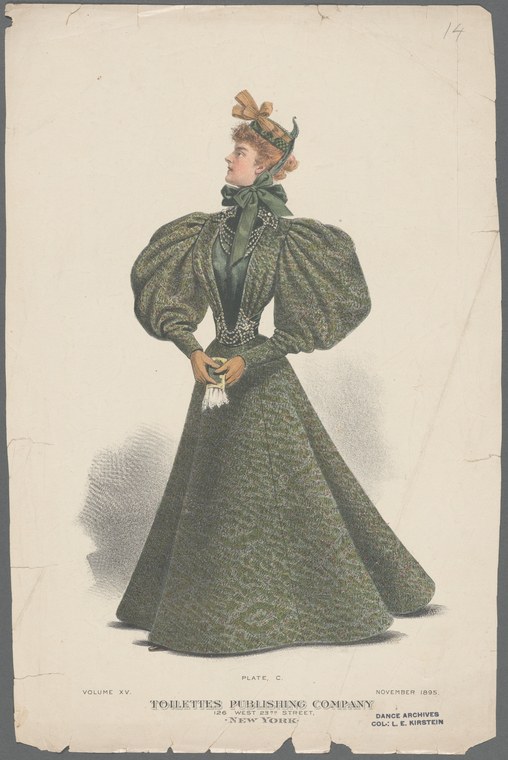
A single fashionably dressed woman stands in three-quarter view against a plain cream background, facing left. She wears an elaborate dark green wool or heavy silk dress with a voluminous skirt that sweeps to the floor, and an extraordinarily wide, gathered cape or cloak that extends from her shoulders in two massive puffed sleeves, creating a silhouette that dominates the composition. Over this she wears a green silk bow at the neck. Her posture is upright and poised, weight on her back leg, suggesting the composed bearing expected of fashionable society. Her hair is elaborately arranged in a high, twisted arrangement adorned with feathers or plumes, and she holds white gloves in her hands folded at her waist. The figure is rendered in hand-colored lithography with careful attention to textile pattern and fabric drape. This is a fashion plate rather than a narrative scene—the woman is presented as a statuary object for admiration rather than as a figure engaged in action or interaction.
The dancing
A single female figure stands in a posed, stationary position. Her weight appears centered with a slight back-weighted stance, one leg forward in a subtle contrapposto that suggests ballroom deportment. Her arms hang naturally at her sides, hands folded and holding gloves. The body is elongated and presented in frontal-profile alignment typical of fashion illustration. There is no dynamic movement or footwork visible; the figure is composed for display rather than captured mid-motion.
The dance depicted
This image does not depict dance in motion. It is a fashion plate—a commercial illustration designed to display elite women's clothing for a fashionable audience. However, the dress and deportment reflect the formality and bodily presentation required for ballroom society in the 1890s. The posture, the elevated bearing, and the elaborate costume are all consistent with the social dance milieu of the Gilded Age, and the image would have been consumed by women who danced in such settings. The enormous puffed sleeves and cinched waist reflect the Gibson Girl silhouette at its height, a period when ballroom dancing was central to social performance.
How it was made
This is a hand-colored lithograph, recognizable from the characteristic crayon marks, the tonal modeling in the background shadow, and the supplementary hand-coloring in green and flesh tones over a printed base. The production method—lithography followed by coloring—was the standard for commercial fashion plates in the 1890s, allowing for relatively rapid reproduction and wide circulation in fashion magazines and commercial prints. This particular plate comes from Toilettes Publishing Company, a commercial publisher. The technique required both a skilled stone-drawer and colorists, representing a substantial investment; such prints were expensive objects aimed at middle and upper-class consumers.
About this work
This is a fashion plate from the November 1896 issue of Toilettes Publishing Company's periodical, depicting a woman in the height of 1890s elite fashion. The image does not show dance itself, but rather the costumed body of a woman positioned in the formal, upright bearing required for ballroom society. Fashion plates and dance history intersect at the point of embodiment: what the body was required to look like, how it should be held, what silhouette it should present. This image documents the material culture of the Gilded Age ballroom—not the movement, but the apparatus in which movement occurred.
For a dance historian, fashion plates matter because they establish the constraints on the dancing body. The enormous cape sleeves visible here would have restricted arm movement in ways we cannot know from photographs of dancing alone. The tightly corseted waist, the weight distribution, the upright carriage—all of these shaped how dancers could move, what hold was possible, how a woman could present herself. This plate belongs in a dance archive not because it shows dance, but because it shows the material and social body that danced.
How to look at it
Read this as a document of constraint rather than freedom. Notice the enormous volume of the cape—how it would prevent a woman from raising her arms, what it would require of her partner's frame to accommodate. The extreme corseting of the waist, visible in the sharp angle between hip and ribs, tells you how the body's internal pressure was distributed. The height and elaboration of the hair and hat speak to the investment in verticality and display. The posed, frontal presentation is deliberate: fashion plates do not show women moving because that would obscure the clothing. To see this woman dance, you would need to watch her in motion and then return here to understand what material constraints she moved within.
The artist
Unknown. The plate is credited to Toilettes Publishing Company, a New York-based publisher of fashion plates and ladies' magazines. The publisher was active in the 1890s-1900s and produced commercially successful fashion illustration. Hand-colored lithographic fashion plates were produced by workshop teams: a stone-drawer, a lithographic printer, and colorists. Attribution to an individual artist is unlikely; this is a product of commercial production.
The period
This plate dates to November 1896, at the height of the "Gibson Girl" era—a period when elite American fashion centered on the idealized figure of the athletic, corseted young woman. The 1890s saw the rise of the "New Woman," though this image emphasizes upper-class femininity and ballroom propriety rather than athleticism. Socially, the 1890s was the heart of the Gilded Age ballroom season in American cities, when cotillions, debutante balls, and private dances were central to elite social life. The enormous puffed sleeves and dramatic silhouette visible here were at the absolute peak of fashion; within a few years they would be regarded as dated. For ballroom dancers, this was the era of the Waltz, the Cotillion, and the Lancers—formal, structured dances in which this woman's upright, composed bearing and restricted dress would have been essential to propriety.
Where it lives
This print comes from the NYPL's collection of prints depicting dance. It is catalogued as part of a series of American fashion plates, Volume XV, from Toilettes Publishing Company, and is dated November 1896. Fashion plates were commercial products, widely distributed, and this item reflects the NYPL's systematic collection of such materials as historical documents.
Questions about this work
Is this a dance image?
Not strictly. This is a fashion plate—a commercial illustration designed to display clothing. But it belongs in a dance archive because fashion plates document the embodied constraints on dancers: the silhouette, the corseting, the deportment, the material restrictions that shaped how the dancing body could move. To understand what a Gilded Age ballroom dancer experienced, you need both images of dancing and images of the body as it was dressed and presented.
Why are the sleeves so enormous?
This is the "leg of mutton" sleeve, at its most exaggerated form, from circa 1893-1897. The puffed upper sleeve and fitted lower arm were the dominant silhouette in elite fashion during the 1890s. For a ballroom dancer, these sleeves would have been restrictive: they would not allow the arm to rise above shoulder height without bunching or tearing, and they would have required careful choreography of the arm in any hold. The partner would have needed to negotiate the volume of fabric.
What does her posture tell you?
The woman's upright carriage, the slight contrapposto weight distribution, and the composed arm position are all consistent with ballroom deportment of the era. She is not relaxed; she is *posed*—held in the formal bearing expected of elite women in social dance contexts. The presentation is static because fashion plates are meant to display clothing without distraction, but the body's training for ballroom society is evident in the discipline of her stance.
Who would have used this image?
Fashion plates were consumed by middle and upper-class women seeking to understand current fashion, and by dressmakers and seamstresses who needed to know what silhouettes, proportions, and details were fashionable. Many women who read Toilettes magazine were active in ballroom society, so this image would have been both a fashion guide and a statement of social position. The woman depicted is clearly elite—the quality of the fabric, the elaboration of the accessories, the fashionable height of the dress all signal wealth and social standing.
More dance artwork





