49 works in this view — arrow keys or swipe to move between them.
Dance in Art
Folk and ethnic dancing in wood engravings
Unknown artist
- Collection:
- Prints depicting dance
- Source:
- New York Public Library
- Rights:
- Public domain — free to use, share and adapt.
- Recorded as:
- Public Domain
For historians of Pacific dance, this image reveals the visual conventions through which 19th-century Western artists represented indigenous movement to Western audiences—often flattening, exoticizing, or misrepresenting the actual practice. For print historians, it demonstrates wood engraving's role in distributing images of global cultures in a period before photography dominated such documentation. For dance historians, it raises questions about how movement practices were understood and represented across cultural boundaries in the age of exploration and colonialism.
What you are looking at
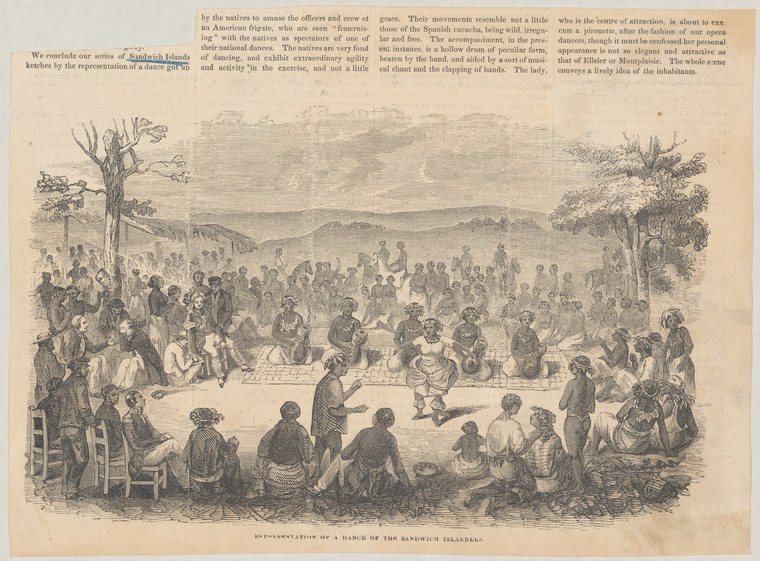
A wood engraving depicting a large outdoor gathering of indigenous people in a tropical setting, with tall trees framing both sides of the composition. Dozens of figures are distributed across the scene—some standing, many seated or crouching on the ground in the foreground, others visible in the middle distance. The setting appears to be a clearing or beach, with mountains visible in the hazy background. The assembled group seems to be witnessing or participating in a performance or ceremony. In the foreground, several figures are positioned low to the ground in postures suggesting active movement or ritual participation. The engraving's hatching and line work creates depth and atmosphere typical of 19th-century wood-engraved reportage.
The dancing
The bodies throughout the composition display a variety of postures and positions rather than synchronized formation. Several figures in the foreground are bent or crouched, with weight distributed through the legs and torso in ways suggesting dynamic, ground-connected movement. Some standing figures have arms raised or extended. The overall impression is of a gathering where movement is individual or small-group rather than precisely coordinated; bodies are turned toward the center of activity from many angles. Clothing and bodily decoration visible in the engraving suggests the figures are unclothed or minimally clothed, consistent with indigenous practice in tropical regions.
The dance depicted
The engraving most likely depicts a social or ceremonial gathering of an indigenous Pacific or Caribbean population, possibly Sandwich Islanders (Hawaiian), given the catalogue's reference to the Sandwich Islands in its apparent caption. The dance or movement activity appears to be participatory and communal rather than a formal performance with strict choreography. The ground-level postures and distributed positioning suggest movement rooted in folk or ceremonial practice rather than any theatrical or courtly tradition. Without clearer inscription or attribution, the specific dance form cannot be definitively identified, though the setting and composition suggest a sacred or festive gathering.
How it was made
This is a wood engraving, a relief printing technique in which an image is cut into the end grain of a hardwood block. The fine parallel lines (hatching) visible throughout create tonal variation and depth. Wood engraving allows for high detail and was the dominant reproductive medium for illustrated periodicals and books in the 19th century, enabling wide circulation of images of exotic peoples and places to European and American audiences. The technique's association with reportage and travel literature suggests this image was likely produced for a publication documenting Pacific island peoples or colonial encounters.
About this work
This is a 19th-century wood engraving of a large social or ceremonial gathering involving indigenous dancers and participants in a tropical outdoor setting, probably representing Hawaiian (Sandwich Island) or similar Pacific island culture. The work belongs in a gallery of dance in art as documentary evidence of how European and American printmakers represented indigenous movement practices for home audiences during an era of intense colonial and commercial interest in the Pacific. It captures not the movement itself but rather the moment of gathering and the artist's visual interpretation of an unfamiliar cultural practice—a mediated and stylized rendering rather than ethnographic record. The engraving exemplifies how dance imagery circulated as part of broader colonial discourse about 'exotic' peoples and places.
How to look at it
Attend to the distribution and posture of bodies rather than any sense of unified choreography. Notice how the artist has chosen to freeze the scene at a moment of gathering rather than in the midst of synchronized movement—the engraving captures assembly and participation more than dance as discrete performance. The composition's perspective places the viewer as an outside observer, gazing down on the gathering from a vantage point that emphasizes the number and density of participants and the exotic setting. The hatching technique, which was state-of-the-art for the period, creates atmospheric effect and suggests the artist's effort to render unfamiliar bodies and landscapes convincingly for a home audience unfamiliar with such scenes.
The period
This engraving was created during the height of 19th-century Western interest in ethnographic illustration and the representation of colonized or 'discovered' peoples. European and American printmakers and illustrators produced thousands of such images for newspapers, magazines, and travel books, often based on descriptions, sketches by travelers, or earlier artistic renderings rather than direct observation. The wood-engraved medium was ideal for this purpose: durable, reproducible, and suitable for rapid publication. Concurrently, dance anthropology was beginning to emerge as an intellectual project, though such visual representations typically served commercial and colonial interests rather than scholarly ones.
Where it lives
The work is held in the New York Public Library's Prints collection, which includes thousands of 19th-century wood engravings and other printed images. It is catalogued as depicting folk and ethnic dancing, indicating its classification within a collecting framework that groups dance images by cultural category.
Dance in this work
Questions about this work
What dance is depicted here?
The specific dance form cannot be definitively identified from the image alone. The setting and composition suggest a social or ceremonial gathering of indigenous Pacific island peoples, possibly Hawaiian, involving ritual movement or participatory dance rather than a formalized choreographed practice. Without accompanying text or inscription, the exact form remains unclear.
Is this an accurate representation of the dance?
Almost certainly not in detail. 19th-century wood engravings of indigenous peoples were typically based on travelers' reports, earlier artistic interpretations, or imaginative reconstruction rather than direct observation. The image should be read as a Western artistic interpretation of an unfamiliar practice, shaped by the conventions of the period and the artist's assumptions about 'exotic' movement.
Why was this image made and circulated?
Images like this were produced for illustrated periodicals, travel narratives, and encyclopedic works aimed at European and American audiences curious about colonized or recently 'discovered' regions. They served both commercial and ideological purposes, feeding Victorian fascination with exotic cultures while often reinforcing colonial attitudes.
More dance artwork





