49 works in this view — arrow keys or swipe to move between them.
Dance in Art
Carlotta Grisi
Unknown artist
- Collection:
- Prints depicting dance
- Source:
- New York Public Library
- Rights:
- Public domain — free to use, share and adapt.
- Recorded as:
- Public Domain
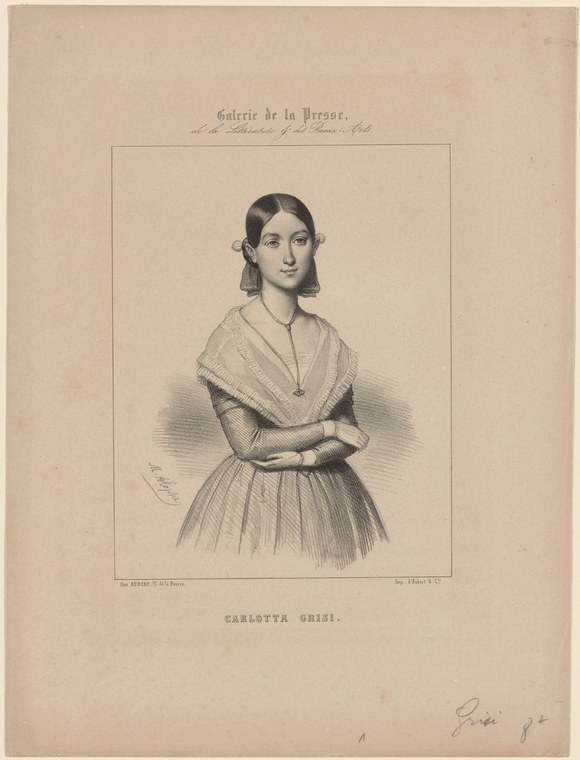
Carlotta Grisi was one of the defining artists of Romantic ballet, yet this portrait reminds us that dance history is not only about movement captured in action. The image shows how nineteenth-century dancers became celebrities whose likenesses were mass-produced and consumed as fashion objects, revealing the cultural prestige and commercial machinery surrounding the art form at its height.
What you are looking at
A three-quarter-length portrait of a young woman set against a plain background, rendered as an engraving or lithograph. She stands in a composed, frontal stance wearing the fashionable dress of the 1840s: a day bodice with a deep shawl collar crossed over the chest and tied at the waist, and a full skirt with pronounced vertical pleating that falls nearly to her feet. Her dark hair is parted in the center and drawn back smoothly, with a small decorative ribbon or bow visible. Her gaze is direct and her expression serene, her arms crossed lightly at the waist in a pose that conveys both repose and the quiet dignity expected in mid-nineteenth-century portraiture. The rendering is delicate and precise, with fine cross-hatching establishing form and volume; the print is unsigned but bears the notation "Galerie de la Presse" at the top, indicating this was part of a series of celebrity portraits.
The dancing
A single standing figure in a relaxed contrapposto, with weight evenly distributed and both arms crossed gently at the waist. The posture is upright but not rigid, suggesting the refined carriage expected of a young woman of social standing. There is no active dance movement or characteristic dance position evident—this is a formal portrait pose rather than a dance scene or performance documentation.
The dance depicted
This is a portrait of Carlotta Grisi, the celebrated Italian ballet dancer of the Romantic era, but the image itself does not depict her dancing or in any costume related to performance. It is a formal society portrait in civilian dress, showing her as she would have appeared in public life outside the theatre. Grisi was the creator and original performer of the role of Giselle (1841) and a leading dancer of the Romantic ballet, but this engraving documents her as a fashionable contemporary figure rather than capturing her practice or art.
How it was made
This is a steel or copper engraving, or possibly a lithograph, printed as part of the Galerie de la Presse series of celebrity portraits—a popular mass-produced format in mid-nineteenth-century France. The technique allowed fine tonal gradation through cross-hatching and stippling, and rapid distribution of images of celebrities to a broad readership. The print would have circulated widely among the educated urban public, making the subject recognizable and fashionable.
About this work
This is a formal portrait engraving of Carlotta Grisi, one of the most celebrated dancers of the Romantic ballet era, as she appeared in civilian dress during the 1840s. Though Grisi revolutionized ballet performance and created iconic roles, this particular image documents her not as an artist but as a fashionable public figure—a testament to the celebrity status dancers enjoyed during the Romantic period. It belongs in a dance archive as evidence of how dancers were seen and circulated in the popular imagination, and of the crossover between theatrical and social identity in the nineteenth century.
How to look at it
Attend to the care with which the artist has rendered the texture of fabric—the fine pleating of the skirt, the drape of the shawl collar—and the restrained elegance of Grisi's bearing. This is not a dynamic pose but a studied presentation of refinement and composure. Notice that she is shown as a woman of fashion and cultivation, not as a performer in character or mid-movement. The contrast between this civilian identity and the theatrical roles she was famous for embodies the social ambiguity and appeal of Romantic-era dancers: they belonged to the stage, yet their fame made them objects of fascination in everyday society.
The artist
The engraving is not attributed in the catalogue record. Galerie de la Presse was a French periodical that published weekly illustrated portraits of notable public figures—actors, musicians, dancers, and society personalities—throughout the 1840s and 1850s, making use of both engraving and lithography. The series was a precursor to modern celebrity photography and the illustrated press.
The period
This print dates to the height of the Romantic ballet era (1830–1850), when dancers achieved unprecedented fame and social elevation. Carlotta Grisi epitomized the Romantic ballerina: she performed in gas-lit theatres, wore the tulle skirts and pointe shoes that became iconic, and danced roles of ethereal heroines and supernatural beings. Simultaneously, the rise of industrial printing and the illustrated periodical created a new form of celebrity portraiture for mass consumption. A fashionable young woman's likeness could now be reproduced and sold in the thousands, making the dancer's face and identity as much a commodity as her performances.
Where it lives
The print is held in the New York Public Library's collection of prints depicting dance. It was part of the Galerie de la Presse series, a commercial periodical publication that circulated widely in France during the mid-nineteenth century, making it a document of both celebrity culture and printmaking practice of the era.
Questions about this work
Who was Carlotta Grisi?
Carlotta Grisi (1819–1899) was an Italian prima ballerina and one of the greatest stars of the Romantic ballet era. She created and danced the title role in Giselle (1841), one of the most significant ballets ever made, and performed throughout Europe. She was known for her technical brilliance, dramatic intensity, and the ethereal quality that defined Romantic ballet.
Why is she not dancing in this portrait?
This is a civilian portrait, not a theatrical document. Grisi was a public celebrity whose image was valuable apart from her performance. Such portraits celebrated her status as a fashionable society figure, showing how dancers had moved from being entertainers to being celebrities whose private appearance was as much a matter of public interest as their art.
What is the Galerie de la Presse?
Galerie de la Presse was a French periodical published from the 1840s onward that featured engraved or lithographed portraits of celebrities—actors, dancers, musicians, and other notable public figures. It was a commercial product aimed at middle-class readers and a precursor to modern celebrity magazines and photography.
More dance artwork





