49 works in this view — arrow keys or swipe to move between them.
Dance in Art
American fashion plates
Unknown artist
- Collection:
- Prints depicting dance
- Source:
- New York Public Library
- Rights:
- Public domain — free to use, share and adapt.
- Recorded as:
- Public Domain
Fashion plates are primary sources for understanding how bodies were shaped, displayed, and moved in a given period. This image reveals the material constraints and aesthetic ideals that governed the female silhouette around 1900—knowledge essential to understanding the physical capacity and visual expectation of women who danced in ballroom, theatrical, and social contexts during this era.
What you are looking at
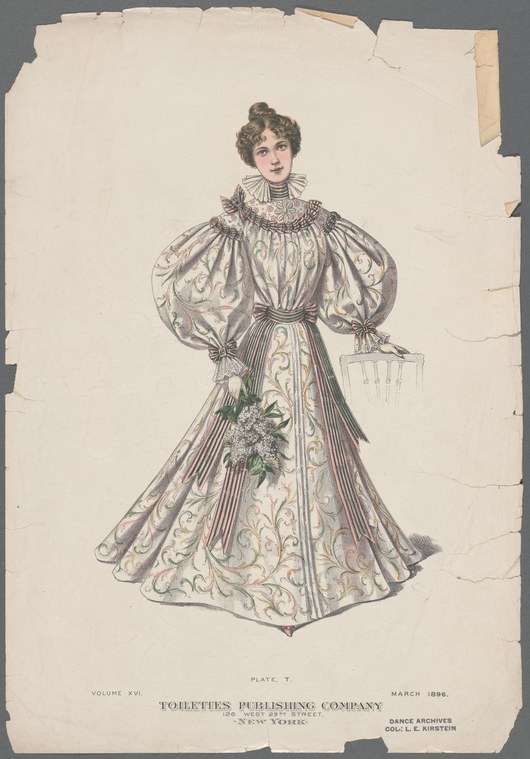
A single female figure dominates this fashion plate, depicted in three-quarter view against an unadorned cream background. She wears an elaborate turn-of-the-century gown with voluminous leg-of-mutton sleeves that billow from shoulder to elbow before tapering to a fitted forearm. The bodice is high-necked with a standing collar of pleated or ruched fabric, and the waist is cinched with a decorative belt. The skirt falls in graceful, sweeping folds to the ground, embellished with ornamental embroidery or appliqué in a scrolling vine pattern down the center front and along the hem. Her posture is upright and elegant, one hand holding what appears to be a small decorative fan or muff, the other resting at her side. Her hair is styled in the pompadour fashion typical of the 1890s–1900s period, swept up and away from her face. The figure's bearing conveys the mannered grace expected of a fashionable woman of leisure, though she is not posed in active movement.
The dancing
The woman stands in a static, frontal pose with weight evenly distributed. Her arms hang naturally, one bent to hold an accessory; there is no suggestion of partnered dance hold, raised frame, or active footwork. The posture is one of presentation rather than motion—the body elongated, the spine straight, the shoulders held back. This is the stance of a fashion model displaying garments, not a dancer demonstrating technique.
The dance depicted
This is not a depiction of dance. The figure is posed in the manner of a fashion illustration—a static presentation of clothing and silhouette. While the period (circa 1900) saw ballroom and social dancing among the fashionable class who would have worn such gowns, nothing in this image—no partnered hold, no evidence of movement, no choreographic framing—indicates that dance is the subject. This is a record of dress and deportment, not of dancing.
How it was made
This is a hand-colored fashion plate, likely a chromolithograph or hand-tinted engraving. The figure is rendered in fine line work with careful attention to pattern and texture, while color is applied sparingly in soft washes—pale flesh tones, muted greens and reds in the embroidery, subtle shading in the fabric folds. The technique is typical of commercial fashion publishing in the 1890s–1900s, designed for reproduction in fashion magazines and journals. Such plates circulated among the urban middle and upper classes—primarily women—as guides to current style.
About this work
This is a fashion plate from the Toilettes Publishing Company, dated March 1898, and is part of a series of commercial fashion illustrations (Volume XVI, Plate 7). The work documents the silhouette and ornament of women's dress in the Gilded Age—specifically the exaggerated sleeve and corseted waist that defined the period. While it depicts a woman from a social class for whom dancing was a regular leisure activity, the image itself is not a representation of dance. It is included in the Dance Archives collection because fashion plates of this era occasionally documented ballroom dress in action, and because the history of dance and the history of fashion are entangled. However, this particular plate is a static fashion study, not a dance scene.
How to look at it
Attend to the construction of the silhouette: the extreme narrowness at the waist and hips, and the compensatory volume in the sleeve and bosom. Notice the ornament—the embroidery, the ruching at the neck, the decorative belt—which signals wealth and leisure. Observe the standing, frontal pose, which presents the figure as an object to be inspected rather than as an agent in motion. The fashion plate is a genre of visual communication quite distinct from action illustration; its purpose is to show what a garment looks like when worn, not what a body can do in it. The fine line work and hand coloring are hallmarks of commercial fashion publishing in the 1890s.
The artist
The work is credited to the Toilettes Publishing Company of New York, a commercial publisher specializing in high-quality fashion plates for the American market. The artist's hand is not recorded. Such plates were typically produced by in-house illustrators and chromolithographers working to tight deadlines and established house styles. The company operated in the competitive fashion-publishing market of the 1890s, when illustrated magazines and loose-leaf plate services were the primary means by which women accessed information about current dress.
The period
The 1890s–1900s saw a radical transformation in women's silhouette. The earlier Victorian hourglass gave way to the 'Gibson Girl' ideal—a taller, more athletic-looking figure with a prominent bosom and narrower hips, achieved through the S-bend corset and the exaggerated leg-of-mutton sleeve. This period also witnessed the rise of women's active recreation: cycling, tennis, and dancing became acceptable pastimes for unmarried women of the middle and upper classes. Fashion plates both documented and prescribed the visual standard for these activities. In dance specifically, the Gilded Age ballroom (waltz, quadrille, two-step) was the dominant social form, and the corseted, high-necked silhouette shown here was the required costume for women in that world.
Where it lives
This plate is held in the New York Public Library as part of its collection of prints depicting dance. It derives from the Toilettes Publishing Company's commercial catalog of fashion plates, which circulated in print form and were bound into periodicals and collected by individual subscribers.
Questions about this work
Is this a dance image?
No. This is a fashion plate—a static illustration of a gown and its wearer. It is held in a dance collection because fashion and dance history are linked, and because understanding the clothes women wore helps explain how they moved when dancing. But the image itself shows a woman posing in a garment, not dancing.
What year is this from?
March 1898, according to the printed date on the plate.
Why are the sleeves so big?
The leg-of-mutton sleeve was the dominant silhouette in the 1890s–1900s. It was achieved by gathering fabric at the shoulder and upper arm while keeping the forearm tight. It signaled fashion-consciousness and wealth, since it required extra fabric and careful construction. It also made certain movements—especially the raised-arm movements of dance—slightly more dramatic and visible.
Who would have worn a dress like this?
A woman of the middle or upper class, probably in an urban American setting. This was fashionable day wear or afternoon wear, suitable for social calls, shopping, or informal entertaining. For formal evening dancing, the neckline would have been lower and the sleeves shorter, but the corseted waist and general silhouette would have been similar.
More dance artwork





