49 works in this view — arrow keys or swipe to move between them.
Dance in Art
Peasant dance
Unknown artist
- Collection:
- Prints depicting dance
- Source:
- New York Public Library
- Rights:
- Public domain — free to use, share and adapt.
- Recorded as:
- Public Domain
This is one of the earliest visual records of peasant dance made by a trained artist, and it shows how seriously printmakers of the Renaissance took the study of ordinary bodies in motion. For dance historians, it is evidence of the continuity between folk movement and the learned dances of the period—the same spiralling torso, the same play of weight and counterweight, appear in both contexts, suggesting a shared physical vocabulary. For art historians, it documents the emergence of 'genre' as a subject for serious technical attention in early modern prints.
What you are looking at
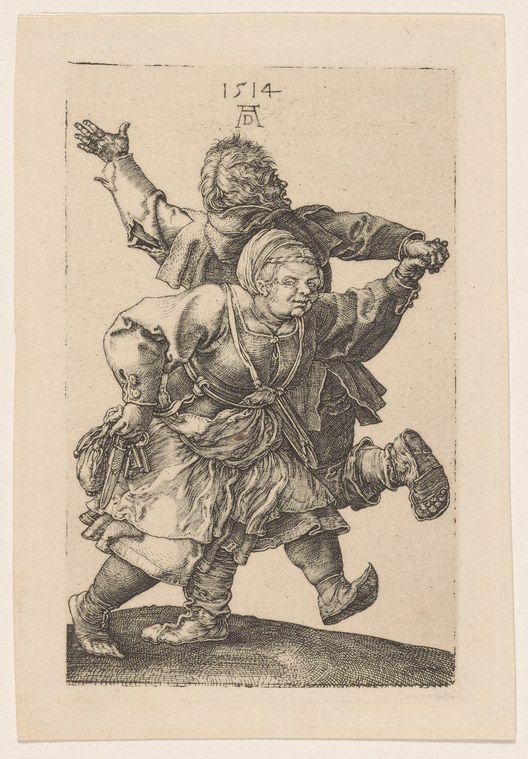
A lively peasant dance captured in an early modern engraving. Two figures dominate the composition: a woman in the foreground, her body twisted in energetic motion, wears a simple dress with full skirt caught mid-movement, her arms extended and one leg lifted. Behind and above her, a second figure—likely male—leans forward in dynamic counterpose, arms raised and spread wide. Both dancers display the vigorous, unselfconscious physicality of folk celebration. The setting is minimal: a bare ground line suggests an outdoor gathering or village space. The engraving technique renders form through fine cross-hatching and bold outlines, capturing the dancers' musculature and the fabric's weight with equal attention. A date mark "1514" and what appears to be an artist's mark occupy the upper portion of the sheet.
The dancing
The woman's weight shifts onto one leg while the other extends behind in a springing motion; her torso twists sharply to one side, creating an S-curve through the spine. Her arms are unbound and expressive, one reaching high. The male figure behind echoes this dynamism but inverts it—his body leans forward from the hips, arms thrown wide and upward, as if caught mid-leap or mid-celebration. There is no formal hold; instead, the two bodies relate to each other through spatial echo and shared momentum. The musculature is explicit and anatomically studied, suggesting the artist understood the body's behaviour under vigorous movement.
The dance depicted
This appears to be a German or Northern European peasant dance of the early sixteenth century, likely a Reigen or folk celebration dance. The vigour, the twisted torsos, the freedom of arm movement, and the outdoor setting all align with contemporary accounts of peasant dancing in prints and texts of this period. The figures show no learned or courtly refinement—instead, the dance is characterized by exuberant, weight-shifted movement and a kind of democratic physical abandon. The print documents how ordinary people danced in their own communities, unmediated by court convention.
How it was made
This is an engraving (possibly a woodcut or engraving on metal), evidenced by the bold, even line-work, the control of tonal variation through hatching, and the crisp definition of form. The technique allowed fine anatomical detail while remaining readable at small scale, suggesting the work was intended for circulation as a portable sheet—perhaps part of a series of costume studies, social types, or dance documents. The precision of line and the studied musculature suggest this was not a casual sketch but a deliberate study made for print reproduction and distribution.
About this work
This is an early sixteenth-century engraving of two peasants engaged in vigorous social dance. It is one of a genre of Northern European prints documenting folk life and popular customs at a moment when printmaking was making such images widely available for the first time. The work belongs in a dance gallery because it records not the formalized steps of court or theatrical dance, but the embodied practice of ordinary people—the dance that sustained village life and survived outside the reach of aristocratic taste. It is a document of how people actually moved together, preserved by an artist observant enough to study their bodies with anatomical seriousness. The print gives weight and dignity to peasant physicality at a time when such subjects were still novelties in high art.
How to look at it
Notice the S-curve through the woman's spine and the way her hips drive her movement while her arms respond freely. Watch how the male figure's weight shifts to allow him to spring upward. The artist has chosen the moment of maximum extension—not a still pose, but the instant of lift and twist. This is not a formalized position (like the stately symmetries of court dance manuals) but a captured instant of momentum. The cross-hatching that models the bodies also suggests physicality and strain—this is work, not ornament.
The artist
The artist is not recorded in the catalogue, but the mark at the top of the sheet and the date 1514 suggest a trained Northern European printmaker, likely German or Flemish. The anatomical precision and the engraving technique point to a professional workshop. The subject matter—peasant life rendered with documentary interest—aligns with the practice of Northern printmakers in the early sixteenth century, for whom such scenes were increasingly marketable as curiosities and social documents.
The period
In the early sixteenth century, printmaking in Northern Europe was creating a new kind of visual culture: portable, reproducible, and unconstrained by the patronage system that governed painted and sculptural commissions. At the same time, peasant life was becoming a subject of fascination for educated urban audiences—a mix of anthropological curiosity and class tourism. In dance, this was the moment when court dances were being formalized and written down (the earliest dance manuals appeared in this period), making the contrast between learned and folk dance increasingly visible. This print sits at that moment of divergence: the peasants dance as they always have, energetically and without steps, while the nobility were codifying the Bassadanza and Ballo into an elaborate art form.
Where it lives
The work is held in the Prints collection at the New York Public Library. It is catalogued as a sixteenth-century engraving depicting peasant dance, and the collection label notes it as one of a body of prints from this period documenting Northern European folk customs. The bare catalogue record (no artist name, no material specification in the original record) is typical of large institutional print collections, where thousands of sheets are documented summarily.
Dance in this work
Questions about this work
How do I know this is actually from 1514?
The date mark at the top of the sheet reads 1514. The engraving technique, line style, and costume details are consistent with Northern European prints of that decade. Without seeing the original or a detailed technical study, we cannot be absolutely certain, but the date is inscribed on the sheet itself.
What dance is this? Does it have a name?
The specific name is lost, but the style and setting suggest a German or Flemish peasant dance—possibly a Reigen, a circle or couples' dance done at festivals and celebrations. Contemporary accounts describe such dances as vigorous, rhythmic, and often accompanied by music. The print does not show steps or formation, only the physical character of the movement.
Why are the bodies so anatomically detailed?
By 1514, Northern European printmakers, especially in Germany and the Low Countries, were studying human anatomy intensively. Showing the musculature and the stress on the body under movement was both a technical display and a way of asserting that peasant bodies deserved serious artistic attention. It was a kind of dignity paid to the subject.
Is this a document or an invention?
It is likely a document: the artist observed peasants dancing and rendered what they saw. But like all prints, it is also composed—the figures are arranged to show their bodies clearly, the moment is chosen to emphasize energy and twist, and the detail is heightened. It is observation shaped by the needs of printmaking and of the eye.
More dance artwork





