49 works in this view — arrow keys or swipe to move between them.
Dance in Art
Folk and ethnic dancing in wood engravings
Unknown artist
- Collection:
- Prints depicting dance
- Source:
- New York Public Library
- Rights:
- Public domain — free to use, share and adapt.
- Recorded as:
- Public Domain
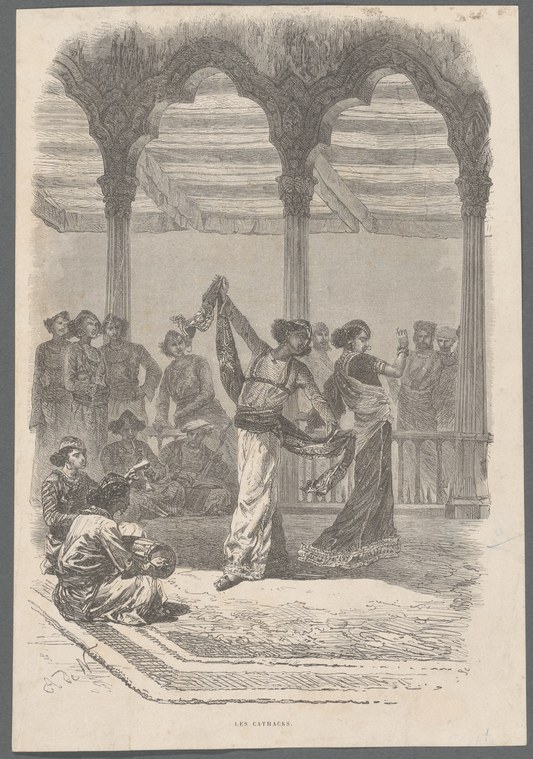
This image is one of few surviving wood engravings that capture the actual body position and social context of ballroom dance in the 19th century, showing not just the dancers but the audience that made such performances meaningful. The work documents the gendered, formal choreography of social dance—the woman's prominent turning motion and the gentleman's supporting presence—that organized courtship and leisure across the European and American middle and upper classes.
What you are looking at
This wood engraving depicts an indoor social gathering centered on dance, framed by a classical colonnade with two substantial columns and an ornate entablature. The space suggests a ballroom or salon of the 18th or 19th century. A group of elegantly dressed figures occupies the floor: at the center, a woman in a full-skirted gown executes a turning movement, her body angled and skirts flaring outward, while a male partner attends nearby. Other couples and onlookers surround the dance floor—some seated on the left in conversation, others standing in clusters along the colonnade, watching the performance. The figures are rendered in the fine hatching typical of wood engraving, creating depth through shadow and light. The title "LES CATHEAUX" (or similar inscription) appears at the lower left, suggesting a specific dance or occasion. The atmosphere combines formality with social ease: this is a moment of approved entertainment among a leisured class.
The dancing
The central dancer, a woman in a full ball gown, is captured mid-turn with her weight on one leg, skirts lifted and billowing—a moment of controlled, elegant rotation typical of ballroom or court dance. Her posture is upright and composed, her arm extended into the turn. A gentleman in fitted coat and breeches stands nearby, positioned as her partner; his weight is centered and his frame ready to receive or follow her lead. Surrounding figures are dressed in the formal wear of the period: women in high-waisted or corseted gowns, men in tailcoats or knee breeches. Several onlookers are seated or standing passively, establishing the social frame in which the dance occurs.
The dance depicted
The identity of the dance cannot be determined with certainty from the image alone. The setting, formal dress, and the nature of the turning movement suggest a ballroom or salon dance of the 18th or 19th century—possibly a waltz, cotillion, or quadrille. The woman's skirts and the turning figure are consistent with Romantic-era ballroom dance. The title inscription may identify the specific dance, but it is not legible enough in this reproduction to confirm. The social gathering format—with spectators watching a central couple—is consistent with court or ballroom dancing as a performed, observed activity rather than purely participatory.
How it was made
This is a wood engraving, a relief printing technique in which an image is cut into the end grain of a boxwood block. The fine parallel lines (hatching) and intricate detail visible throughout indicate skilled execution; wood engraving was capable of finer line work than earlier woodcut. This medium allowed for mass reproduction and circulation among a broad audience, from illustrated newspapers and journals to bound collections. The technique was widely used for illustration and social documentation in the 19th century, making such scenes accessible to readers who might never attend such gatherings. The monochromatic, linear quality gives the work a documentary character—it is capturing a moment of social practice for readers at a distance.
About this work
This wood engraving documents a moment of ballroom dancing in a formal 18th or 19th-century setting, capturing both the central turning figure of a woman in an elegant gown and the wider social frame of spectators, servants, and attendants that surrounded such performances. The classical architectural frame—the columns and entablature—situates the dance within a space of refinement and learning. The work belongs to a tradition of social illustration that used the reproducible medium of wood engraving to circulate images of approved leisure and courtship among the reading public. Its maker is not recorded, but it represents the work of commercial engravers who documented the practices and values of the ballroom.
How to look at it
Attend to the woman's posture and the flare of her skirts: this is the moment a wood engraver chose to freeze, capturing the dynamic turning that defined the waltz and other rotational ballroom dances. Notice how the engraver rendered the architecture—the columns and overhead structure—to frame the dance as a formal, sanctioned activity. Look at the distribution of figures: the active couple in the center, the attentive onlookers around the periphery, and the social hierarchy implied by dress and position. The engraver's use of hatching creates atmosphere and depth, making the ballroom feel like a real space into which the reader is invited to peer.
The period
The 19th century saw an explosion in illustrated print culture, with wood engraving becoming the dominant medium for reproducing images in books, journals, and newspapers. Social dance—especially the waltz and quadrille—became central to middle and upper-class identity during this period. The formal ballroom was a key site of courtship, social hierarchy, and leisure, and illustrated accounts of ballroom life circulated widely among readers who participated in such events or aspired to do so. The classical architectural framing suggests a continuity between Enlightenment ideals of reason and refinement and the managed pleasures of 19th-century ballroom culture.
Where it lives
This work is held in the New York Public Library's collection of prints depicting dance. The catalogue identifies it as part of a group titled "Folk and ethnic dancing in wood engravings," though the formal ballroom setting suggests it may document courtly or upper-class social dance rather than folk practice. The categorization may reflect the library's broader collecting scope rather than a precise historical claim about the dance depicted.
Dance in this work
Questions about this work
What dance is this?
The engraving does not bear a legible title or artist attribution that would identify the specific dance with certainty. The formal dress, the turning figure, and the ballroom setting are consistent with waltzes, cotillions, or quadrilles of the 18th or 19th century. The woman's prominent rotation and flaring skirts suggest a dance built around turning—most likely a waltz.
Who made this and when?
The artist is unknown, and the date is unrecorded. The style of the wood engraving, the form of dress, and the ballroom setting suggest a date in the 19th century, but a precise attribution would require additional research into the print's provenance or comparison with documented works.
Why are there so many people watching?
Ballroom dancing in the 18th and 19th centuries was as much a social performance as an act of courtship. Dancers displayed their skill and their eligibility before a formal audience. The engraver's inclusion of onlookers—seated, standing, in conversation—documents this crucial social frame. To dance was to be seen and judged.
What can we learn from this image about how people danced?
The woman's upright posture, the extension of her arms, and the flare of her skirts all indicate the ballroom style of the period: controlled, elegant, and built around rotational figures. The man's centered weight and ready posture suggest his role as support or leader. The formal dress and polished floor indicate a carefully maintained space designed for this specific kind of movement.
More dance artwork





