49 works in this view — arrow keys or swipe to move between them.
Dance in Art
American fashion plates
Unknown artist
- Collection:
- Prints depicting dance
- Source:
- New York Public Library
- Rights:
- Public domain — free to use, share and adapt.
- Recorded as:
- Public Domain
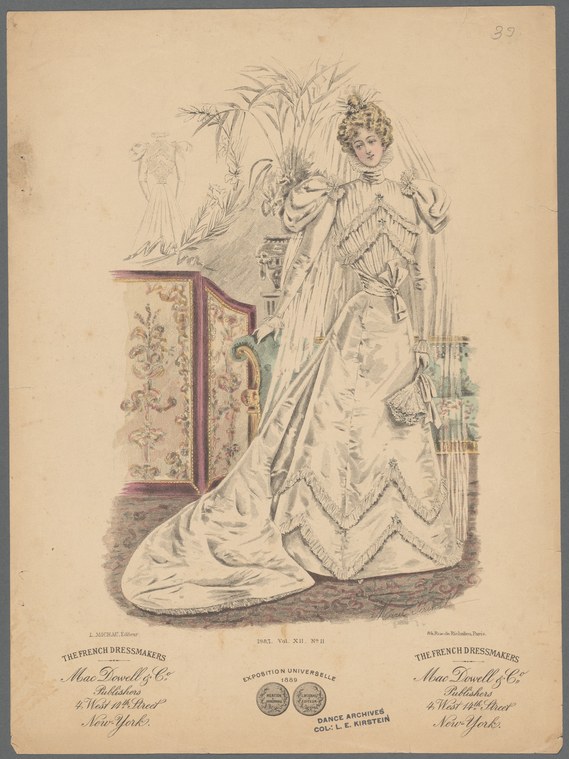
Fashion plates are rarely included in dance history scholarship, yet they are crucial evidence for understanding how costume enabled, facilitated, or constrained ballroom dance. This plate shows a woman's body in ballroom dress, her posture and carriage calibrated to the ballroom context, and the specific garment construction (sleeve, bodice, skirt suspension, train) that would have shaped her movement in Waltz or Quadrille. For researchers studying the material history of 19th-century dance, fashion plates document the lived experience of dressing to dance in a way that no narrative source can.
What you are looking at
A woman in an elaborate white evening gown stands in a graceful pose, her body angled in profile toward the viewer's right. She wears a fitted bodice with puffed sleeves and a voluminous skirt that trails behind her, its hem decorated with scalloped edging and embroidered detail. Her dark hair is styled up and adorned with feathers and ornamental pins. She holds a large feathered fan in one hand and appears to be in mid-gesture, her posture suggesting movement or animated conversation. To her left stands a decorative drapery or curtain panel with floral embroidery in warm tones, establishing an interior setting of considerable elegance. The background is lightly sketched, leaving focus on the figure. The entire composition is rendered in black ink with selective hand-colored detail in the drapery—a technique characteristic of fashion plate reproduction.
The dancing
The woman's stance is one of poised elegance rather than active dance: her weight appears centered, her torso held upright with a slight forward inclination, her arms raised in a gesture of presentation or refined movement. The pose reads as that of a social dancer—someone prepared to engage in ballroom movement—rather than a performer in mid-step. Her frame is open, with ample space around the body, and her gaze appears directed outward, suggesting awareness of an audience or social partner. The feathered accessories and fan are held as props of courtly address rather than functional dancing implements.
The dance depicted
This is not a representation of active dance but rather a fashion plate documenting the dress and deportment of a woman of leisure circa 1870s–1880s. The pose and styling suggest familiarity with ballroom contexts—the carriage, the elevated posture, the refined accessories all index ballroom culture—but the figure is posed for display rather than captured in movement. If this woman were to dance, the social dances of her era would have been Waltz, Quadrille, or similar couple dances; the gown's construction (fitted bodice, full skirt, trained hem) would have accommodated those forms. The image is documentary rather than performative.
How it was made
This is a hand-colored lithographic or engraved fashion plate, identifiable by the fine linear work in black ink, the tonal modeling of shadow and drapery folds, and the selective application of watercolor or chromolithographic color to the drapery. The technique was standard for fashion journalism in the mid-to-late 19th century, allowing rapid reproduction for periodical distribution. The printed credit lines at the base identify this as a publication of *The French Dressmakers*, a New York–based firm, and note it as appearing in a dated issue (visible printing suggests publication from a fashion magazine). The hand-coloring of the drapery was either applied by hand to individual prints or, more likely in commercial runs, achieved through chromolithographic stone separation, making each print a hybrid of mechanical and manual processes.
About this work
This is a commercial fashion plate from an American fashion periodical of the 1870s–1880s, produced by a New York dressmaking establishment to showcase current women's evening wear. It documents not an actual dance event but the costume vocabulary and bodily deportment expected of women in ballroom social contexts. The figure's pose—upright, composed, ornamented—is that of a ballroom attendee prepared to dance, and her gown reflects the silhouette and construction that enabled participation in the Waltz, Quadrille, and other social dances of the era. Fashion plates are primary sources for understanding how dance was materially situated: the garment's construction directly enabled or constrained movement, and the pose records the idealized carriage of a woman positioned to dance.
Fashion plates sit at the intersection of visual art, commerce, and social documentation. They reveal what elite women wore, how they carried their bodies, and what physical capacities their dress afforded. This plate is typical of its moment and format—a single figure in a graceful but static pose, the focus on construction and detail, the credit to a commercial establishment—and offers evidence of the styles that shaped the ballroom experience for the social classes that frequented it.
How to look at it
Note the posture: the woman's carriage is upright, chest open, shoulders back—the bodily alignment required for ballroom dancing and expected of women in elite social contexts. Observe the construction of the gown: the narrow, corseted waist; the fitted sleeves that permit arm movement within a controlled frame; the voluminous skirt that would create visual momentum in a spinning turn; the train that trails but does not impede. The pose itself is neither resting nor dancing but *ready*—a moment of social presentation that contains the potential for movement. The feathered ornaments and fan are accessories of conversation and flirtation, tools of social performance within the ballroom frame.
The period
This plate dates to the era of the Romantic and late-Victorian ballroom, roughly 1870s–1880s, when the Waltz and Quadrille dominated fashionable dancing in America and Europe. Women's evening wear of this period was characterized by the elevated bustle, fitted corseting, and ornamental detail visible here—silhouettes that required a specific carriage and movement vocabulary. The fashion plate was the primary medium for distributing images of current style, and American establishments like *The French Dressmakers* competed to present themselves as arbiters of Continental (particularly Parisian) taste. The rise of commercial fashion journalism in the mid-19th century created a visual archive of how bodies were dressed, posed, and presented for social occasions, including the ballroom. This plate reflects the height of that trade.
Where it lives
This plate is held by the New York Public Library as part of its collection of historical prints and fashion imagery. The printed credit identifies it as published by *The French Dressmakers*, a commercial establishment based on West 28th Street in New York, and dates it to a specific issue (the verso carries publication information). The collection is catalogued as *American fashion plates*, a broad holding that groups commercial prints from the 19th and early 20th centuries.
Questions about this work
Is this an actual dance scene or just a fashion image?
This is a fashion plate—a commercial print designed to showcase dressmaking. The figure is posed for display rather than captured mid-dance. However, it is a dance-adjacent source: it documents the costume, posture, and bodily carriage associated with ballroom attendance and dance. Fashion plates are primary sources for understanding how dress and movement were intertwined in social dance practice.
What dance would this woman have performed?
In the 1870s–1880s, elite American women danced Waltzes, Quadrilles, Lancers, and similar ballroom dances at formal social events. The gown shown here—with its fitted bodice, full skirt, and trained hem—was specifically constructed to accommodate those movements, particularly the spinning and rotational movement of the Waltz.
Why is the drapery colored but the figure sketched?
This is characteristic of fashion plate technique: the figure is rendered in fine line to show detail and construction, while selective color is applied to key elements—here, the background drapery—to enhance visual interest and draw the eye. Hand-coloring was labor-intensive and costs were controlled by applying it strategically.
Who was The French Dressmakers?
The French Dressmakers was a New York–based commercial dressmaking and fashion journalism establishment that produced and distributed fashion plates to promote their services and establish themselves as authorities on current taste. The firm used imagery of fashionable women as marketing tools to appeal to wealthy clients.
More dance artwork





