49 works in this view — arrow keys or swipe to move between them.
Dance in Art
American fashion plates
Unknown artist
- Collection:
- Prints depicting dance
- Source:
- New York Public Library
- Rights:
- Public domain — free to use, share and adapt.
- Recorded as:
- Public Domain
Fashion plates reveal how dancers and performers understood their own visual presence and how the garment industry shaped the body ideal and movement quality of dance. The exaggerated collars, nipped waists, and protruding rear silhouettes of this era directly constrained and channeled how women moved; studying fashion plates alongside dance notation and photographs shows the material relationship between dress and technique. For historians tracking the evolution of ballroom and social dance aesthetics in America, fashion plates document the standards of elegance and deportment that dancers aspired to embody.
What you are looking at
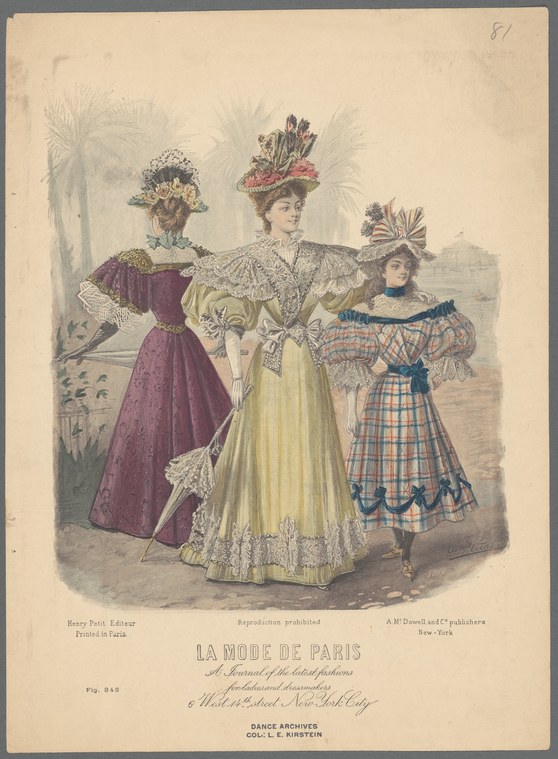
Three elegantly dressed women stand in a fashionable promenade, posed against a backdrop of tall palm trees and a distant Egyptian or Mediterranean arcade. The scene is rendered in hand-colored lithographic style, with careful attention to fabrics and the decorative detail of their costumes. The woman at center wears a striking pale yellow gown with an enormous lace collar and an elaborate feathered headdress; to her left stands a woman in deep burgundy with a smaller feathered hat; to the right, a younger figure in a plaid dress with a navy collar and a straw boater hat trimmed with ribbon. The setting and grouping suggest a public social occasion—a promenade, garden party, or fashionable resort—rather than a formal dance event. The composition treats the three figures as a unified composition showing the variety of silhouettes and ornamentation available to fashionable women of the period.
The dancing
The three women are posed rather than shown in motion; they stand with upright posture and turned-out stance typical of period deportment. The central figure's enormous collar extends far beyond her shoulders, dominating the composition visually. The poses are arranged to display the full length of skirts and the detail of hems and trims. There is no closed hold or partner connection; the figures are independent and self-contained, arranged for visual comparison rather than interaction. The stance and arm position convey fashionable leisure rather than active movement or dance technique.
The dance depicted
This is not a depiction of dance in motion. The image is a fashion plate—a type of commercial illustration used to display and promote current styles of women's dress. While the posture reflects the period's deportment standards and the elegant carriage expected of fashionable women, no specific dance is being performed or illustrated. The figures embody the grace and refinement associated with social dancing of the era, but they are presented as static costume studies rather than as dancers engaged in a specific dance form.
How it was made
This is a hand-colored lithograph, a commercial printing process that allowed for rapid mass production of fashion plates. The technique permitted the delicate rendering of fabrics, lace, and trim, and the hand-coloring added the crucial information of palette and material that buyers needed to understand the garments. The page number and printer's mark ('A.M. Brassai & C° Publishers, New York'; 'Dance Archives') at bottom indicate this came from a published fashion journal or album. Lithography's speed and affordability made fashion plates the primary medium for transmitting style information to a broad American and European audience in the early 20th century.
About this work
This is a fashion plate from an American fashion journal, likely from the early 1900s, showing three women in current fashionable dress posed in a Mediterranean resort setting. Fashion plates belong in a dance archive because they document the silhouettes, postures, and movement vocabularies that shaped how dancers and ballroom competitors dressed and carried their bodies. The exaggerated posture, the prominence of the torso, the treatment of the skirt as a sculptural element, and the emphasis on refined deportment all reflect the era's dance aesthetics. Fashion plates were consumed by dancers, dance instructors, and ballroom patrons as visual guides to elegance and proper carriage. This particular plate, with its three comparative studies in turn-of-the-century silhouettes, offers a snapshot of what fashionable movement looked like at a moment when ballroom dancing was becoming a commercial and social phenomenon.
How to look at it
Study the posture: notice the lifted chest, the turned-out stance, the elongated neck. These are not naturalistic poses; they represent the refined carriage that fashion and dance instruction of the period demanded. Look at how the artist has used the enormous collars and hats to frame the face and lengthen the line of the torso—the visual language of elegance in this era. Compare the three silhouettes: the tight waist, the shelf of the posterior created by the corset, the way the skirts hang. The Mediterranean backdrop signals leisure and luxury; the promenade pose (standing, turning slightly as if for inspection) is the fashion plate's way of saying 'this is how you should look when you are on display.' The careful hand-coloring and the precision of the line work show that this was a luxury object, affordable only to women of means or to professionals—dressmakers and dancers—who needed to stay current.
The artist
The print is credited to 'A.M. Brassai & C°' as publisher in New York and identified as coming from 'Dance Archives.' The artist of the original illustration is not recorded. Brassai's firm was among the major publishers of American fashion plates in the early 20th century, producing colored lithographs for distribution to retailers, dressmakers, and fashion-conscious consumers. The publication by a commercial house suggests this plate was part of a broader circulation of fashion information through periodicals and albums rather than a unique or gallery-intended work.
The period
This plate dates to the Edwardian or Belle Époque era (roughly 1900–1914), a period of expansive silhouettes and unprecedented ornamentation in women's fashion. The enormous feathered hats, oversized lace collars, and S-bend corsetry visible here were concurrent with the rise of ballroom dancing as a commercial entertainment and social pastime in America. The Mediterranean or Egyptian setting reflects the era's fascination with exoticism and travel. Fashion plates of this period often featured resort or promenade scenes because leisure and display were key to how fashion was marketed and consumed. The theatrical quality of the dress—the elaborate trim, the sculptural scale of hats and collars—reflects the influence of theatrical costume and the crossover between stage and street fashion in the early 20th century.
Where it lives
This is a fashion plate from a publication or album held in the Dance Archives collection, likely at the Library of Congress or a similar institution based on the New York publisher's mark. The page number (348) visible at top right indicates it is part of a numbered series or bound volume. Fashion plates circulated as commercial prints, in fashion journals, and in albums; this particular copy's provenance through a dance archive suggests it was recognized and preserved for its documentation of period dance aesthetics.
Questions about this work
Is this a real photograph or a drawing?
This is a hand-colored lithograph, a printing technique that allowed the publisher to produce many identical copies and then hand-tint each one with watercolor or similar pigments. Lithography was the dominant technology for fashion illustration in the early 20th century because it could capture fine detail and color, and it was fast and affordable enough to keep pace with changing fashions. The result looks polished and idealized—more refined than a photograph, and designed to persuade rather than to document.
Why are the hats so enormous?
In the Edwardian era (1900–1914), large, elaborately feathered hats were a key marker of fashionable femininity and wealth. A hat this size required expensive materials (ostrich plumes, silk ribbons, expensive trim) and announced that the wearer had the leisure and means to be fashionable. The hats were also integral to the silhouette created by corsetry and posture; they extended the vertical line and created a sense of balance. For dancers and performers, these hats became part of theatrical costume and an essential part of how elegance was visually read.
What is this dress style called?
This is Edwardian or Belle Époque fashion, characterized by the Gibson Girl silhouette—a tiny waist, a pronounced rear shelf created by the S-bend corset, and an elevated, pigeon-breasted posture. The enormous lace collar on the center figure is called a 'Medici collar' or theatrical collar and was fashionable for evening wear and special occasions. These styles dominated between roughly 1900 and 1914, and they appear frequently in ballroom dance photographs and illustrations of the same period because the same corsetry and posture ideal shaped both fashion and dance movement.
Why is this in a dance archive?
Fashion plates are historical documents of how dancers and performers understood elegance and movement. The postures, silhouettes, and deportment standards visible in fashion plates directly shaped how dancers trained and performed. The exaggerated posture and the architectural quality of the dress created movement constraints and opportunities that are visible in dance photographs and films of the same era. For historians, fashion plates reveal the embodied ideals of refinement and sexuality that dancers of the period worked to achieve.
More dance artwork





