49 works in this view — arrow keys or swipe to move between them.
Dance in Art
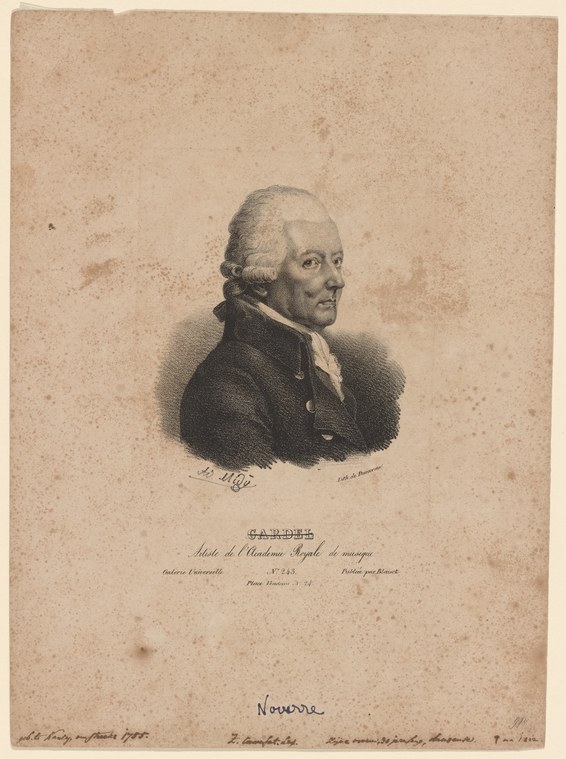
Gardel. Artiste de l'Academie Royale de Musique
Unknown artist
- Collection:
- Prints depicting dance
- Source:
- New York Public Library
- Rights:
- Public domain — free to use, share and adapt.
- Recorded as:
- Public Domain
The Gardels were mythic figures in 18th-century ballet—among the first male dancers to be celebrated as virtuosi and stars in their own right. This portrait engraving is primary evidence of their celebrity and the visual culture of the theatre at the height of the Classical ballet era. Without dance-action images of Gardel himself, such portraits are crucial witnesses to how the profession presented itself and was understood by contemporaries.
What you are looking at
A bust-length portrait of a man in three-quarter view, facing left, rendered in fine linear engraving. The subject wears a dark coat with a white collar or cravat, consistent with late 18th-century formal dress. The figure is depicted from the shoulders up against a plain background, with careful hatching and cross-hatching to model the face and create volume in the clothing. The style and execution suggest this is a formal commemorative print, likely a reproductive engraving made from a painting or drawn original. The inscription below identifies the subject as 'Gardel, Artiste de l'Academie Royale de Musique' (Gardel, Artist of the Royal Academy of Music), with additional French text noting his role and possibly the date or engraver information.
The dancing
The pose is still and formal—the standard presentation for a commemorative portrait print rather than an action image. The head is held upright, the shoulders squared within the frame, the gaze directed into the middle distance. There is no body language suggesting dance movement or physical exertion; this is a formal likeness of the man himself, not a representation of him performing. The restraint of the pose and the formal dress are consistent with 18th-century artistic practice for dignified sitters.
The dance depicted
The inscription names this subject as Gardel, an artist (dancer) of the Académie Royale de Musique in Paris. The Gardels were the most celebrated male dancers of the late 18th century in France—this is almost certainly a portrait of either Jean-Gilles Gardel (1740–1761) or his brother Maximilien Gardel (1741–1787), both of whom achieved renown in the ballet of the French Baroque and Classical period. The image does not depict Gardel dancing; it is a commemorative portrait meant to honour his status as a star performer. The style and dress point to the 1760s–1780s, the height of the Gardels' careers in Paris.
How it was made
This is a reproductive engraving, executed in the linear technique characteristic of 18th-century French portrait prints. Fine parallel lines (hatching and cross-hatching) build tone and volume, particularly in the face and the folds of the coat. The technique allowed precise detail and fine gradation of light, suited to the wide distribution of theatrical portraits in this period. Engraved portraits of celebrated performers were a standard form of theatrical publicity and commemoration, circulated to audiences and collectors as souvenirs of admired artists. The paper, the style of engraving, and the French inscription all point to a Parisian publication, likely in the 1770s or 1780s.
About this work
This is a commemorative portrait engraving of Gardel, a leading dancer of the Académie Royale de Musique in Paris during the late 18th century. The work does not depict dance movement or performance, but rather presents a formal likeness of the celebrated performer as a dignified public figure. Engraved theatrical portraits of this kind were among the primary visual records of ballet stars of the era, particularly for male dancers who rarely appeared in large-scale history paintings or sculpture. The work belongs in a gallery of dance in art as documentary evidence of the celebrity and visual identity of a foundational figure in the history of French ballet, and as an artefact of how dancers were commemorated and circulated to the public in the Ancien Régime.
How to look at it
Examine the engraver's rendering of the face: the fine modelling of the features, the subtle play of light and shadow created entirely through line. Note the formal dress—the dark coat, the white cravat—as markers of professional standing and respectability. This is not a romantic or idealized vision of the dancer, but a sober, dignified presentation befitting a public artist of high rank. The absence of any reference to dance (no tunic, no classical drapery, no dramatic gesture) is itself significant: Gardel is presented as a man of standing in society, not as a fantastical or mythological figure.
The artist
The artist of this engraving is not recorded in the catalogue. The work is typical of the reproductive engraving trade in Paris, where skilled printmakers produced portraits of celebrated performers for circulation among theatre-goers and collectors. Engravers working in this mode were not primarily inventors but skilled technicians tasked with translating paintings or drawings into widely reproducible form. The signature or initials of the engraver may appear on the plate (customarily at lower left or right), but the catalogue record does not preserve it.
The period
This portrait belongs to the age of the Classical ballet and the rise of the male ballet star in France. The Gardels danced at the Académie Royale de Musique (the Paris Opéra) during the reign of Louis XVI, a period when ballet was undergoing fundamental change—the rigid codes of Baroque court dance were giving way to a more natural, expressive style. Male dancers of the Gardels' generation were the first to achieve genuine stardom comparable to that of celebrated actresses and singers. The 1780s saw the publication of many such commemorative portraits as part of a broader culture of theatrical celebrity and fan culture beginning to emerge in Europe.
Where it lives
The work is held in the New York Public Library's collection of prints depicting dance. It is a reproductive engraving, likely a loose print published in Paris in the late 18th century, now part of a broader collection of theatrical and dance-related prints documenting performance culture of the period.
Questions about this work
Who was Gardel?
Gardel (most likely Maximilien or Jean-Gilles Gardel) was a celebrated male dancer of the Académie Royale de Musique in Paris in the late 18th century. The Gardels were among the first male dancers to achieve genuine stardom and were central figures in the development of Classical ballet in France.
Why is this portrait not showing Gardel dancing?
Formal commemorative portraits of performers honoured them as respected public figures, not as characters or in action. This convention reflected the professional status Gardel had achieved—he is presented as a dignitary, not as a stage character.
What is an engraving and why was this medium used?
An engraving is a print made by incising lines into a metal plate with a sharp tool (burin), then inking and pressing the plate onto paper. It allowed fine detail and was ideal for portraiture. Engravings could be produced in large numbers, making them affordable for distribution to theatre audiences.
How does this image document dance history?
It is visual evidence of the celebrity of a legendary dancer and the visual culture of 18th-century French ballet. Without action images of performers like Gardel, such portraits are crucial documents of how dancers were viewed and commemorated in their own time.
More dance artwork





