49 works in this view — arrow keys or swipe to move between them.
Dance in Art
Emma Livry
Unknown artist
- Collection:
- Prints depicting dance
- Source:
- New York Public Library
- Rights:
- Public domain — free to use, share and adapt.
- Recorded as:
- Public Domain
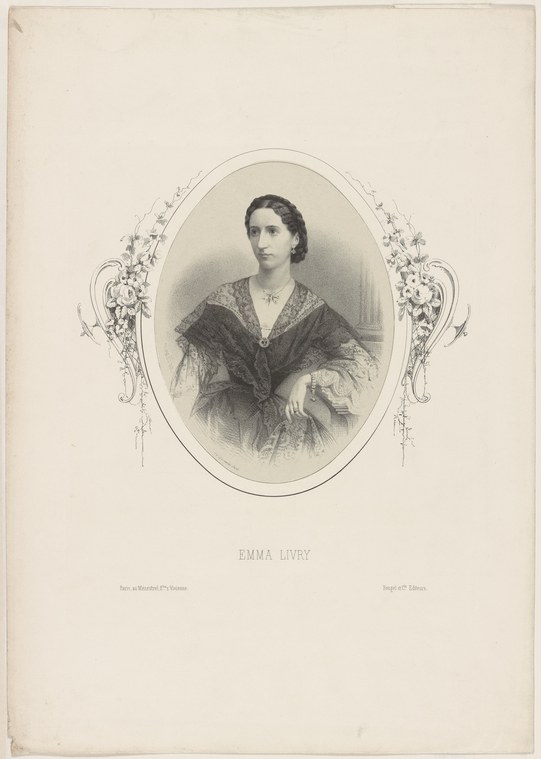
Emma Livry was a principal dancer of the Paris Opéra during the height of the Romantic ballet, known for her technical skill and for her tragic early death in a stage accident in 1863. Portraits like this one are primary historical documents of how dancers of that era were represented to the public—as refined, composed individuals rather than as bodies in motion. The engraving also demonstrates the machinery of theatrical celebrity in the mid-nineteenth century: the technologies and aesthetic conventions through which audiences knew performers.
What you are looking at
A portrait of a woman in mid-nineteenth-century dress, shown from the waist up within an oval frame. She wears a dark, off-shoulder garment with what appears to be a shawl or draped fabric across her shoulders and arms. Her dark hair is styled simply, parted and pulled back. The woman's pose is contemplative and dignified: she gazes slightly away, with her body turned at three-quarter angle and one arm resting across her lap. The oval frame is decorated with elaborate scrollwork and floral motifs in the rococo manner, rendered in fine linear detail. The background is plain, the entire image executed in fine engraving or steel engraving with subtle tonal gradations created through cross-hatching.
The dancing
A single female figure, posed statically rather than in motion. Her weight appears centered and settled; her shoulders are relaxed but held with visible poise. One arm rests in her lap while the other drapes loosely across her body. The pose conveys quiet dignity and composure rather than any dynamic or gestural quality. There is no visible footwork or evidence of movement.
The dance depicted
This is not a representation of dance in motion. Emma Livry (1842–1863) was a celebrated French ballet dancer of the Romantic era, and this is a formal portrait rather than a dance scene. The image documents her as a person rather than capturing her in performance. The work belongs to the iconography of the Romantic ballet star—an object of celebrity and visual documentation—but shows no choreographic content.
How it was made
This is a fine-line engraving or steel engraving, a print medium that allowed for mass reproduction and wide circulation. The technique is evident in the crisp linear handling of the decorative frame, the precise tonal modeling through cross-hatching, and the overall clarity of detail. Such engravings were standard vehicles for theatrical portraiture in the nineteenth century, allowing theaters, publishers, and collectors to disseminate images of celebrated performers. The rococo ornament framing the oval portrait was a conventional aesthetic choice for female performers of the period.
About this work
This is a printed portrait of Emma Livry, a Romantic-era ballet dancer whose career spanned the mid-nineteenth century. The work documents her as a celebrity figure rather than as a dancer in action. It is a fine engraving, a reproductive print that circulated among those who followed theatrical performers. The portrait is formal and composed, showing Livry in contemplative pose with no suggestion of movement or dance. It belongs in a gallery of dance imagery because Livry was a significant figure in ballet history and because such portraits form an important visual archive of the professional dancer as a recognized public figure—the star system of nineteenth-century theater made visible.
How to look at it
This is not a dance image but a social document: look at how Livry is positioned as a subject of display and contemplation. The oval frame and ornamental surround establish distance and formality; this is a woman being presented for admiration, not caught in a fleeting moment. The stillness and controlled bearing were themselves part of the Romantic ideal of the ballerina—refined, controlled, and otherworldly even in stillness. Compare this with action-based prints of the same period to see the convention of the static portrait as a form of celebrity documentation.
The period
This portrait dates to the peak of Romantic ballet in Europe (1830–1860), when dancers like Livry achieved celebrity status and their likenesses were in commercial demand. Engraved and lithographed portraits of theatrical stars were widely published and collected. The rococo ornament of the frame, though the ballet itself was Romantic in aesthetic, reflects the enduring appeal of an older decorative language for portraits of refined subjects. Livry danced in works such as *Sylphide* and *Giselle*, roles that defined the Romantic ballet vocabulary, but this portrait captures her in a mode of repose and formal presentation rather than in the ethereal, otherworldly characters for which she was known.
Where it lives
This print is held in the New York Public Library's collection of prints depicting dance. The inscription at the foot reads 'EMMA LIVRY' with publication information, indicating it was a commercially produced and distributed engraving.
Questions about this work
Was Emma Livry a famous dancer?
Yes. She was a principal dancer of the Paris Opéra during the Romantic ballet era and was celebrated for her technical skill and lightness. She became famous for roles in major ballets of the period, but her career was cut short when she died from injuries sustained in a stage fire in 1863 at age twenty.
Why is this portrait in a dance gallery if it doesn't show dancing?
Because dance history includes the star system and the public identity of dancers, not only the choreography they performed. This engraving is a historical document of how nineteenth-century ballet dancers were presented to audiences and how they were consumed as cultural figures. It is part of the visual archive of dance.
How can you tell this is an engraving and not a painting?
The technique is visible in the precise linear structure, the cross-hatched shading, the fine continuous lines, and the ability to reproduce the image multiple times—all hallmarks of engraving. Paintings cannot be mass-produced in this way. The even tone and delicate detail are also characteristic of steel or fine-line engraving of the period.
More dance artwork





