49 works in this view — arrow keys or swipe to move between them.
Dance in Art
The parable of the prodigal son
Unknown artist
- Collection:
- Prints depicting dance
- Source:
- New York Public Library
- Rights:
- Public domain — free to use, share and adapt.
- Recorded as:
- Public Domain
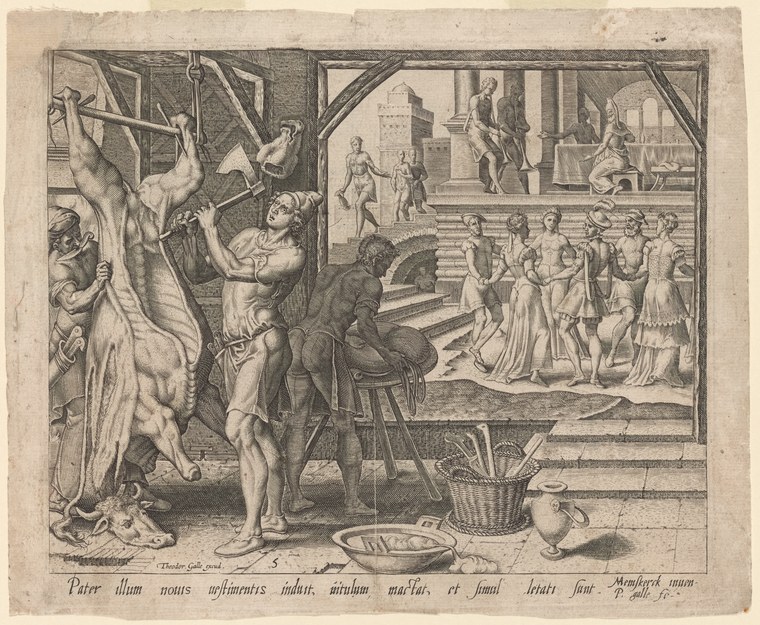
Renaissance prints like this established visual conventions for depicting the body in formal, hierarchical settings that would shape how artists represented court dance. Understanding how the Prodigal Son's undressing and presentation was staged—the passive male body, the orderly female observers, the columned architecture—illuminates the spatial and gestural codes underlying contemporary court spectacles and early ballet.
What you are looking at
A woodcut or engraving depicting a biblical scene arranged in two registers. The lower foreground shows a semi-nude male figure being dressed or undressed by attendants in a rustic interior with woven baskets and pottery. To the left, figures hang from gallows or beams in shadow. The upper register displays an architectural setting with classical columns and a balcony where richly dressed courtiers or nobility stand in formal arrangement, some seated, watching the action below. The spatial division suggests both judgment and ceremony—a narrative of punishment and restoration or reception. The dense cross-hatching and fine line work characteristic of northern European Renaissance printmaking creates strong contrasts between lit and shadowed areas.
The dancing
The central male figure stands with arms raised or extended, passive under the ministrations of attendants who adjust his clothing. His posture suggests submission or transformation rather than active movement. The spectators in the upper register maintain formal, upright stances typical of court presentation—standing or seated in ordered lines, their bodies oriented toward the central scene below. No figures are in motion or dance hold; all gesture is gestural rather than kinetic, communicating social hierarchy and ritual rather than choreography.
The dance depicted
This is not a dance scene. The figures are participating in a narrative tableau—likely illustrating the biblical parable of the Prodigal Son, as the title indicates. The raised arms and undressing of the central figure suggest preparation, reception, or judgment rather than dance movement. The formal arrangement of the courtly observers above follows court ceremony conventions but does not depict social or theatrical dancing. The work documents ritual and hierarchical arrangement in a devotional or moral narrative context.
How it was made
This is an engraving or woodcut, identifiable from the parallel hatching lines, fine detail, and tonal modeling characteristic of sixteenth-century northern European printmaking. The technique allowed for precise narrative detail and complex spatial recession through linear perspective and atmospheric depth achieved through line density. Such prints circulated widely as devotional or moral instruction, accessible to both courtly and mercantile audiences. The print appears to be from a numbered series (a '5' is visible at bottom left), suggesting it was part of a larger sequential narrative.
About this work
This is a biblical narrative engraving illustrating the Parable of the Prodigal Son, likely from a sixteenth-century print series. The composition divides earthly judgment (lower register) from noble or divine witness (upper register), using Renaissance perspective and elaborate cross-hatching to create dramatic spatial and moral contrast. The work belongs in a dance gallery not because it depicts dance, but because it documents the formal, hierarchical body language and spatial arrangement of Renaissance court life—the courtly stance, the ordered positioning of witnesses, and the ritual gesture that governed movement in elite spaces.
How to look at it
Attend to the spatial division: the lower register of action and transformation, the upper register of witness and judgment. Notice how the print uses line density and perspective to establish moral and social hierarchy—the courtiers are literally elevated and enclosed within classical architecture, while the protagonist below is exposed and attended to. The stillness of every figure is itself significant: the body in court life was a site of controlled, meaningful gesture rather than fluid movement.
The artist
The artist is not recorded. The print is part of a numbered series (visible as '5'), suggesting it belongs to a larger devotional cycle. The style is consistent with mid-sixteenth-century northern European engraving, possibly Flemish or German in origin, produced for a mercantile or courtly market.
The period
The sixteenth century saw the emergence of the print as the primary medium for circulating moral and biblical narratives to educated audiences across Europe. Court spectacles and early ballet were developing simultaneously in Italy and France, drawing on similar Renaissance ideals of perspective, hierarchy, and the display of the noble body. The formal arrangement of courtiers witnessing a central figure echoes the spatial logic of court performance—a witnessed, elevated, morally charged human action framed by architecture and social rank.
Where it lives
The work is held by the New York Public Library in its collection of prints depicting dance. The title and attribution are recorded; date and artist remain unknown. It is part of a numbered series, likely a moral or devotional cycle.
Questions about this work
Why is this in a dance collection if there is no dancing?
Dance history includes the formal, gestural body language of court life and ceremony. This print documents how the Renaissance body was positioned, arranged, and displayed in hierarchical settings—conventions that shaped early ballet and court spectacle. The composition teaches us how bodies and space were organized in elite performance contexts.
What is the numbered '5' at the bottom?
The print is numbered as part of a larger series, likely a sequence of biblical or moral scenes. This was standard practice for prints intended as a cycle, allowing collectors to assemble them in narrative order.
Is this a painting or a print?
This is an engraving or woodcut—a print made from an incised or carved plate. The fine parallel lines (hatching) and the even distribution of tone are diagnostic of relief or intaglio printmaking, not painting.
More dance artwork





