49 works in this view — arrow keys or swipe to move between them.
Dance in Art
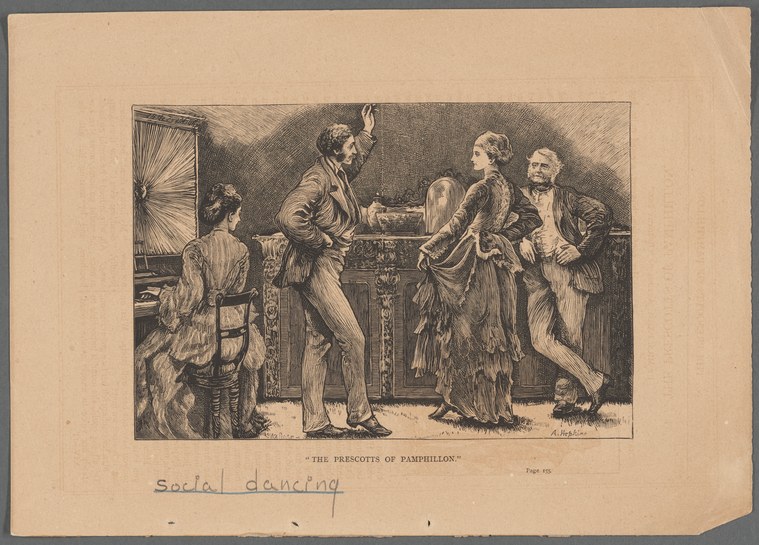
The Prescotts of Pamphillon, page 155
Unknown artist
- Collection:
- Prints depicting dance
- Source:
- New York Public Library
- Rights:
- Public domain — free to use, share and adapt.
- Recorded as:
- Public Domain
This work matters because it documents the social world that produced and contained ballroom dancing in the Gilded Age. Rather than showing technique or movement, it shows us the room, the dress code, the gender roles, and the moment of anticipation or transition—the context without which we cannot understand what ballroom dancing meant to its practitioners. It is a rare image of the social rather than choreographic dimensions of dance history.
What you are looking at
Four elegantly dressed figures are gathered in an interior space lit by a tall window on the left. The composition centers on a moment of social interaction rather than active movement: a standing man in a dark suit gestures upward animatedly while addressing the group, a seated woman in the foreground observes him, and two other figures in light-colored clothing stand to the right, one appearing to respond or attend to his words. The setting appears to be a well-appointed room with classical architectural details. The engraving captures a moment of conversation and social engagement rather than choreographed dance, though the figures' postures and the formal arrangement suggest an upper-class social gathering where dancing may occur. The title references the Prescotts of Pamphillon, indicating this is likely an illustration from a narrative work depicting a scene from their social life.
The dancing
The figures adopt the upright, formal postures of late-nineteenth-century social convention. The standing man's raised arm and animated stance suggest emphatic speech or storytelling rather than dance movement; his body is turned toward the seated woman in classical rhetorical pose. The other figures maintain alert, receptive stances typical of parlor conversation. There is no closed hold, no extension of the frame, no footwork visible—these are bodies in social address rather than in dance.
The dance depicted
This image does not depict active dancing. It shows a social moment in an upper-class interior where dancing might be part of the evening's entertainment, but the figures are engaged in conversation or social interaction. The formal dress, interior setting, and the apparent status of the figures suggest this is from a Gilded Age narrative, and such gatherings would have included dancing (likely waltzes, quadrilles, or other ballroom forms), but the frozen moment here precedes or interrupts rather than captures that dancing. The title's reference to "The Prescotts of Pamphillon" and the page number suggest this is a book illustration documenting a specific scene from a novel or society chronicle.
How it was made
This is an engraving, executed with fine lines and careful cross-hatching to render texture, fabric, and light. The technique allows precise delineation of dress details—the women's fabric textures, the men's formal suits—and the careful rendering of facial expression and gesture. The medium was suited to book illustration and circulation among a reading public, suggesting this appeared as a chapter illustration in a published work. The handling of light from the window demonstrates the engraver's skill in creating atmospheric depth.
About this work
This is a scene illustration from a narrative work, likely a novel or society chronicle of the late nineteenth century, documenting an interior moment among the Prescott family or their social circle. The engraving captures not a dance itself but the social context in which dances took place—the formal drawing room, the hierarchy of attention, the rituals of conversation among the well-dressed upper classes. It belongs in a dance gallery not because dancing is occurring, but because it documents the setting, dress, and social protocols within which Gilded Age ballroom dancing was embedded. The image reveals how dance was framed within broader narratives of courtship, family, and social standing in this period.
How to look at it
Attend to the spatial arrangement: the standing man occupies the narrative center and commands attention through gesture, while the others orient toward him in attitudes of listening. This is the visual language of hierarchy and social attention, not dance. Notice the precision of the engraver in rendering the women's sleeves and drapery—such details were important to contemporary readers as markers of class and fashion. The tall window on the left is the light source and also a compositional anchor that frames the scene as an observed interior moment. The engraver has chosen a moment of speech or revelation rather than action, which is typical of narrative illustration: the image should intrigue us about what is being said or about to happen.
The period
The engraving dates to the late nineteenth century, a period when illustrated novels and serialized fiction were the primary means of entertainment for the literate middle and upper classes. The Gilded Age drawing room was the site of elaborate social choreography: dancing (especially waltzes and quadrilles) was one of many codified interactions through which young people, particularly young women, were displayed, assessed, and paired. Book illustrations such as this one helped readers visualize the manners and settings they read about, and often idealized or dramatized the social scenes they depicted. The formal dress and composed interior shown here reflect aspirational norms of propriety and refinement.
Where it lives
This engraving is part of the NYPL's collection of prints depicting dance. It is identified as page 155 from a work titled "The Prescotts of Pamphillon," but the parent publication, date, author, and artist are not recorded in the catalogue. The object is a book illustration, not an independent artwork.
Questions about this work
Is there actually dancing in this picture?
No. This is a scene of social conversation in a drawing room, not a depiction of dancing. However, it shows the setting and society in which ballroom dancing took place. The formal dress, interior architecture, and social gathering suggest this is the context before, after, or beside the dancing that would have been part of such an evening.
What does the title "The Prescotts of Pamphillon" refer to?
The catalogue record does not identify the source. The title suggests this is a character family from a narrative work—likely a novel or society chronicle—and this engraving is an illustration of a scene from that narrative. Without the parent publication, we cannot determine the author or the fictional or historical basis of the story.
What can I learn about Gilded Age ballroom dancing from this image?
This image documents the social world of ballroom dancing rather than the dancing itself. You can see the formal interior setting, the dress codes (women in light gowns with careful drapery, men in dark suits), the gender dynamics (the man standing and gesturing while others listen), and the moment of social interaction that preceded or framed dancing. It shows us that ballroom dancing was embedded in a larger system of courtship ritual, family display, and class performance.
More dance artwork





