49 works in this view — arrow keys or swipe to move between them.
Dance in Art
National costumes of Yugoslavia
Unknown artist
- Collection:
- Prints depicting dance
- Source:
- New York Public Library
- Rights:
- Public domain — free to use, share and adapt.
- Recorded as:
- Public Domain
Folk dance costumes are primary sources for understanding how communities expressed identity, status, and celebration through dress and movement. This meticulous rendering preserves the specific color, pattern, and construction of Yugoslav folk dress at a moment of national and cultural definition, making it an invaluable reference for historians, choreographers, and costume makers seeking to reconstruct or understand regional dance practice. The image also documents the gendered and ceremonial significance of embroidery and adornment in Balkan culture.
What you are looking at
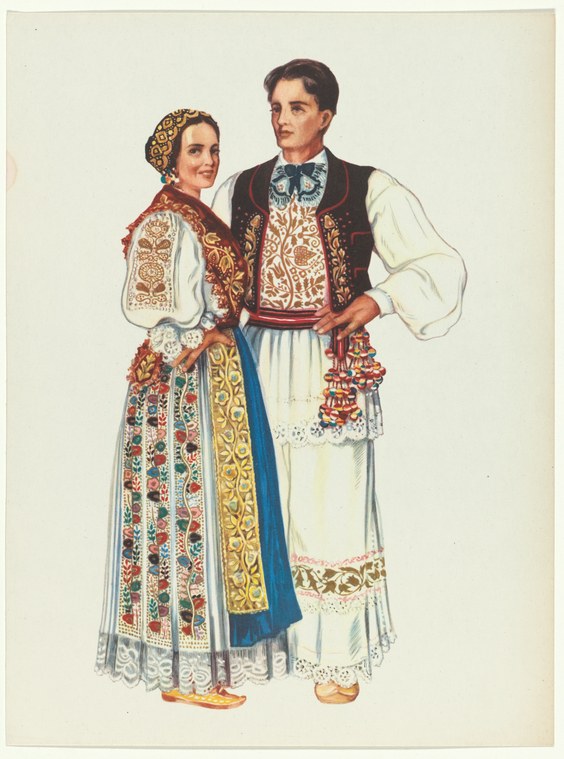
Two figures in traditional Yugoslav folk dress stand against a plain background, presented as a costume study or reference illustration. The woman on the left wears an elaborate embroidered ensemble: a white linen shift with puffed sleeves, a richly patterned apron with geometric and floral motifs in red, gold, and green, a decorative sash, and an ornamental shoulder cape or overgament heavily embroidered in gold thread. Her hair is bound in a decorated net or snood. The man on the right wears a white linen shirt with puffed sleeves, a dark embroidered vest or tunic with gold and white floral patterns, white breeches, and a decorative belt with red tassels or fringing. Both wear ankle-height leather shoes. The costumes are rendered in bright, accurate color with meticulous attention to embroidery patterns and textile construction. The figures stand in a relaxed pose, not dancing, facing slightly toward each other—a presentation stance rather than an action scene.
The dancing
The figures stand at ease in a three-quarter pose, their bodies upright and aligned rather than engaged in active movement. The woman's shoulders are relaxed and open; her arms hang naturally at her sides. The man stands in a similar neutral stance, weight evenly distributed. Neither figure displays the dynamic weight shift, tension, or spatial relationship of dancers in motion. The formal frontality and stillness suggest these are costume documentation figures rather than dancers captured mid-performance.
The dance depicted
While the title identifies these as national costumes of Yugoslavia, the image itself does not depict dance. The figures are static presentation poses typical of ethnographic costume documentation or fashion illustration. However, such costumes would have been worn for traditional Yugoslav folk dances—likely circle dances, line dances, and couple dances from the Balkans such as Kolo (Serbian), Oro (Macedonian), or similar regional forms. The elaborate embroidery, patterning, and construction suggest costumes intended for celebration and ceremonial occasions where folk dance was central, but the image shows the dress, not its use in dance.
How it was made
This is a hand-colored illustration or lithograph, executed with careful attention to costume detail. The line work is clean and precise; the colors are applied flatly and evenly, typical of 19th or early 20th-century lithographic or chromolithographic printing with hand-coloring. The technique allows for accurate documentation of textile patterns and color, suggesting this was created as a reference work or educational material—possibly for costume makers, anthropologists, or collectors of folk dress. The precision and the choice of plain background indicate a scientific or archival purpose rather than fine art.
About this work
This is a costume documentation study depicting the national dress of Yugoslavia (likely early-to-mid 20th century, before the title 'Yugoslavia' was in common use). It presents male and female folk dress with meticulous rendering of embroidery, pattern, and construction. While the figures do not dance, their costumes are inseparable from Yugoslav folk dance tradition—these garments were made to move in circle dances, celebratory events, and regional rituals. The work belongs to a gallery of dance imagery because costume is both archive of dance practice and material evidence of how dancers inhabited and displayed their bodies. Without seeing the dress in motion, we understand something essential about the choreography of celebration and community in Yugoslav culture.
How to look at it
Study the density and placement of embroidery—the woman's apron and cape are covered in geometric repeating patterns and floral motifs that required substantial hand-embroidery work, while the man's vest shows a more restrained but still ornate treatment. Notice the construction of the garments: the puffed sleeves, the way the apron hangs, the fit of the vest. These details tell us about the body underneath—the silhouette, movement, and posture these clothes allowed and encouraged. The stillness of the presentation is deceptive; these garments were engineered for motion in group dances, and their weight, volume, and drape would have created specific visual and kinesthetic effects when worn by dancing bodies.
The period
This work dates to an era when ethnographic collecting and documentation of folk costume was at its height—likely early-to-mid 20th century. The systematic presentation and scientific approach reflect the influence of folklore studies, anthropology, and museum cataloging practices. The publication of such costume studies was common in Europe during this period, serving both scholarly and practical audiences (costume makers, dancers, cultural historians). Yugoslavia as a unified state was established in 1918; costume documentation from this period often served nation-building purposes, using folk dress to assert and visualize a new national identity drawn from regional and ethnic traditions.
Where it lives
Held in the New York Public Library's Prints collection, which catalogs this work under the category 'Prints depicting dance.' The broad cataloging category and sparse record suggest this is one of many costume studies or ethnographic illustrations in the collection, likely part of a larger series or reference set.
Dance in this work
Questions about this work
Is this image of people actually dancing?
No. The figures are posed statically in a presentation stance, not captured in dance movement. However, the costumes themselves are folk dance dress and are documented here for their historical and cultural significance.
What is 'Yugoslavia' and when was this made?
Yugoslavia was a unified state in the Balkans established after World War I and lasting until the 1990s. The title suggests this was created during or shortly after that period, though the exact date is not recorded. The costumes themselves represent regional folk traditions that predate the modern state.
Which Balkan countries or regions are these costumes from?
The record identifies them only as 'Yugoslav,' without specifying the region. The elaborate embroidery and color palette could place them within Serbian, Macedonian, Croatian, or Bosnian traditions, but further research would be needed to identify the specific origin.
What kinds of dances would these costumes have been worn for?
Yugoslav folk dances include Kolo (Serbian circle dance), Oro (Macedonian circle dance), and various couple and line dances performed at celebrations, weddings, and festivals. The formal construction of these costumes suggests they were worn for ceremonies and public celebrations, not everyday dress.
More dance artwork





