49 works in this view — arrow keys or swipe to move between them.
Dance in Art
National costumes of Yugoslavia
Unknown artist
- Collection:
- Prints depicting dance
- Source:
- New York Public Library
- Rights:
- Public domain — free to use, share and adapt.
- Recorded as:
- Public Domain
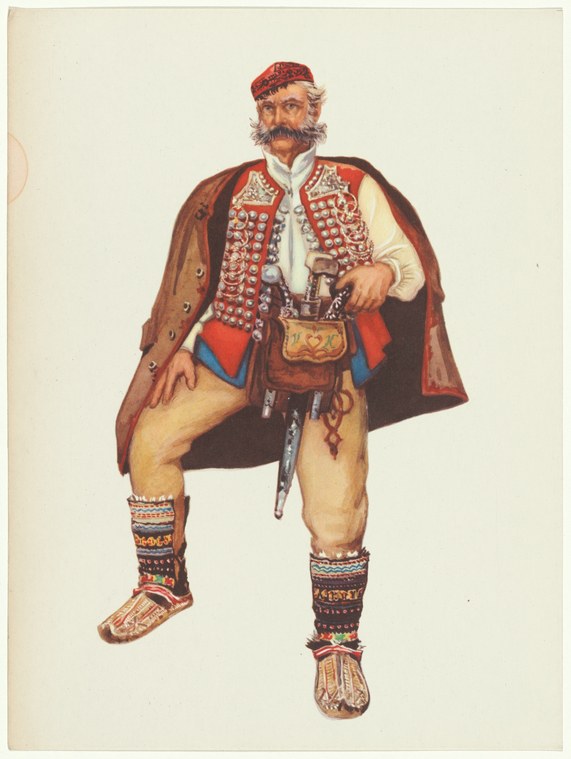
For dance historians and costume practitioners, this image is valuable evidence of how a specific regional male dancer would have been dressed, the weight and volume of the fabrics, the ornamental emphasis, and the silhouette. It shows the embroidered detail that would have caught light and sound during movement. The confidence and formality of the pose reflects the social standing and authority expected of male dancers in Balkan folk tradition.
What you are looking at
A single male figure stands in a confident contrapposto pose against a plain cream background, his weight shifted onto his left leg with the right knee bent and foot advanced. He wears the ornate national costume of a Balkan or South Slavic people: a short embroidered wool jacket with elaborate geometric patterns in white on a dark ground, paired with a voluminous red wool cape lined in darker fabric that drapes from his shoulders. His legs are bare and muscular, encased below the knee in richly decorated white wool leg wrappings (putees or similar binding) with geometric embroidery in earth tones. On his feet he wears embroidered soft shoes. A tall red embroidered cap sits at an angle on his head, and his face is marked by a prominent upturned moustache. At his hip hangs an ornate pouch or money bag decorated with braid and geometric patterns. His right arm rests naturally at his side; his left is bent as if gesturing.
The dancing
The pose is a deliberate theatrical stance rather than a captured moment of motion—the figure confronts the viewer directly with an aristocratic bearing. The stance suggests readiness and strength, with the extended right leg and upright torso communicating confidence and authority. The figure's engagement with the viewer—the direct gaze and assertive posture—is characteristic of ethnographic or national costume illustration rather than dance documentation; it is a presentation of identity and dress rather than movement.
The dance depicted
While the catalogue title identifies this as a national costume, the pose and styling evoke the folk traditions of the Balkans and South Slavic regions, where such dress is associated with celebratory dances and social gathering. The costume itself—the embroidered jacket, cape, wrapped legs, and ornamental cap—appears consistent with Balkan male formal and ceremonial wear. However, the figure is not captured mid-dance; rather, he is posed as a costume study. The stance suggests the proud bearing required in male-dominated Balkan social dances such as line dances or circle dances where men lead, but the image is a costume documentation rather than a dance action study.
How it was made
The work is a hand-colored illustration, likely a chromolithograph or watercolor on paper, executed with attention to the decorative detail of the embroidery and textile patterns. The flat background, precise rendering of costume elements, and even coloration are consistent with early-to-mid 20th-century ethnographic or costume documentation, a period when such illustrations were produced for educational texts, costume encyclopedias, or anthropological publications. The technique allows precise documentation of color, pattern, and construction, making it useful for costume historians and folk dance practitioners.
About this work
This is a costume study from a series documenting the national dress traditions of Yugoslavia, likely produced in the early-to-mid 20th century. The figure represents the formal male costume of a South Slavic people, presented as a standing study rather than as a dance in progress. It belongs in a dance archive because such regional costumes were (and remain) inseparable from the dances performed at celebrations, weddings, and festivals; the garment tells us about the context and formality of the dance traditions it adorned. The work is a document of material culture and regional identity during a period when Yugoslavia was consolidating its national identity, and costume was a primary visual marker of ethnic and regional affiliation.
How to look at it
Attend to the precision of the embroidered detail on the jacket, cap, and leg wrappings—these patterns are not decorative alone but encode regional and ethnic identity. Notice the weight and cut of the cape, which would have moved dramatically during a male-led circle or line dance. The bareleg-and-wrapped-calf silhouette was standard across much of the Balkans and differs markedly from other European folk traditions. The figure's upright stance and direct gaze follow the convention of ethnographic costume studies: the subject presents himself as a representative of a people rather than as an individual performer captured in a moment of dance.
The period
Yugoslavia as a unified nation-state was established in 1918, and the 1920s–1940s saw intense documentation and codification of 'national' folk traditions as a way of consolidating diverse ethnic and regional identities into a single state narrative. Costume illustration became a tool of cultural policy and ethnographic study. This work dates to that era of active collection and presentation of folk materials. Simultaneously, European and American dance and costume historians were systematizing the study of regional dress and its relationship to movement, producing illustrated costume references for performers, choreographers, and educators.
Where it lives
The work is held in the New York Public Library's collection of prints depicting dance, a broad category that includes costume studies, performance photographs, and dance documentation. It is catalogued as part of a series on the national costumes of Yugoslavia, suggesting it is one of a set of similar studies documenting regional variation across the former nation.
Dance in this work
Questions about this work
Is this a real dance or a costume study?
It is a costume study presented as a standing figure rather than a captured dance action. However, the costume itself is genuine regional dress from Balkan folk tradition, worn during social and celebratory dances. The image documents what a male dancer would have worn and how he would have carried himself formally.
What dances would a man in this costume have performed?
Balkan folk traditions include line dances (kolo and its variants), circle dances led by men, and couple dances performed at weddings and celebrations. The strength and formality suggested by the costume indicate the wearer was likely a lead dancer or honored guest. Specific dances varied by region and ethnic group across Yugoslavia.
Why are the legs bare and wrapped?
The wrapped leg (putees or similar bindings) was a practical and aesthetic feature across Balkan and eastern European folk traditions. It provided support during extended dancing, defined the calf, and created a distinctive silhouette. The wrappings were often elaborately embroidered to display wealth and regional affiliation.
When was this made?
The catalogue record does not provide a specific date. However, the style of chromolithography, the ethnographic approach to costume documentation, and the context of Yugoslavia's national consolidation suggest a date between 1920 and 1950. A more precise date would require examination of the original object or the series it belongs to.
More dance artwork





