49 works in this view — arrow keys or swipe to move between them.
Dance in Art
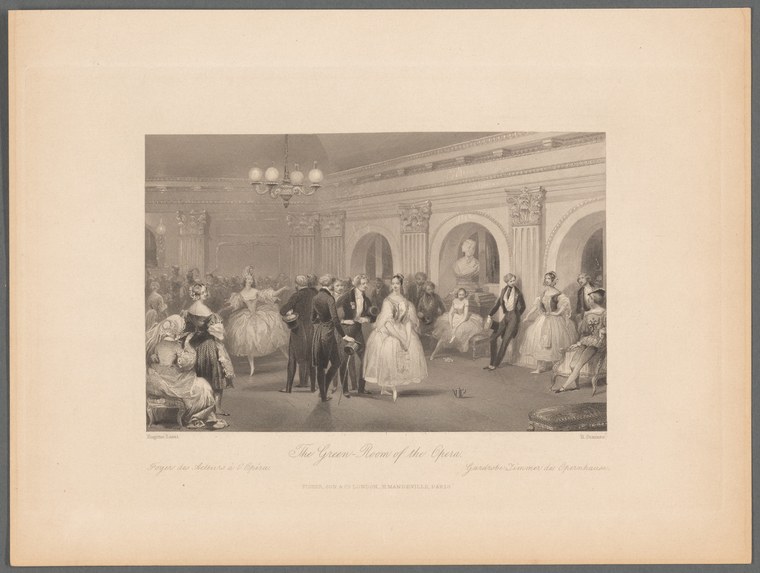
The green-room of the Opera
Unknown artist
- Collection:
- Prints depicting dance
- Source:
- New York Public Library
- Rights:
- Public domain — free to use, share and adapt.
- Recorded as:
- Public Domain
This image documents the non-theatrical aspects of professional dance in the 19th century—the patronage structures, the social hierarchies, and the rituals of courtship and display that enabled and framed dance as a social practice. For historians of dance culture, it reveals that the dancer's world extended far beyond the stage, into the foyer where reputation, access, and romantic possibility were negotiated. For art historians, it captures the operatic society at a moment when dance was central to elite leisure and identity.
What you are looking at
A grand foyer or ballroom scene at an opera house, rendered in mezzotint or similar tonal engraving. The space is defined by a colonnade of tall Corinthian columns receding into depth, with arched openings between them framing distant figures. A chandelier hangs from a coffered ceiling. The floor is crowded with figures in formal 19th-century dress: women in full-skirted gowns with off-shoulder necklines, men in dark tailcoats and trousers. The composition divides into clusters of conversation and social interaction—some figures stand in animated discussion, others form couples, a few are positioned as if arriving or departing. The lighting is even and cool, typical of the medium, with the architecture rendered in precise perspective. The scene captures the pre-performance or intermission social ritual of an aristocratic opera audience, a moment of courtship, networking, and display rather than active dancing.
The dancing
The figures stand predominantly upright in conversational postures, with weight evenly distributed—this is a promenade scene rather than a dance. A few couples position themselves in proximity suggesting flirtation or courtship, but no closed holds or active steps are visible. Arms hang at sides or gesture expressively in conversation. The women's full skirts are rendered with precision, their posture upright and formal. The depth of field and the distribution of figures across the composition suggests the social choreography of salon society rather than the choreography of ballroom dance.
The dance depicted
This is not a depiction of active dance, but rather the social context in which dance occurred—the greenroom or foyer where dancers and opera patrons gathered before or between performances. The title explicitly places this at an opera house, where the balletic spectacle would have been staged in the theatre proper, not here. The image documents the ceremonial and romantic dimensions of opera society: the display of costume, the rituals of introduction and courtship, the hierarchy of access to such exclusive spaces. It is a record of dance culture rather than dance itself.
How it was made
This is a mezzotint or related tonal engraving process, identifiable by the even gray tonality, the precise control of light and shadow without hatching, and the capacity to render architectural recession and atmospheric depth. The medium allows for the subtle gradation of tone across a large composition and the fine detail of costume and physiognomy. Mezzotint was expensive and labour-intensive, reserved for important subjects intended for a cultivated audience. The technique and the subject matter together suggest this was a prestigious publication documenting high society, likely mid-19th century.
About this work
The Green-room of the Opera documents the social life of the opera house—the formal, hierarchical space where dancers, singers, and patrons of rank gathered between performances. It is a print, likely mezzotint, of a scene of pure social spectacle: dress, posture, and proximity performing identity and desire. The work belongs in a dance collection not because dance happens in it, but because it records the world in which professional and social dance were inseparable, where performance continued off the stage and where the body's presentation was as choreographed as any step. It is evidence of how dance was embedded in the total social performance of opera culture.
How to look at it
Attend first to the architectural frame: the colonnade and the deep recession establish the opera house as a space of order and grandeur. Then trace the distribution of figures: note how couples occupy prominent positions in the foreground, how groups form and dissolve, how the eye moves through clusters of social interaction. The precision of the women's dress—the geometry of the skirts, the exposed shoulders—suggests that the body's presentation is itself the subject. Notice finally the lack of action: this is a moment of stasis, of display and conversation, not of movement or dance. The artist has chosen to freeze the social choreography rather than the balletic choreography.
The period
This print dates to the mid-19th century, a period when ballet and opera were at the apex of their cultural authority in European society. The Romantic era had elevated the ballerina to the status of icon, and the opera house had become the primary venue for the display of wealth, taste, and social position. The greenroom—literally the backstage waiting area where performers and their patrons mingled—was a legendary site of romance and intrigue, documented in literature and visual culture. This image participates in that documentation, recording the foyer as a stage where social performance mirrored theatrical performance.
Where it lives
Held in the New York Public Library's collection of prints depicting dance. The work comes from a body of 19th-century prints documenting operatic society and performance culture, likely part of a published series on high society or the opera house.
Questions about this work
Is this a picture of people dancing?
No. This is a scene of the greenroom or foyer of an opera house, where dancers and patrons gathered before or between performances. The figures are shown in conversation and formal social interaction, not in choreographed movement. It documents the social world of dance rather than dance itself.
What is a 'greenroom'?
The greenroom was traditionally the backstage waiting area in a theatre where performers and guests gathered. By the 19th century, the term had expanded to mean any informal reception space in an opera house or theatre. It was a space where professional and social hierarchies intersected, where dancers and singers might encounter patrons and potential suitors.
What does the architecture tell us?
The colonnade and the deep perspective emphasize the opera house as a space of order, grandeur, and regulated access. The architectural precision suggests an elite institution, architecturally designed to facilitate both performance and the social rituals that surrounded it. The columns frame and separate figures, suggesting how social space in such buildings was hierarchically organized.
Why would a print of a non-dance scene belong in a dance collection?
Because dance was not confined to the stage in the 19th century. The social life of dancers—their patronage, their courtship, their social position—was inseparable from their professional practice. This print documents the world that made professional dance possible and explains why dancers mattered to society.
More dance artwork





