49 works in this view — arrow keys or swipe to move between them.
Dance in Art
National costumes of Yugoslavia
Unknown artist
- Collection:
- Prints depicting dance
- Source:
- New York Public Library
- Rights:
- Public domain — free to use, share and adapt.
- Recorded as:
- Public Domain
Dance historians studying folk traditions cannot separate choreography from costume, and this plate preserves the precise visual record of garments that contextualized Balkan women's dance. For costume designers and ethnographic researchers, the level of detail in embroidery, construction, and accessories provides evidence of regional identity, social function, and the material culture of celebration that costume documentation alone can communicate.
What you are looking at
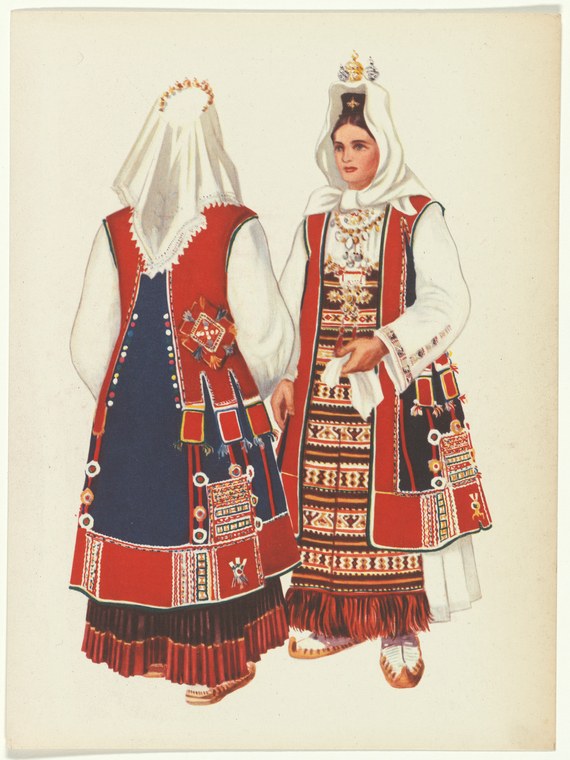
Two figures are depicted in what appears to be a costume reference illustration, each wearing richly decorated traditional dress. Both stand against a plain background, presenting full-length views. The figure on the left wears a red sleeveless bodice over a dark blue skirt with embroidered geometric patterns and a deep red pleated underskirt, paired with a striking white linen headdress with radiating pleats crowned by an ornamental circlet. The figure on the right wears similar construction: a red sleeveless garment with geometric embroidery worn over a long skirt combining patterned sections in browns and reds, with a white headscarf and ornamental headdress. Both figures display embroidered white linen sleeves and decorative chains or beaded elements. The rendering style is consistent with early-to-mid 20th century ethnographic costume documentation, with careful attention to textile patterns, construction details, and ceremonial accessories. The poses are static and presentational rather than kinetic—the figures are positioned to display the garments fully rather than to show movement.
The dancing
Both figures stand in upright, frontal positions with minimal bodily articulation—the stance is formal and display-oriented rather than gestural. The left figure's arms hang naturally; the right figure's arm is positioned across the torso, likely to show the construction and fit of the embroidered sleeve. There is no indication of weight shift, partnering, or dynamic movement. The bodies serve as hangers for the textile arts rather than as agents of dance. The illustrated poses suggest documentation of costume construction rather than capture of choreographed movement or a particular moment of dance execution.
The dance depicted
The catalogue record identifies these as 'National costumes of Yugoslavia,' and the style, construction, and ornamental detail are consistent with festive or ceremonial dress from the Balkans—specifically the characteristic embroidered bodices, geometric patterns, and pleated linen headdresses associated with folk traditions of the region. While the record labels this as 'dance' imagery, the figures are not shown dancing. These are costume reference plates, the type used in ethnographic or theatrical documentation to preserve or communicate the material culture associated with regional dance traditions. Without evidence of movement or kinetic context, the work functions as a textile and costume study rather than a depiction of dance in action. It would have served theatrical, ethnographic, or educational purposes—preserving a visual record of garments worn in folk celebrations.
How it was made
This is a hand-colored print, most likely a chromolithograph or watercolor on lithographic paper, typical of early-20th-century ethnographic or theatrical costume documentation. The rendering is representational and precise, with careful attention to pattern, color, and three-dimensional form of the garments. The technique allowed for accurate color reproduction and distribution of multiple copies, making it suitable for reference use in theatrical costume design or ethnographic archives. The medium implies a systematic project of cultural documentation or theatrical preparation, not a singular artwork for exhibition.
About this work
This is an ethnographic or theatrical costume reference plate depicting two versions of traditional Balkan women's festive dress, likely from Yugoslavia. The work documents the material and ornamental aspects of folk costume rather than choreography or movement. It belongs in a dance archive as evidence of the textile culture and festive contexts in which folk dance traditions were practiced and performed, even though the figures themselves are not shown dancing. The careful rendering of embroidered detail, construction, and accessories reveals the labor and cultural investment embedded in the ceremonial garments that framed regional dance traditions.
How to look at it
Attend to the precision of the embroidered patterns, which would be replicated by hand or machine during costume construction. The two versions may represent variations by region or social context—a careful viewer can read the subtle differences in color placement, pattern emphasis, and accessory choice. The headdresses deserve particular attention: their pleated geometry and ornamental crowns show how much of the costume's visual impact comes from headwear rather than the garment itself. The static presentation allows the viewer to read construction techniques that would be invisible on a moving body.
The period
This plate dates from an era of systematic ethnographic documentation of European folk cultures, likely early-to-mid 20th century. The aesthetic and method align with interwar projects of national cultural preservation and theatrical research into 'authentic' folk costume. Yugoslavia's formation as a nation-state in 1918 prompted renewed interest in documenting regional costume traditions as markers of national or ethnic identity. Simultaneously, theatrical movements including ballet and contemporary dance were turning to folk sources for choreographic material and visual design, making costume reference plates an essential tool for designers working in urban theaters.
Where it lives
The work is held by the New York Public Library in its Prints collection, identified as depicting dance. It is catalogued as a costume reference plate rather than an independent artwork, suggesting it was part of a larger documentary project or thematic series.
Dance in this work
Questions about this work
Why is this catalogued under dance if no one is dancing?
Costume reference plates belong to dance documentation because festive dress cannot be separated from the traditions and contexts in which it is worn and displayed. This plate preserves the visual material culture of a folk dance tradition. Its inclusion signals that dance history includes not only movement and choreography but the material and social contexts in which dance occurs.
How do I know these are Yugoslavian costumes?
The embroidered geometric patterns, the construction of the sleeveless bodice worn over a full skirt, the pleated linen headdresses with ornamental circlets, and the color palette (deep reds, blues, browns with white linen) are characteristic of Balkan folk costume traditions, particularly those documented as Yugoslav in early-20th-century ethnographic and theatrical sources. The catalogue record states this directly.
Could these costumes be used in theater as well as folk dance?
Yes. By the 1920s–1940s, theatrical designers routinely consulted ethnographic costume documentation to create 'authentic' folk-inspired costumes for ballets and modernist theater. A single reference plate could serve both a folk festival context and a theatrical production, making the distinction between ethnographic document and theatrical design intentionally fluid.
More dance artwork





