49 works in this view — arrow keys or swipe to move between them.
Dance in Art
Images of ethnic dancing from illustrated books and series
Unknown artist
- Collection:
- Prints depicting dance
- Source:
- New York Public Library
- Rights:
- Public domain — free to use, share and adapt.
- Recorded as:
- Public Domain
This image is valuable as one of relatively few documentary records of how regional European dances were actually performed in the 18th century—not as spectacle or as interpreted by theatrical performers, but as lived social practice in specific places by ordinary people. The casual, unposed quality of the figures and the choice to embed the dance in its actual architectural and social context offer a window into vernacular culture that formal dance histories often miss. For historians of folk and regional dance, images like this provide crucial evidence of posture, dress, spatial arrangement, and social context that written descriptions cannot convey.
What you are looking at
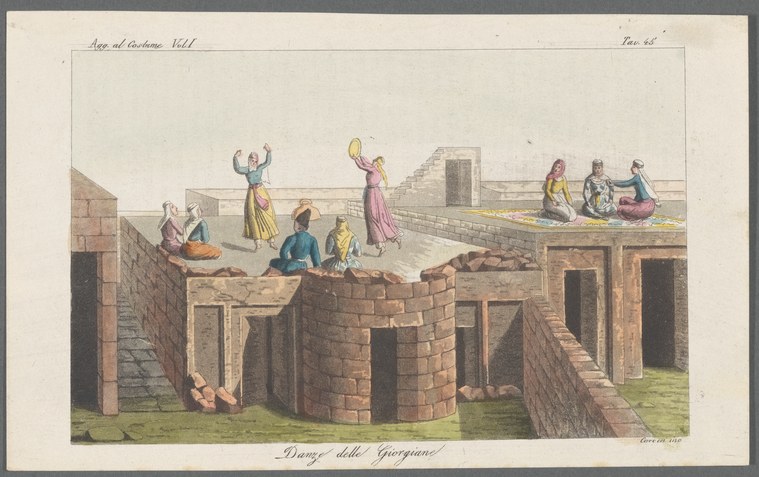
This colored engraving depicts a rooftop or terrace in what appears to be an Italian or Mediterranean setting, with brick fortification walls and casemates visible below. The scene captures a moment of leisure and social dancing among figures in 18th-century dress. On the upper terrace, several women in long skirts and fitted bodices move across the space—one figure with arms raised in a celebratory gesture, others in various attitudes of repose or movement. Men in breeches and coats occupy the foreground and middle ground. The composition emphasizes the depth of the architectural space: casemates recede into shadow at ground level, while the terrace opens to sky above. Light falls across the figures unevenly, creating a sense of afternoon leisure. The title suggests this depicts "Danza della Giorgiana" or a regional Georgian dance, situating it as a record of ethnic or regional dance practice observed in this fortified setting.
The dancing
The figures display relaxed, social postures rather than formal balletic alignment. One woman extends both arms upward in an exuberant gesture; others stand or sit in conversational clusters. The men remain largely stationary, appearing to watch or converse. The women's bodies show freedom of movement—skirts are full and allow for walking and turning—and their positioning suggests spontaneous rather than choreographed action. No pair holds in a closed or open ballroom frame; the grouping is informal and scattered across the terrace.
The dance depicted
The inscription identifies this as a regional or ethnic dance, likely Italian ('Giorgiana' or similar), though the exact style cannot be determined from the image alone. What is clear is that this represents a social or recreational dance rather than a formal court or theatrical form—the setting is public and utilitarian (a military fortification), the dress is period-contemporary rather than costume, and the execution is casual. The presence of both male and female figures in a mixed social setting suggests a participatory folk or regional form rather than a spectacle. The raised arms and apparent joy of one central figure indicate an expressive, celebratory character.
How it was made
This is a hand-colored engraving, identifiable by the fine parallel hatching visible in the fortification walls and the precision of the architectural perspective. The color has been applied by hand to a printed engraved plate, a technique common for travel narratives and ethnographic illustration in the 18th century. The title appears in an italic script below the image, typical of didactic or documentary series. The technique allowed both precise architectural documentation and atmospheric effect—the shadows within the casemates and the modeling of the figures suggest both technical skill and artistic intention beyond mere reportage.
About this work
This is a hand-colored engraving from an 18th-century illustrated book or series documenting regional dance practices, most likely Italian or Southern European. It records a moment of social dancing among people of modest means in a fortified setting—a rare documentary image of vernacular dance in an everyday context rather than a staged performance or aristocratic entertainment. The work sits at the intersection of travel writing, architectural documentation, and ethnographic record-keeping: the fortification is as much the subject as the dance, yet the human figures animate the space and justify its observation. The inscription confirms that the artist sought to name and preserve the specific character of a regional dance tradition.
How to look at it
Attend first to the setting: the fortification and the rooftop terrace are not mere backdrop but essential context for understanding this as a record of a specific place and community. Notice the informality of the figures—no one is posed or performing for the viewer, yet the composition is carefully arranged to show the gathering space and the range of postures. The raised arms of the central female figure, the seated and standing figures, and the way bodies occupy the terrace tell you this is observational rather than theatrical. The precision of the architectural rendering suggests the artist valued accuracy; assume the postures and dress are similarly intended as documentary record rather than artistic invention.
The artist
The artist is not recorded. The style and execution suggest a trained printmaker working in the tradition of 18th-century travel and documentary engraving, likely Italian or German, producing either independent prints or plates for an illustrated book series. The combination of architectural precision and social observation indicates someone accustomed to documenting both built environments and the life within them.
The period
The 18th century saw growing European interest in regional and 'ethnic' cultures as subjects worthy of documentation and illustration. Travel narratives, antiquarian studies, and encyclopedic works increasingly included depictions of folk customs, dress, and dance. This image reflects that broader fascination with the particular and the local at a moment when Enlightenment rationalism was producing systematic taxonomies of human practice. In dance specifically, the period was dominated by courtly and theatrical forms (minuet, ballet, opera seria); vernacular and regional dances were often invisible in high culture. Images like this offered urban, educated audiences a glimpse of dance as it was practiced outside court and theater.
Where it lives
The print comes from the Prints collection at the New York Public Library, held as part of a series of images of ethnic and regional dances from illustrated books. The catalogue record does not specify the source book or series title, the date, or the artist's name, indicating this is a fragment of a larger work whose full context has not been recovered.
Dance in this work
Questions about this work
What dance is this?
The inscription names it as a regional or ethnic dance (likely Italian, possibly 'Giorgiana' or similar), but without additional documentary evidence, the specific style and name cannot be verified from the image alone. The casual, unstructured appearance and the mixed social setting indicate this is a folk or regional social dance rather than a formal ballroom or theatrical form. The raised arms and apparent joy suggest an expressive, celebratory character.
Is this a real dance or an artist's invention?
The precision of the architectural setting, the variety of postures, and the documentary intention of the inscription suggest this is intended as a record of observed practice rather than pure imagination. However, like all visual representations, it is mediated through the artist's eye and hand. The casual, unposed quality argues for reportorial intent, but you cannot assume every detail is historically accurate without independent sources.
Why is this in a fortification?
The setting may be incidental—the fortification simply happens to be where this community gathered and danced—or it may be significant: these may be soldiers, military families, or residents of a fortified town. The rooftop offers a commanding view and open space suitable for dancing. The artist chose to document the dance in its actual place rather than moving it to a studio or theatrical setting, which is rare and valuable for a historian.
More dance artwork





