49 works in this view — arrow keys or swipe to move between them.
Dance in Art
Floral ball, Philadelphia
Unknown artist
- Collection:
- Prints depicting dance
- Source:
- New York Public Library
- Rights:
- Public domain — free to use, share and adapt.
- Recorded as:
- Public Domain
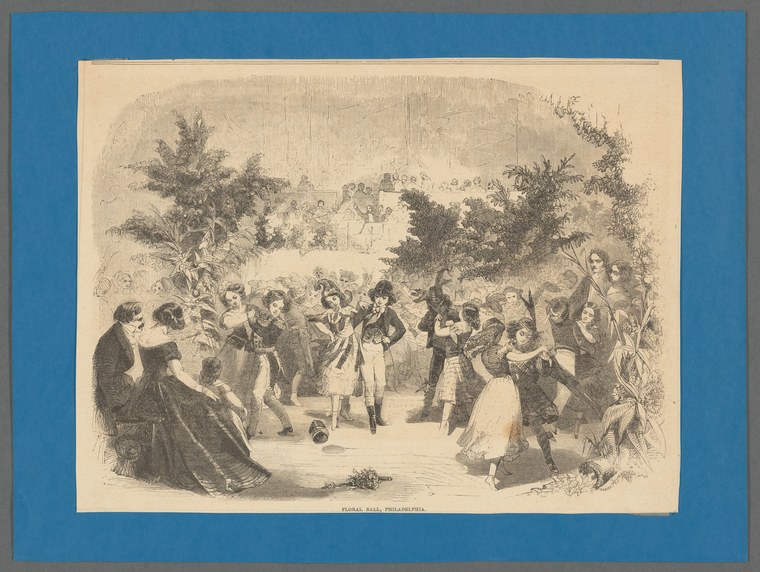
This is one of the few period images that shows ballroom dancing not as a formal or theatrical subject, but as an actual social event in situ—with all the complexity of a real gathering: onlookers, multiple conversations, and dancers at various stages of engagement. The detail of Philadelphia in the title places this in a specific geographic and social context, allowing it to be read alongside historical records of that city's social life. For dance historians and social historians alike, it is evidence of how central dancing was to the leisure culture of the American upper-middle class.
What you are looking at
A garden party or outdoor social gathering, rendered in fine engraving or etching with delicate cross-hatching throughout. The scene is set in a wooded or parkland setting with flowering trees and climbing vines framing the composition. A large crowd of fashionably dressed men and women occupies the central clearing—perhaps thirty to forty figures—arranged in loose clusters and small groups. The figures are animated and in motion: some stand in conversation, others gesture expressively, several appear to be dancing or about to dance. The dress is decidedly nineteenth-century, with the women in full skirts, bonnets, and cloaks, and the men in dark coats and hats. The lighting is soft and atmospheric, created entirely through the density and direction of the engraved lines, suggesting either late afternoon or the quality of gaslight. The composition draws the eye toward a central space where dancing appears to be taking place, though the press of figures and the busy surface make the precise choreography difficult to read.
The dancing
The dancers occupy the central ground but are embedded within the crowd rather than isolated on a stage or cleared floor. Several pairs appear to be in closed position—one couple is notably visible in the lower center, the woman's full skirt swept outward in a turn or pivot. The postures are upright and formal rather than bent or deeply engaged; the arms are extended in ballroom fashion rather than dropped at the sides. The men wear dark tailcoats; the women's bare shoulders and fitted bodices above expansive skirts are characteristic of mid-nineteenth-century ball dress. The overall frame suggests a social ballroom or drawing-room dance rather than a theatrical performance, and the multiple figures in various attitudes of dancing, waiting, or observation suggest a social event where dancing was one activity among many.
The dance depicted
This appears to be a social ballroom scene, most likely a waltz or quadrille given the dress, setting, and era. The title 'Floral Ball, Philadelphia' and the outdoor garden setting suggest a themed social event rather than a formal ball in a purpose-built ballroom—though the dancing itself follows ballroom convention of the mid-nineteenth century. The presence of so many figures, the garden architecture, and the festive atmosphere indicate this was likely a popular social occasion. Without clearer detail of the footwork or a visible orchestra, the precise dance cannot be confirmed, but the hold, posture, and the social context all point toward the standard ballroom dances of the 1850s–1870s.
How it was made
This is a fine engraving or possibly a steel engraving, recognizable from the precision of the line work, the use of parallel hatching to build tone and shadow, and the overall tonal delicacy. The technique allowed for high circulation as a print—this was a reproducible image, not a unique painting—which suggests it was published in a newspaper, magazine, or as a standalone print for a educated middle-class audience interested in social scenes and current events. The fineness of the line work indicates skilled execution and was likely produced by a professional printmaker from a drawing or painting by another artist. The composition and subject matter suggest it was made for a general audience rather than as fine art for a collector.
About this work
A mid-nineteenth-century engraving of a fashionable outdoor social gathering in Philadelphia, with dancing as the central entertainment. The work captures a moment of ballroom culture in its social context—not a theatrical performance or formal court ball, but a community event where music, dance, and social interaction merged. The garden setting, the crowd of onlookers and participants, and the careful rendering of contemporary dress all mark this as a document of actual social practice rather than an idealized or theatrical representation. For dance historians, it offers rare visual evidence of how ballroom dancing was woven into the social fabric of a prosperous American city in the mid-nineteenth century.
How to look at it
Attend first to the central space where the clearest dancers are engaged—particularly the couple in the lower center whose silhouettes are most legible. Notice how the artist has used the density of the crowd to create a sense of social occasion rather than theatrical spectacle: the dancers are not elevated or separated, but part of a mingling social body. Observe the fullness of the women's skirts and how the engraver has rendered the movement of fabric—this tells you about both the dance (the turning and gliding that disturbed such skirts) and the era's fashion. The atmospheric framing with trees and vines creates a sense of an actual place, which was important to contemporary viewers who recognized this as a real event in a real city.
The period
This engraving was made in an era when ballroom dancing was at the height of its social prestige in America and Europe. The 1850s–1870s saw the waltz, polka, and quadrille as the dominant social dances, and public gardens and themed balls were popular settings for displays of fashion and social status. Prints of such scenes were widely circulated in newspapers and periodicals, serving both as reportage of actual events and as models of fashionable behavior. Philadelphia in this period was a wealthy, cosmopolitan city with a strong tradition of formal social events. The image reflects the Victorian ideal of refined leisure and the visibility of women in public social space—though always under the watchful eye of chaperones and the strictures of formal dress and decorum.
Where it lives
The holding collection is described as 'Prints depicting dance,' part of the New York Public Library's collections. This is a print in a broader archive of dance-related imagery, which suggests it was valued as a document of dance practice rather than primarily as fine art or social history.
Dance in this work
Questions about this work
Is this an actual event or an imaginary scene?
The title 'Floral Ball, Philadelphia' suggests this was a specific, named event—possibly an annual or well-known gathering. However, nineteenth-century prints often generalized or stylized such scenes, so it may be a composite or idealized version of such events rather than a direct record of one particular night. The specificity of the place name and the detail of the dress and setting suggest the artist worked from actual observation or report.
What dances would have been performed at such an event?
In the mid-nineteenth century, the primary social dances were the waltz, the polka, and the quadrille. The outdoor garden setting and the apparent informality suggest this may have been less strictly choreographed than a formal ball, but ballroom dances would still have been the main entertainment. The presence of multiple couples in the space suggests either individual pairs waltzing or groups in quadrille formation.
Why were garden balls a significant social form?
Garden balls combined leisure, fashion display, and courtship in a setting that suggested both civility and natural ease. For wealthy urban societies, they represented an ideal of refined pleasure, and they allowed for a larger and more mixed gathering than a formal ballroom. The garden setting also permitted women greater freedom of movement and visibility than an enclosed ballroom, which was important to the era's evolving ideas about women's social participation.
How was this image circulated and seen?
As a steel engraving, this work was reproducible and likely appeared in newspapers, magazines, or as a standalone print. Such images served both as reportage—documenting actual social events that readers might recognize—and as models of fashionable behavior. They were affordable and accessible to a broad middle-class audience, not just to wealthy collectors.
More dance artwork





