49 works in this view — arrow keys or swipe to move between them.
Dance in Art
Images of ethnic dancing from illustrated books and series
Unknown artist
- Collection:
- Prints depicting dance
- Source:
- New York Public Library
- Rights:
- Public domain — free to use, share and adapt.
- Recorded as:
- Public Domain
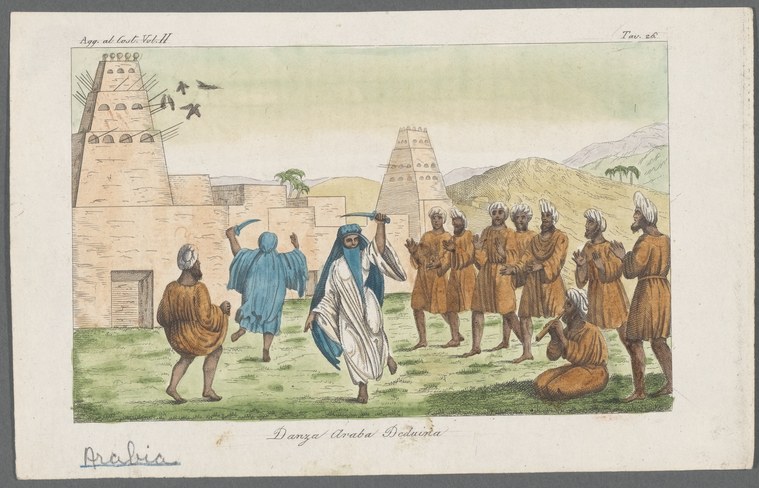
This image is significant because it captures a moment of African communal dance as understood and represented through a European artistic lens in the colonial period. It records body posture, clothing, architectural context, and the participatory nature of group movement in a way that, despite its limitations and biases, provides visual evidence of dance practices outside the European theatrical and ballroom traditions that dominate earlier dance imagery.
What you are looking at
An open-air gathering of figures in an African settlement, centrally featuring dancers in motion. The architecture consists of two massive conical or pyramidal structures with multiple tiers, typical of West African fortified settlements or ceremonial compounds. The background shows rolling hills and sparse vegetation including palm trees. The nearest structure on the left displays small openings in its walls. The ground is bare and light-colored. One central figure wears a long white garment that billows as they move, suggesting rapid motion or a spinning turn. Surrounding this figure are approximately eight to ten others in earth-toned garments—ochre, tan, and brown fabrics that appear to be traditional wrapping styles. Some figures have their arms raised; others stand in watching or waiting postures. The composition suggests active participation by multiple people in a coordinated movement event rather than passive observation.
The dancing
The bodies are upright and mobile rather than in stable positions. The central dancer in white shows a dramatic silhouette with fabric swept outward, consistent with rotational movement or a pivoting turn. The surrounding figures stand with varied arm positions—some raised to shoulder height or above, others at rest. Postures suggest both dancers and observers, with no rigid formal frame or hold visible. The spacing is loose and informal, typical of participatory or ceremonial group movement rather than partnered ballroom dance. Weight appears distributed for standing and stepping movement on level ground.
The dance depicted
This depicts a communal gathering dance within an African settlement, most likely West African based on the architectural style and dress. The central white-garmented figure may be a principal dancer or celebrant, while the earth-toned figures represent community participants. The broad, shallow space and lack of musical instruments visible suggest a secular social or ceremonial gathering rather than a formal performance. The movement appears to be rotational or processional group dancing, a form documented across West African cultures for celebration, rites of passage, and community assembly. The artist has captured a moment of active participation involving multiple bodies in shared rhythmic movement.
How it was made
This is a hand-colored engraving or print, executed in the documentary illustration style common to European travel accounts and ethnographic series of the 18th and 19th centuries. The line work is precise and controlled, defining architectural forms and human figures with clarity. Color has been applied by hand in controlled flat washes—ochres, blues, greens, and flesh tones—typical of the period's commercial print production. This technique allowed affordable wide circulation of images to European audiences curious about non-European peoples and practices, though the images were often filtered through European artistic convention and colonial perspective.
About this work
This is a documentary illustration from a European ethnographic print series depicting an African communal dance in its architectural and social setting. The work records a moment of participatory group movement centered on a figure in distinctive white dress, surrounded by community members in traditional garments. The conical fortified structures and landscape situate the scene geographically, while the composition emphasizes the active involvement of multiple bodies rather than spectacle. As a hand-colored engraving from a commercial series, it represents a specific historical moment in European visual culture—the production and consumption of images of non-European dance and ritual by audiences who had no direct experience of these practices. The work belongs in this collection as documentary evidence of how African dance was visualized and circulated in European print culture.
How to look at it
Attend to the central figure's pose and the way the white fabric suggests movement in a still image—the artist has chosen a moment of spin or rotation rather than a static pose. Notice how the surrounding figures occupy the same space and appear to participate in or witness the movement, not in formal lines or couples. The architectural setting is not background decoration but part of the documentary claim—the fortified structures establish that this is a specific African place with its own building traditions. The lack of European figures or colonial apparatus in the scene is notable and suggests this was meant to document African life as an autonomous cultural practice, however filtered through European artistic convention.
The period
This print belongs to a long tradition of European ethnographic illustration stretching from the 16th century through the 19th. Such images circulated widely through published travel narratives, natural history collections, and illustrated periodicals aimed at middle-class European audiences. They were produced with varying degrees of accuracy and cultural knowledge—some by artists who had traveled to the regions depicted, others compiled from written accounts and earlier illustrations. By the 18th and 19th centuries, such prints served both documentary and entertaining purposes, feeding European curiosity about 'exotic' peoples and cultures while simultaneously reinforcing colonial hierarchies and stereotypes. The style and coloring of this work—its precision, its use of architectural elements to establish geographic difference, its documentary ambition—place it within this established commercial and intellectual tradition.
Where it lives
This work belongs to the New York Public Library collection of prints depicting dance from illustrated books and series. It is one item within a larger body of documentary engravings and hand-colored prints produced for European commercial and educational circulation.
Dance in this work
Questions about this work
Is this a painting or a print?
This is a hand-colored engraving or etching—a print technique that allowed multiple copies to be produced and distributed. The evidence is the precise line work defining forms, the flat application of watercolor or gouache in controlled areas, and the style of reproduction consistent with 18th–19th century European commercial printmaking.
What do the large structures in the background represent?
These are fortified architectural forms typical of West African settlements, particularly the Sahel and coastal regions. The tiered conical or pyramidal shape is seen in structures associated with defense, prestige, or ceremonial function in cultures across the region. Their presence in the composition establishes geographic specificity and suggests the dance is rooted in a particular cultural and architectural context.
How many people are dancing?
The central figure in white appears to be the primary focus of movement, surrounded by approximately eight to ten others in traditional dress. Some are clearly participating or moving with the central dancer; others appear to be present as observers or waiting participants, suggesting a communal or ceremonial practice rather than a performance for an external audience.
Who created this and when?
The catalogue record does not identify the artist or provide a precise date. The style and technique—hand-colored engraving in the documentary ethnographic tradition—place it most likely in the 18th or 19th century, but a closer reading of the print or series would be needed to establish authorship and date with confidence.
More dance artwork





