49 works in this view — arrow keys or swipe to move between them.
Dance in Art
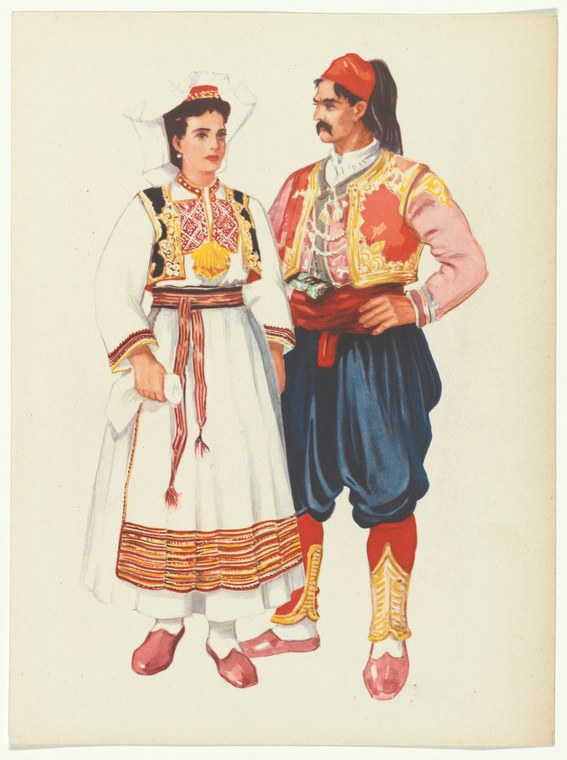
National costumes of Yugoslavia
Unknown artist
- Collection:
- Prints depicting dance
- Source:
- New York Public Library
- Rights:
- Public domain — free to use, share and adapt.
- Recorded as:
- Public Domain
For dance historians and archivists, this image is valuable not for depicting dance itself but for preserving the appearance of the costume context in which Yugoslav folk and regional dances were performed. Understanding what dancers wore is part of understanding the full visual language of a tradition—the silhouette, weight distribution, mobility, and aesthetic of a style. The print also documents the state of regional identity and the practice of ethnographic collection at a particular historical moment.
What you are looking at
Two figures in richly decorated traditional dress stand against a plain ground, posed as though for a formal presentation or documentation of national costume. On the left, a woman wears a white linen dress with red and gold embroidered hems, a black embroidered vest, and a tall white headdress with radiating points; she holds her hands at her sides with a composed stance. On the right, a man wears a red cap, a pink jacket with elaborate gold embroidery and red appliqué panels, blue wool trousers gathered at the calf, and red leather boots with gold trim. Both figures are rendered in clean outline with flat areas of color, characteristic of late 19th or early 20th-century ethnographic illustration. The composition is symmetrical and documentary in intent, presenting the figures as types rather than individuals, with no narrative action or interaction between them.
The dancing
Both figures stand in neutral, upright postures with weight evenly distributed—this is presentation posture, not active dance movement. The woman's arms hang at her sides in a relaxed but formal manner; the man stands with one hand placed near his hip, a posed attitude of repose. There is no closed hold, no frame suggesting partnership, no indication of footwork or weight transfer. The bodies are shown frontally or three-quarter view to display the costume fully rather than to convey movement.
The dance depicted
This image does not depict dance in action. It is a costume study, likely used to document or preserve the appearance of traditional dress associated with a specific Yugoslav region or ethnic group. While traditional dress often appears in folk and regional dance, and the costumes shown here may well have been worn for such purposes, this image captures only static presentation. The formality and symmetry of the composition, the neutral stances, and the complete absence of any suggestion of motion or partnering all indicate this is ethnographic or cultural documentation rather than dance imagery.
How it was made
This is a hand-colored print, likely a chromolithograph or color-separated lithograph, based on the flat areas of color, the clean outlines, and the registration typical of early 20th-century color printing. The technique allowed for mass reproduction of ethnographic materials for educational and documentary purposes, and would have circulated widely among scholars, museums, and the general public interested in European folklore and national culture. The precision of the line work and the careful preservation of detail suggest this was made from an original drawing.
About this work
This is a costume documentation print showing the traditional dress of two figures identified as Yugoslav—likely representing a specific region or ethnic group within the former Yugoslavia. It belongs to a large body of ethnographic and folkloric illustration produced from the late 19th century onward, when European nations and researchers sought to catalog and preserve the visual record of traditional dress before industrialization and modernization erased regional distinctions. While the costumes themselves are associated with folk traditions and regional identity (and thus with the dances of those communities), this particular image functions as visual archive rather than dance representation. It records what was worn, not how it was moved in.
How to look at it
Approach this as a historical document rather than a narrative artwork. Notice the careful attention to texture and embellishment—the geometric patterns of the embroidery, the weight and drape of the fabrics, the specific details of fastenings and ornaments. These details would have been functional and meaningful within the community that wore them. The formal, symmetrical composition and the neutral presentation are deliberate: the image aims to show, without distraction or emotion, exactly what these garments looked like and how they were worn. The absence of any suggestion of motion or relationship between the figures emphasizes that this is specimen documentation, not storytelling.
The period
This print dates to the era of intensive European folkloristic collection, roughly 1890–1920s, when the rise of nationalism, the consolidation of nation-states, and scholarly interest in ethnography and anthropology drove systematic documentation of regional costume and tradition. Yugoslavia as a state was formed only in 1918, but the territories had long distinctive ethnic and regional cultures. Such costume prints were produced for educational use, museum display, scholarly reference, and popular consumption, reflecting both genuine interest in cultural preservation and the period's obsession with cataloging and classifying human difference. The flat, descriptive style of the illustration was standard for scientific and educational publishing of the period.
Where it lives
This print is held in the New York Public Library's prints collection, part of a broader holdings focused on dance imagery. The NYPL's designation of it as dance-related reflects the connection between these costumes and the living traditions of folk and regional dance with which they were associated, even though the image itself is ethnographic documentation rather than dance representation.
Dance in this work
Questions about this work
Is this actually a dance image?
Not in the sense of depicting movement or choreography. It is a static costume documentation—two figures posed to display traditional dress. However, it belongs in a dance archive because the costumes shown were worn during folk and regional dances, and understanding what dancers wore is part of understanding their traditions. This kind of image was often created precisely to preserve the visual record of costume that went with living dance practices.
What region of Yugoslavia is this from?
The catalogue record identifies only 'Yugoslavia' and does not specify a particular region or ethnic group. The style of embroidery, the specific cut and ornament of the garments, and the form of the headdress might allow a specialist in Yugoslav textiles or ethnography to identify the origin more precisely, but that information is not included in the available record.
When was this made?
The date is unknown according to the catalogue record. Based on the style of the print, the ethnographic approach, and the reference to 'Yugoslavia' (which as a state dates to 1918), this was almost certainly made in the early 20th century, probably between 1900 and 1940, but a specific date cannot be determined from the image alone.
Who made this?
The artist is not recorded. This was a commercial educational or reference print, and such works often circulated without clear attribution to the illustrator, who may have been an in-house artist for the publisher or a specialist in ethnographic illustration working in a collaborative studio environment.
More dance artwork





