49 works in this view — arrow keys or swipe to move between them.
Dance in Art
Images of ethnic dancing from illustrated books and series
Unknown artist
- Collection:
- Prints depicting dance
- Source:
- New York Public Library
- Rights:
- Public domain — free to use, share and adapt.
- Recorded as:
- Public Domain
For dancers and historians, this print is evidence that African dance was documented and circulated in European print culture by the 18th century, yet rendered through European artistic conventions that subordinated accuracy to exoticism. It raises critical questions about how dance from non-European cultures has been represented, preserved, and mediated through Western visual media—a problem that persists in contemporary dance historiography.
What you are looking at
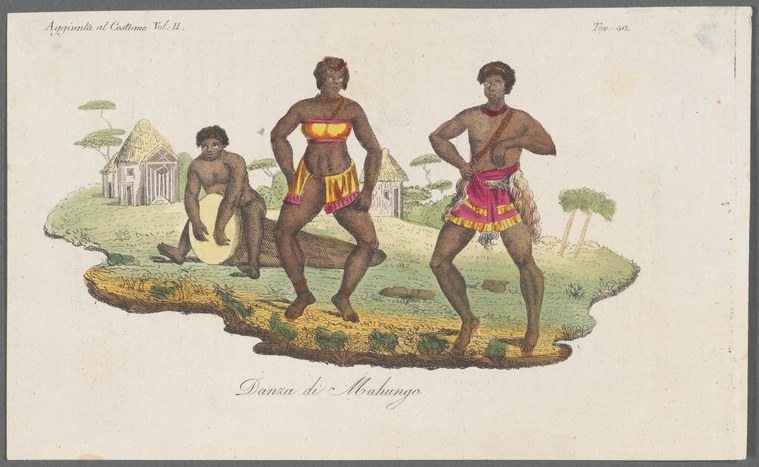
A hand-coloured engraving depicting four figures in a landscape setting, identified by the Italian caption as 'Danza di Abubungo' (Dance of Abubungo). The composition shows figures arranged on uneven ground with a hut structure visible in the background among stylised trees. Two figures wear decorated cloth wrappings around the hips in yellow and red tones; one wears an orange-yellow band across the chest. A fourth, smaller figure crouches or bends at the left. The scene employs the conventions of 18th-century ethnographic illustration: the figures are rendered with brown skin tones, the landscape is schematic, and the framing suggests these are exotic or foreign peoples being documented for a European audience. The light is even and the palette is restrained, typical of hand-coloured prints from this period.
The dancing
Three of the four figures stand upright in postures suggesting active movement or gesture, with arms raised or held away from the body in what appears to be expressive or celebratory positions. The two taller central figures face toward the right of the composition with bent knees and engaged stances. The fourth figure, smaller and positioned at the left, is crouched or in a forward-bending position. None of the figures appear to be in formal ballroom holds or classical ballet positions; instead their bodies suggest vigorous, uninhibited movement typical of participatory social or ceremonial dance.
The dance depicted
This image documents an African dance practice—identified as Abubungo—from the perspective of 18th-century European ethnography. The title and composition suggest this is a record of an actual dance form, though filtered through European artistic convention and the biases of the period. The open postures, raised arms, and varied body positions suggest a dance that emphasises individual expression and celebratory gesture rather than strict codified steps. Without additional historical sources on Abubungo specifically, the image cannot confirm the actual steps, music, or social function of the dance, but it testifies to the documentation and circulation of African dance forms in European print culture of the Enlightenment.
How it was made
This is a hand-coloured engraving, a reproductive printmaking technique that allowed wide circulation at relatively low cost. The engraved line is fine and precise, defining the figures and landscape; the hand-colouring—applied after printing—adds local colour to the cloth, skin, and vegetation. The technique was standard for European ethnographic and travel illustration in the 18th century, allowing the work to reach educated audiences interested in natural history and exotic cultures. The caption in Italian suggests publication in Italy or for an Italian market, though the style is consistent with Northern European illustrated books of the period.
About this work
This is an 18th-century hand-coloured engraving documenting an African dance identified as Abubungo. It belongs to a long tradition of European ethnographic prints that recorded—and thereby framed for European consumption—the cultural practices of colonised and distant peoples. The image shows four figures in active, expressive postures on a stylised landscape, rendered in the conventions of contemporary natural history illustration. As a historical document, it reveals both the actual existence of African dance practices circulating in European knowledge at this period and the aesthetic and colonial assumptions embedded in how those practices were represented and understood.
How to look at it
Attend first to the postures and arm positions: the artist has chosen to freeze the dancers in mid-movement, with bent knees and raised or extended arms that suggest energy and gesture. Notice how the three taller figures occupy different positions in space—not lined up in formation—which suggests the dance was participatory and less rigidly choreographed than European court or ballroom dances. The landscape setting and the hut in the background locate this as an outdoor, communal practice rather than a domestic or theatrical one. The relatively even attention paid to all four figures—despite their scale difference—suggests the artist's effort to document all participants, not to create a theatrical hierarchy of performers and audience.
The period
This engraving dates from an era of intense European expansion and ethnographic illustration. The 18th century saw the publication of lavishly illustrated travel narratives and natural histories—such as those by Linnaeus, Buffon, and later Johann Reinhold Forster—that aimed to classify and document human diversity. Dance, as a marker of cultural identity and social practice, was a standard subject in such works. The hand-coloured engraving was the dominant medium for such documentation, combining the precision of line engraving with selective colour to guide the viewer's attention. By the late 18th century, ethnographic prints were being compiled into bound volumes and series, circulating among educated collectors and institutions.
Where it lives
Held by the New York Public Library as part of a collection of prints depicting dance from illustrated books and series. The work is catalogued as one of a series of ethnographic dance images, though its specific publication context and date remain unrecorded in the current catalogue.
Dance in this work
Questions about this work
Is Abubungo a real dance?
The caption identifies it as such, but this engraving is our only known visual evidence of a dance by that name. The image was created by a European artist working within conventions of ethnographic illustration, so it documents both the existence of an African dance practice and the European interpretation of it. Without corroborating oral histories or other sources, we cannot confirm details of how the dance was actually performed or what it signified to the communities that danced it.
Why are there four dancers but one is so much smaller?
The smaller figure at the left may represent a child participating in the dance, or the artist may have used scale to indicate spatial recession. 18th-century ethnographic prints often included figures of different scales and ages to suggest the communal nature of cultural practices. The variation may also be an artefact of the print's composition rather than a precise record of the actual event.
What can we learn about the dance from the postures?
The open, expressive arm positions and bent-knee stances suggest a dance that valued visible gesture and individual expression over formal steps. The lack of any visible partnership or hold indicates participants moved independently or in coordination without physical contact. The outdoor setting and informal composition suggest this was a social or ceremonial practice rather than a performance for an external audience.
More dance artwork





