49 works in this view — arrow keys or swipe to move between them.
Dance in Art
Images of ethnic dancing from illustrated books and series
Unknown artist
- Collection:
- Prints depicting dance
- Source:
- New York Public Library
- Rights:
- Public domain — free to use, share and adapt.
- Recorded as:
- Public Domain
This is among the earliest European visual documentation of Pacific Islander dance, preserving formation and social structure that oral and movement traditions might not record in the same way. For historians of ethnography and visual culture, it demonstrates how 18th-century scientific engraving made non-European bodies and practices visible and collectible, establishing a template for dance ethnography that would shape the field for centuries.
What you are looking at
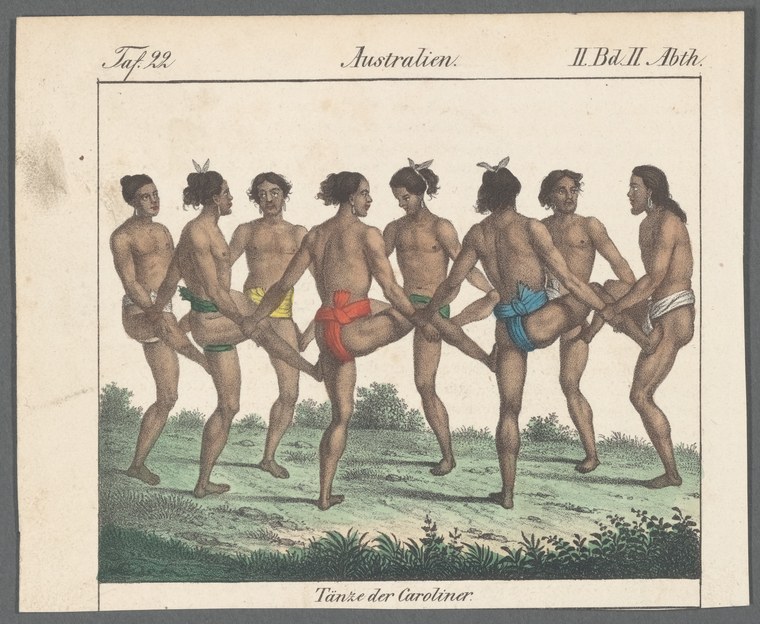
Eight nude or near-nude male figures stand in a circle on a grassy ground, hands linked or clasped together in a closed ring. They wear minimal clothing: some have colored loincloths (red, yellow, blue), others wear white cloth or nothing. All wear distinctive headdresses or have their hair styled upward in peaks or crests. The figures have varying skin tones rendered in brown pigment. The setting is minimal—grass and a few plants at ground level against a plain background—placing emphasis entirely on the dancers' bodies and their geometric formation. The composition is balanced and symmetrical, with each figure occupying equal visual weight around the circle. The style is hand-colored engraving or etching, with fine detail in the musculature and anatomical precision typical of ethnographic illustration. The German title *Tänze der Caroliner* (Dances of the Caroliners) identifies this as a depiction of Pacific Islander dance practice, likely from an 18th-century illustrated travel or natural history series.
The dancing
All eight dancers maintain an upright posture with legs engaged and feet planted firmly on the ground. Their arms are extended and linked with neighbors, creating continuous connection around the circle; the hands appear clasped or grasped at chest to shoulder height. The torsos are held erect and the heads face slightly inward toward the ring. The uniformity of posture across all eight figures suggests a synchronized, coordinated group action rather than individual improvisation. No complex footwork is visible; the focus is on the stable, grounded position and the unity of the linked-hand formation.
The dance depicted
This depicts a circle dance, likely a welcoming or social dance from the Caroline Islands (Micronesia), documented in late 18th-century European travel accounts and ethnographic collections. The linked-hands circle is a primary social formation found across Pacific Island cultures. The stillness and formality suggest either a moment of greeting or preparation within a longer performance sequence. Without additional documentation, the specific style and ritual function cannot be determined with certainty, but the formation and dress are consistent with male group dances documented in early European contact accounts of Micronesian peoples. The emphasis on the circle and symmetry suggests communal identity and collective participation rather than hierarchical or virtuosic display.
How it was made
This is a hand-colored engraving or etching, a reproductive print technique that allowed wide circulation through illustrated books and collections. The fine lines defining anatomy, the parallel hatching in shadows, and the careful registration of the colored washes are characteristic of late 18th-century naturalistic engraving. The technique permitted both precise anatomical documentation and the addition of color by hand, making these prints valuable as both scientific records and marketable curiosities. The presence of a German title and the style of the series imply publication in a German-language ethnographic or travel compendium, likely distributed among educated collectors and naturalists.
About this work
This is a single plate from an illustrated series on global dance practices, probably German, from the late 18th or early 19th century. It documents a male circle dance of the Caroline Islands through the conventions of anatomical engraving: nude or near-nude figures rendered with careful musculature, arranged in their characteristic formation, labeled with the vernacular name of the culture. The work sits at the intersection of travel documentation, natural history illustration, and dance ethnography—a period when European artists and publishers began systematically collecting visual records of non-European performance.
The image is both a historical document and an artifact of colonial visual culture. It represents how Pacific Island practices reached European consciousness and were rendered legible to European audiences through the technical and aesthetic conventions of the time. For dance historians, it provides rare evidence of formation, spacing, and group structure in early-documented Micronesian dance, though the perspective and selection of the European observer inevitably shaped what was shown.
How to look at it
Attend first to the formation itself—the closed circle and linked hands are the essential structure, not the individual body. The engraver has frozen a moment of stillness or preparation, not a moment of vigorous movement; note that all weight appears balanced and central, with no leap, turn, or asymmetry visible. The anatomical precision and the emphasis on musculature reflect a scientific mindset: the body is presented as an object of study, not primarily as a vehicle of expression. The colored loincloths and headdresses signal difference and exoticism to the European viewer, while the anatomical convention claims universal human form beneath.
The artist
The artist is not recorded in the catalogue. The work belongs to a tradition of naturalistic anatomical engraving practiced across northern Europe in the 18th century, often associated with travel accounts and natural history collections. German publishers were particularly active in commissioning and distributing such series, which targeted educated collectors and natural philosophers. The hand-coloring suggests either a high-value commissioned copy or production by a workshop specializing in colored prints for wealthy subscribers.
The period
This engraving dates to an era of intense European exploration and documentation of the Pacific (mid- to late 18th century), when illustrated travel narratives became fashionable among educated Europeans. The Caroline Islands had been visited by European traders and naturalists; their peoples, practices, and bodies became subjects of curiosity and systematic description. In European dance, this period saw the refinement of ballet technique and the rise of dance notation (Beauchamp-Feuillet), while simultaneously non-European dances were being observed, recorded, and circulated as exotic spectacles or scientific curiosities. The juxtaposition reflects the hierarchies of the time: European dance was documented through choreographic notation and professional performance; non-European dance through naturalistic illustration of the body.
Where it lives
The work is held in the New York Public Library's collection of dance-related prints. It is catalogued as part of a broader series on ethnic or global dance imagery from illustrated books and collections, a category that spans centuries and geographies. The German inscription and the style place it within 18th-century ethnographic publishing traditions, likely part of a larger travel narrative or natural history compendium now dispersed across institutional collections.
Dance in this work
Questions about this work
Did Pacific Islanders really dance in circles like this?
Circle formations appear in many Pacific Island dance traditions and are documented in other early sources, making this plausible. However, this image shows the dance through European artistic conventions—it is a record filtered through an engraver's training and assumptions about how to make bodies legible to a European audience. The stillness and formal anatomy may emphasize documentation over the actual energy and speed of the dance as performed.
Why are the men almost naked?
The minimal dress served multiple purposes in European ethnographic illustration: it allowed anatomical precision, aligned with classical ideals of the body, and signified 'otherness' and exoticism to European viewers. Early European observers often interpreted or rendered non-European dress as absence of dress, shaped by their own assumptions about civilization and covering.
Is this a historically accurate record?
It is a historical document, but not photographic. It records what a trained European engraver observed or imagined, using the visual language of his craft. The formation and male group participation likely reflect actual practice; the anatomical precision and the moment of stillness reflect European aesthetic priorities. It is most valuable read alongside other sources—accounts by traders, later photography, and living tradition.
More dance artwork





