49 works in this view — arrow keys or swipe to move between them.
Dance in Art
Images of ethnic dancing from illustrated books and series
Unknown artist
- Collection:
- Prints depicting dance
- Source:
- New York Public Library
- Rights:
- Public domain — free to use, share and adapt.
- Recorded as:
- Public Domain
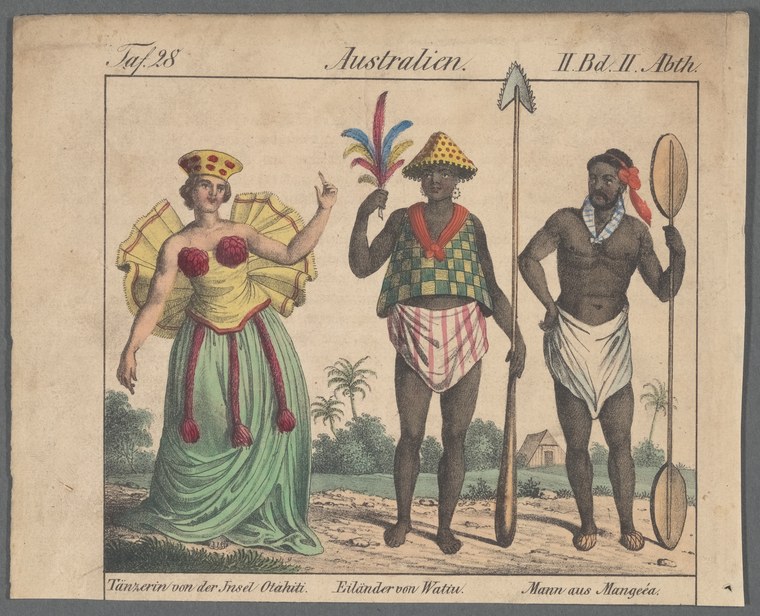
This print is essential to understanding how dance and dancers from non-European cultures were mediated and distorted through European visual convention during the colonial period. It shows the complex relationship between authentic practice and theatrical stereotype: the woman's pose borrows from European court dance vocabulary, while the male figures are stripped of individual movement vocabulary and reduced to costume and weaponry—a common strategy in such prints. For historians and dancers working on questions of cultural appropriation, colonial representation, and the history of exoticization in theatrical dance, this image is a primary document of how 'exotic dance' was invented for European consumption.
What you are looking at
This engraving depicts three figures in an exotic or colonial setting, arranged in a single plane against a sparse landscape with small palm trees and a distant structure. On the left stands a woman in elaborate European court dress: a yellow silk bodice with a deep décolletage covered by a gold fan-shaped ornament, and a voluminous green skirt decorated with pink ribbons or bows. She wears a tall plumed headdress and holds her arms in an expressive, theatrical pose—one raised and bent, the other gesturing outward. The figure in the center wears a patterned vest or tunic in green and yellow checks over a striped hip cloth, with a tall feathered headdress, and holds what appears to be a staff or ceremonial object aloft in one hand while the other is raised. The rightmost figure is depicted with dark skin, minimal upper-body covering, a striped hip cloth, and holds a large oval or shield-like object in one hand and a staff in the other, with a red cloth or feathers around the head. The composition presents these three figures as representatives of distinct and exoticized cultures.
The dancing
Each figure occupies an independent stance with no physical contact or grouping; the bodies are presented frontally or nearly so, displaying costume rather than exploring movement relationship. The woman's raised and curved arms suggest theatrical or stylized gesture rather than functional dance position. The two male figures hold objects (staff, shield-like form) that dominate their compositional weight. None of the figures shows the weight distribution, turnout, or coordinated partnering that characterizes identified dance forms; the poses read as representative or ethnographic display rather than as captured motion.
The dance depicted
The image is labelled as representing dance and dancers—the inscriptions at the base identify these as figures from different regions or peoples—but the poses appear to be stylized ethnographic or theatrical representations rather than documentation of actual dance. The woman's gesture evokes European theatrical or courtly movement conventions of the 17th–18th century, while the poses of the male figures suggest either warrior stances or ceremonial bearing. Without clear evidence of a specific dance vocabulary, this appears to be a didactic or entertainment print designed to display exotic costumes and stereotyped gesture rather than to teach or document a particular dance practice.
How it was made
This is an engraving, hand-colored with watercolor or gouache. The fineness of the line-work and the precision of the parallel hatching are characteristic of 17th- or 18th-century copperplate engraving. The hand-coloring—applied after printing—shows considerable care in the rendering of fabrics and skin tone, though the palette is vibrant and somewhat flattened, typical of popular colored engravings. The technique allowed for wide circulation of these images as affordable prints, making them a significant medium for the dissemination of exoticizing imagery to a European audience.
About this work
This is a hand-colored engraving from a series depicting 'Australian' or exotic dancers and peoples, catalogued in the New York Public Library's collection of prints showing dance. The three figures are presented as representatives of different cultural regions, each identified by label at the base. The work is a product of early-modern European visual culture, when such prints served as both entertainment and pseudoethnographic documentation, circulating images of distant peoples to curious audiences in Europe. The image sits at the intersection of dance imagery, costume study, and colonial-era exoticizing representation—valuable not as accurate documentation of actual dance practices, but as evidence of how European artists and audiences of the period imagined and staged 'otherness' in print form.
How to look at it
Note the stark difference in how the three figures are posed and dressed: the woman's movement vocabulary is drawn from European theatrical convention (raised, curved arms, theatrical stance), while the other two figures are presented as static displays of costume and accoutrements rather than as dancers in motion. Observe the engraver's use of fine parallel lines to create texture and volume, especially in the rendering of the woman's elaborate dress—the technique was well-suited to the reproduction of fabric detail and ornament. The sparse landscape and the figures' isolated, frontally presented stances suggest this is a didactic print meant to display costumes and 'types' rather than a scene of actual dance or social interaction.
The period
This engraving belongs to a long tradition of European prints depicting exotic peoples and costumes, which flourished particularly in the 17th and 18th centuries as European colonial expansion increased contact (and European fascination) with distant regions. Such prints served multiple purposes: they functioned as curiosities for wealthy collectors, as educational material on geography and ethnography, and as inspiration for theatrical costumes and performances. The theatrical stylization of the poses—especially the woman's exaggerated gesture—reflects the influence of court ballet and commedia dell'arte on European artistic convention. The print's label references 'Otaheiti' (Tahiti) and other Pacific locations, suggesting it was part of a larger series created in response to European voyages and the subsequent flood of travel narratives and exotic imagery that fed public appetite for representations of distant lands.
Where it lives
This engraving is held by the New York Public Library in its collection of prints depicting dance from illustrated books and series. It is part of a larger series of hand-colored engravings representing exotic dancers and peoples, likely compiled or produced in the 18th or early 19th century. The print's circulation history—its inclusion in bound volumes or sold as individual colored prints—made it accessible to a broad European audience.
Questions about this work
Are these real dances or stereotypes?
These are stylized, theatrical representations filtered through European artistic convention and colonial fantasy rather than documentation of actual dance practices. The woman's pose draws on European court dance and theatrical gesture; the male figures are presented as static ethnic 'types' with minimal movement vocabulary. The print is valuable as evidence of how Europeans in the 18th century imagined and staged 'exotic' dance, not as an accurate record of how these dances were actually performed in their home cultures.
What were these prints used for?
Such prints served multiple purposes: they were sold as affordable colored engravings to middle- and upper-class collectors interested in exotic curiosities; they circulated as illustrations in travel narratives and geography books; and they inspired theatrical costume designers and performers seeking 'exotic' material. They were both entertainment and a form of pseudoethnographic documentation—selling the fantasy of distant lands to curious European audiences.
Why is the woman dressed so differently from the other figures?
The woman is dressed in exaggerated European court costume (implying wealth, status, and 'civilization' according to European values), while the male figures are depicted with minimal clothing and emphasized ornaments, reflecting the period's hierarchies of racial and cultural representation. This visual distinction was common in such prints: non-European men were often shown as exotic curiosities defined by difference, while women were sometimes posed in a hybrid of European and exotic costume to appeal to European male viewers' fantasies.
More dance artwork





