49 works in this view — arrow keys or swipe to move between them.
Dance in Art
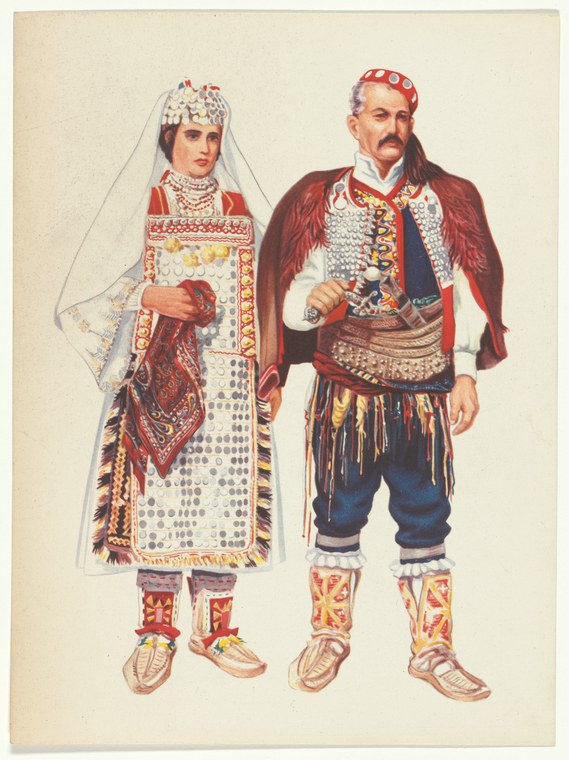
National costumes of Yugoslavia
Unknown artist
- Collection:
- Prints depicting dance
- Source:
- New York Public Library
- Rights:
- Public domain — free to use, share and adapt.
- Recorded as:
- Public Domain
For dance historians and ethnographers, this plate documents the material culture of South Slavic folk dance in the early 20th century, showing the precise construction and embroidery of ceremonial dress worn for traditional dances. The image is evidence of how national identity was visually constructed through folk costume at a moment of political transformation (the formation of Yugoslavia), and how dance traditions were materialized, documented, and canonized through ethnographic publishing.
What you are looking at
Two figures in richly decorated folk costume stand facing the viewer against a plain pale background. The woman on the left wears a long white linen dress embroidered with geometric patterns in red and gold, with a wide decorative belt or apron panel hanging from her waist. Over this she wears a red jacket or sarafan, also patterned. Her headdress is an elaborate kokoshnik—a tall embroidered crown—from which a sheer veil hangs down her back. She holds a patterned cloth or kerchief in her hands. The man on the right wears a deep red or maroon jacket trimmed with fur, decorated with ornamental buttons and braid, over a heavily embroidered shirt with a white collar. His lower body is dressed in dark blue trousers with decorative patterned boots. Both figures wear embroidered shoes with distinctive turned-up toes and geometric designs. His headdress is a red cap with a white dot pattern. The illustration is rendered in the style of early 20th-century ethnographic documentation—precise, flat color, crisp outlines—suggesting this is a reproduction of a historical costume study rather than a scene of active dance.
The dancing
Both figures stand in a formal, frontal pose with minimal dynamic movement. They are positioned side by side, the woman slightly forward and to the left. Their arms hang naturally at their sides; the woman's hands grip a folded cloth or kerchief. There is no physical contact between them, no embrace or closed ballroom hold. The posture is that of a costume display or ethnographic presentation rather than a moment captured mid-dance. The weight appears evenly distributed; both stand upright and still.
The dance depicted
The title "National costumes of Yugoslavia" and the formal presentation suggest this is ethnographic documentation of folk dress rather than a depiction of active dance. However, the elaborate embroidered costumes—particularly the woman's kokoshnik headdress and the man's patterned boots and jacket—are characteristic of South Slavic folk dress worn for ceremonial occasions and traditional dances. The style and decoration of both costumes, especially the geometric embroidery patterns and the formal jacket styling, are consistent with early 20th-century ethnographic records of Serbian, Croatian, or Bosnian folk costume. The image documents the material culture associated with folk dance traditions but does not show dancing itself.
How it was made
This is a chromolithograph or hand-colored lithograph, a printing technique that allowed mass reproduction of ethnographic and costume studies in the early 20th century. The precision of the line work, the flatness of the color, and the regular registration of hues are characteristic of lithographic production. The technique was ideal for educational and documentary purposes—costume plates for museums, ethnographic publications, and fashion reference works circulated widely in this medium. The clean, almost clinical rendering suggests this was printed for a serious documentary purpose rather than artistic display.
About this work
This is an ethnographic costume plate documenting the folk dress of South Slavic peoples (identified as Yugoslav, the political designation used 1918–1992). It presents two figures in full traditional costume, each element precisely rendered: embroidered jackets, decorative boots, and the woman's ornate kokoshnik headdress. The work belongs to a long tradition of European ethnographic documentation that flourished from the 19th century onward, particularly as nationalist movements sought to preserve and codify the material culture of emerging nation-states. Such plates were produced for museums, scholarly publications, and fashion archives, serving both preservation and educational functions. While the figures do not dance, their costumes are inseparable from the folk dance traditions of the region—the dress is the context in which these dances were performed.
How to look at it
Approach this as a documentary record rather than a narrative scene. The stillness of the figures is intentional—a costume plate is designed to display every element of dress clearly: the embroidery patterns, the construction of the headdress, the decoration of the boots, the layering of garments. Pay attention to the geometric embroidery: it is not ornamental but carries meaning, often indicating region, community, or status. Note the woman's kokoshnik, which is too tall and formal to be a casual garment—it marks ceremonial occasion. The man's fur-trimmed jacket and patterned boots signal wealth or formal dress. This is dress for occasions—festivals, weddings, dances—not everyday wear.
The period
This plate was made during or shortly after the formation of the Kingdom of Serbs, Croats and Slovenes (1918), later renamed Yugoslavia (1929). The early 20th century saw a surge in ethnographic documentation of folk culture across Europe, driven by nationalist movements seeking to define and preserve the cultural identity of newly independent or aspiring nations. South Slavic folk costume and dance became symbols of national heritage and were systematically documented, illustrated, and disseminated through educational publications. Lithographic costume plates were a standard medium for this work, allowing detailed color reproduction and wide distribution to schools, museums, and scholarly institutions. The precise, museum-quality rendering reflects the seriousness with which folk culture was being codified and standardized.
Where it lives
The plate is held by the New York Public Library in its collection of prints depicting dance. It is a printed reproduction, not a unique artwork, and likely one of many copies distributed for educational use in the early 20th century.
Dance in this work
Questions about this work
Is this a picture of people dancing?
No. This is a costume documentation plate showing two figures in formal traditional dress, standing still in a frontal pose as if for a museum or reference display. However, these are the clothes in which people danced. The costumes shown here—particularly the woman's kokoshnik and embroidered dress, and the man's decorated jacket and boots—are folk ceremonial dress worn for traditional dances, weddings, and festivals in South Slavic communities.
What is the kokoshnik?
The tall embroidered crown worn by the woman is a kokoshnik, a formal headdress traditional to many Slavic cultures. It was worn for important occasions—weddings, dances, religious ceremonies—and the style, height, and embroidery patterns varied by region and community. The sheer veil attached to it could be drawn across the face or left to flow down the back. It was a marker of married status, formal occasion, and cultural identity.
What do the embroidery patterns mean?
The geometric patterns embroidered on the dress, jacket, and boots were not purely decorative. Different patterns, colors, and layouts indicated region of origin, sometimes community, and occasionally marital or social status. By the early 20th century, ethnographers were systematically documenting these patterns as markers of national and regional folk identity. The precise rendering in this plate makes it a reference record for costume historians.
Why does the title say Yugoslavia if this looks like earlier folk dress?
The Kingdom of Yugoslavia was formed in 1918, and the name reflects when this plate was published or cataloged. The costume traditions themselves are much older and are shared across South Slavic peoples (Serbs, Croats, Slovenes, Bosnians). The political term "Yugoslavia" was used retrospectively to describe the ethnic and regional folk cultures being unified under the new nation-state.
More dance artwork





