49 works in this view — arrow keys or swipe to move between them.
Dance in Art
Images of ethnic dancing from illustrated books and series
Unknown artist
- Collection:
- Prints depicting dance
- Source:
- New York Public Library
- Rights:
- Public domain — free to use, share and adapt.
- Recorded as:
- Public Domain
This work documents the moment when non-Western dance traditions first entered European visual culture at scale, through illustrated publications. It reveals both authentic details of Asian ceremonial dress and movement and the interpretive lens—romanticizing, distancing, and costumizing—through which European audiences encountered these traditions. Understanding how Asian dance was visually mediated in the 19th century is essential to decolonizing dance history and recognizing the power of images to shape (and distort) global understanding of performance.
What you are looking at
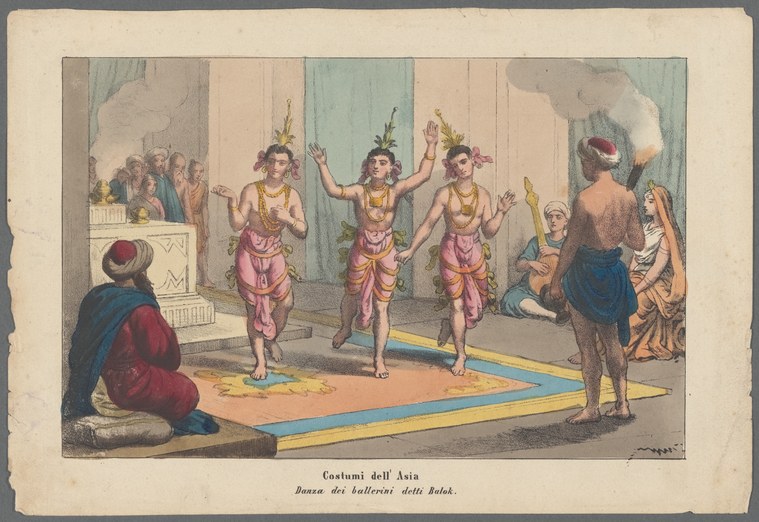
A hand-colored engraving depicts a dance performance in what appears to be an Asian palace or temple interior, with architectural elements including draped fabrics and columned passages visible in the background. Three young male dancers occupy the center of the composition, posed dynamically with raised arms and bent knees in a moment of energetic motion. They wear coordinating costumes of pink/coral silk with gold ornamental details—fitted jackets or chest pieces and short skirts or loincloths—and headdresses that suggest ceremonial or ritual significance. At left, a figure in deep red and blue robes sits cross-legged watching the performance; at right, several other spectators stand or sit, including a figure in tan robes and another partially visible. The floor is marked with colored bands (blue and yellow striping) that define the performance space, emphasizing the formal, designated nature of the event. Incense or ceremonial smoke rises from an altar or brazier visible at the far left, reinforcing the sacred or court context.
The dancing
The three central dancers move in near-unison, their bodies weightless and buoyant: knees deeply bent, torsos upright and energized, arms raised to shoulder height or higher with hands open and gesturing outward in an attitude of exuberance or invocation. Their posture is springy and momentary, suggesting rapid elevation and fall rather than sustained positions. The sideline figures remain still and composed, their stillness contrasting sharply with the dancers' explosive energy. No partner holds or connections are evident; each dancer occupies independent space while moving synchronously.
The dance depicted
This appears to document a Southeast or East Asian court or temple dance, most likely from the Balinese or Indonesian tradition given the costume details, the ceremonial setting with incense, and the dynamic, buoyant movement quality. The synchronized male group movement, the ritual context, and the ornamental headdresses are consistent with sacred or court dances of the region—possibly a form related to Legong, Baris, or another classical Javanese or Balinese genre. The engraving's title, 'Costumi dell'Asia' (Costumes of Asia) and caption reference to 'Banca dei balleroci della Batab' (possibly 'dancers of the Batab' or a similar regional authority), suggests this is documentary imagery from a 19th-century ethnographic or travel publication intended to illustrate non-European dance practices to a European audience.
How it was made
This is a hand-colored engraving or lithograph, identifiable by the fine linear hatching visible in the shaded areas, the crisp outlines, and the applied watercolor or hand-applied pigment (notable in the pink costumes, blue and yellow floor bands, and red robe of the seated figure). The technique allowed for mass reproduction and wide circulation through illustrated books and periodicals in the 19th century, making this a common format for ethnographic and travel imagery. The coloring was likely applied by a workshop team after the base print was struck, which was standard practice for such publications.
About this work
This is a 19th-century European engraving documenting Asian court or temple dance, part of a series on global costume and customs. The image shows three young male dancers in synchronized motion within a ceremonial interior, wearing ornate silks and headdresses and observed by seated and standing spectators. The work belongs to the tradition of ethnographic visual reportage that accompanied European colonial expansion and the growth of comparative anthropology; it was intended to familiarize European audiences with non-Western performance practices and to fix those practices within a framework of 'exotic costume' and 'foreign manners.' For historians of Asian dance, it provides evidence of how these traditions were perceived and represented in the 19th century; for dancers and choreographers, it offers a snapshot of a historical moment of cross-cultural visual encounter.
How to look at it
Attend to the precise moment frozen here: the dancers are caught mid-leap or mid-gesture, bodies weightless and open, rather than at a moment of stillness or closure. This choice of the explosive, energetic instant rather than a composed pose tells us something about how the artist (and the European audience) understood this dance—as wild, vital, ecstatic, uncontrolled—a reading shaped by colonial ideology rather than by the dancers' own understanding of their practice. Also note the careful rendering of the ornamental details of the costume: the headdresses, the gold trim, the silk sheen. These specifics suggest the artist or source had some direct observation, even if the overall compositional frame and interpretive lens were European.
The period
The 19th century saw an explosion of illustrated ethnographic and travel publications, driven by colonial expansion and the rise of comparative anthropology. Works like this—often unsigned and produced in workshop batches—circulated widely through periodicals, bound series, and educational materials aimed at middle-class European readers. The artistic conventions of the period favored picturesque, staged compositions that presented 'exotic' subjects as simultaneously authentic and theatrical, designed to satisfy curiosity about distant lands while confirming European assumptions about cultural hierarchy. Dance, as a visible and spectacular practice, was a favored subject for such imagery.
Where it lives
The work is held in the New York Public Library's collection of prints depicting dance, part of a broader holding of dance imagery. The Italian caption and the style of the series suggest this was part of a 19th-century European publication, likely Italian or translated into Italian, aimed at circulating knowledge of global costume and custom.
Dance in this work
Questions about this work
Where did this dance come from?
Based on the costume, headdresses, architectural setting, and the caption's reference to 'Batab' (a regional leader), this is most likely a Balinese, Javanese, or broader Southeast Asian court or temple dance. The artist's direct source is not recorded. The work documents how this tradition appeared to (and was presented to) 19th-century European audiences, not necessarily how it was understood or practiced in Asia itself.
Is this historically accurate?
The engraving contains genuine details of costume, architecture, and group movement that suggest observation or consultation of reliable sources. However, the overall composition, the choice to emphasize spectacle and 'exotic' costume over the interior logic of the dance form, and the framing of the dancers as objects of European curiosity all reflect 19th-century European perspectives and biases. It is a document of how European artists saw and represented Asian dance, as much as it is a document of Asian dance itself.
What can we learn from this image about the dance itself?
The synchronized movement, the buoyant and energized posture, the ritual context suggested by the incense and formal setting, and the male-only grouping all suggest a form with ceremonial or court significance, likely featuring rapid elevation, open body positions, and group cohesion. However, to understand the actual structure, meaning, and technique of the dance, we would need to consult Asian sources, oral tradition, and living practice rather than relying solely on this European visual interpretation.
More dance artwork





