49 works in this view — arrow keys or swipe to move between them.
Dance in Art
Images of ethnic dancing from illustrated books and series
Unknown artist
- Collection:
- Prints depicting dance
- Source:
- New York Public Library
- Rights:
- Public domain — free to use, share and adapt.
- Recorded as:
- Public Domain
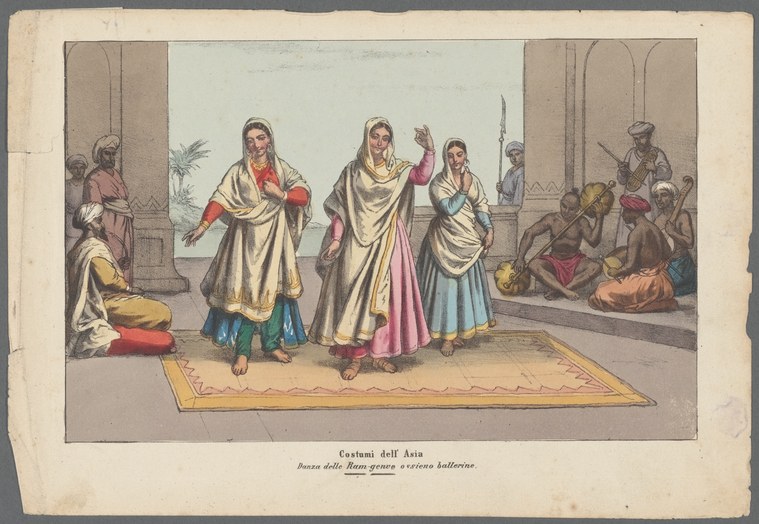
This image documents how European audiences encountered non-European dance in the pre-photographic era, and reveals the print culture that shaped colonial-era ethnographic knowledge. For dance historians, it is evidence of what European viewers believed Asian dance to be—formalized, gestural, performed in courts for audiences—and what details they chose to emphasize or omit. The work shows the moment when European interest in documenting dance extended beyond ballet and vernacular European forms to include the wider world.
What you are looking at
A hand-colored engraving depicting women in South Asian dress performing or dancing in an architectural setting. Three figures stand prominently in the center foreground on a raised yellow platform or stage, wearing draped white and cream garments with colored accents—pink, blue, and red—and head coverings. Their poses suggest active movement: the leftmost figure gestures with one arm extended, while the central and rightmost figures raise their arms in various attitudes. The setting is an open hall or courtyard with columns and arched alcoves; additional figures sit or recline on the right and left periphery, some appearing to play instruments or observe. The floor is rendered in perspective, and the light is even and flat, characteristic of hand-colored prints. The title cartouche at bottom reads "Costumi dell'Asia / Danza della Raum guerrz o rienza balleraree," indicating this depicts Asian dance customs.
The dancing
Three primary dancers occupy the center, their bodies held upright in what appears to be a standing or processional stance rather than a closed partnered hold. Their arm positions vary: raised, extended, or positioned at mid-body, suggesting sequential movement or a vocabulary of gestures rather than ballroom frame. The standing posture is formal and dignified. No pointe work or acrobatic elements are visible. The peripheral figures—some seated, some standing—appear to be musicians or observers rather than dancers, establishing a performer-audience distinction typical of court or courtly performance.
The dance depicted
This appears to depict a South or Southeast Asian court or ceremonial dance form, most likely from the 18th century based on the print style and the title's reference to "Asia." The formal standing positions, the raised-arm gestures, and the architectural setting (a palatial hall with columns and arches) suggest a courtly or sacred dance tradition rather than social dance. The presence of musicians and an audience indicates this is a formal performance rather than participatory dance. The specific form cannot be identified with certainty from the gesture vocabulary alone, but the composition—with its emphasis on individual gestures and formal bearing—is consistent with classical Asian dance traditions that use arm and hand positions to convey narrative or ritual meaning.
How it was made
This is a hand-colored engraving, a reproductive print technique widely used in the 18th and 19th centuries to circulate images of distant lands and customs to European audiences. The clean outlines and flat color application are characteristic of prints hand-tinted after printing. The technique allowed for wide distribution and relatively affordable production, indicating this was part of a series or book aimed at a general educated audience interested in ethnographic imagery. The formal composition and the cartouche in Italian suggest publication in Italy or for an Italian-speaking market, though such prints circulated across Europe.
About this work
This engraving is one of a series of prints depicting the dress and dance customs of Asia, intended for European audiences in the 18th or 19th century. It shows three women in formal dress performing or dancing in a palatial interior, accompanied by musicians and observers. The work belongs to a long tradition of European prints documenting—and often exoticizing—the cultures of Asia, a tradition that shaped European understanding of dance outside the ballet and court-dance traditions familiar at home. The image records both the appearance of a non-European dance form and the European way of seeing it: as a spectacle, formalized and removed, to be observed and catalogued.
How to look at it
Pay attention to the formal, upright posture of the three central figures and the vocabulary of arm and hand positions rather than footwork or spatial patterns. The raised and extended arms are clearly deliberate gestures, not incidental to movement. The composition places the dancers at a distance and slightly elevated—they are shown being observed, not inviting participation. The seated musicians and observers frame the dance as a courtly spectacle. Notice too what is absent: no European dress, no interior space that might suggest comparison to European court dance, no indication of narrative or character beyond the formal performance of gesture.
The artist
The artist is not recorded. The engraving is one of a series on Asian customs, and was likely produced by a professional print workshop in Italy or another European center in the 18th or early 19th century. Such ethnographic series were often compiled from travel accounts, earlier prints, and imagination, rather than from direct observation. The hand-coloring suggests work by a secondary hand, a common division of labor in print production of this period.
The period
The 18th and 19th centuries saw an explosion of European illustrated books and print series depicting the customs, dress, and manners of distant lands. This was the age of travel narratives, colonial expansion, and the emergence of anthropology as a field of inquiry. In dance specifically, European ballet was consolidating its classical vocabulary and increasingly defining itself against "exotic" or "primitive" dance forms—a process visible in how this image frames Asian dance as formal, courtly, and visually exotic rather than embodying movement principles European ballet recognized as dance. The print tradition both reflected and reinforced this hierarchical view.
Where it lives
This print belongs to the New York Public Library's collection of dance imagery from illustrated books and series. It is part of a broader collection documenting the visual representation of dance across cultures and periods, particularly the European print tradition that shaped how non-European dances were circulated and understood.
Dance in this work
Questions about this work
What dance form is this showing?
The title refers to it as an Asian dance custom, but the specific form cannot be identified with certainty from the image alone. The formal posture, gestures, and courtly setting suggest a classical Asian dance tradition, but without more information about the source of the print or the compiler's references, we cannot say whether this depicts Kathakali, a Southeast Asian court dance, or a European artist's interpretation of an account of Asian performance.
Who made this print?
The artist's name is not recorded. It is one of a series on Asian customs, likely produced by a European print workshop in the 18th or 19th century. Such ethnographic prints were often collaborative works, with different hands responsible for the engraving and the hand-coloring.
Why are there musicians and observers?
The presence of musicians and an audience identifies this as a formal courtly or sacred performance rather than social dance. It reflects both the reality of how such dances were performed and the European convention of showing "exotic" dances as spectacles to be observed and catalogued from a distance.
How did Europeans see Asian dance?
Through prints like this one. Before photography, the image Europeans had of dance in distant places came from travel narratives, collected prints, and the imagination of engravers. This print exemplifies the formalized, exotic, courtly presentation that dominated European visual culture about non-European dance, shaping colonial-era ideas about what dance from other cultures looked like and meant.
More dance artwork





