49 works in this view — arrow keys or swipe to move between them.
Dance in Art
National costumes of Yugoslavia
Unknown artist
- Collection:
- Prints depicting dance
- Source:
- New York Public Library
- Rights:
- Public domain — free to use, share and adapt.
- Recorded as:
- Public Domain
This work documents the formal dress of Balkan communities during a period of significant political change in the region, and may provide evidence of textile traditions and ceremonial regalia. For dance historians, such costume prints are useful references for understanding what dancers wore, though this particular image does not show dancing.
What you are looking at
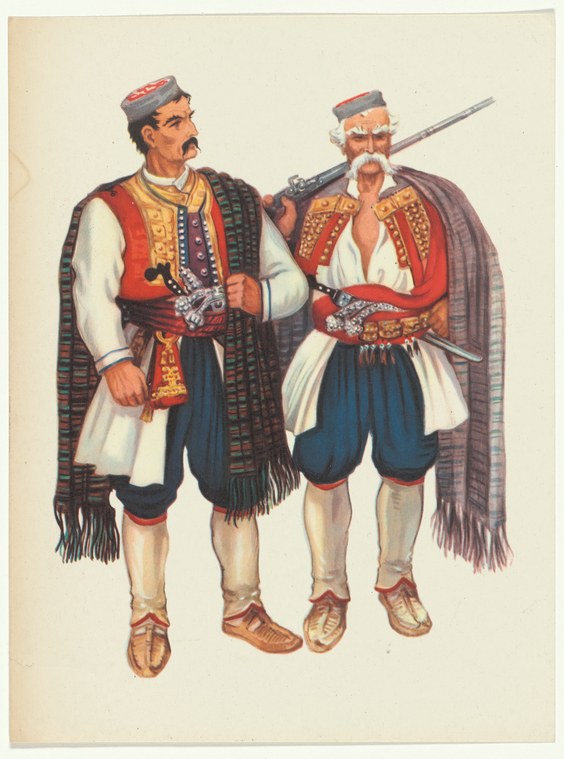
Two male figures stand facing the viewer in a shallow, neutral space, wearing richly embroidered military or ceremonial dress. Both men have prominent mustaches and wear ornate red and gold embroidered vests or jackets over white linen shirts, with blue breeches cut to the knee. Each wears a striped cape or cloak draped from the shoulders, decorated with gold embroidery and deep fringe. The figure on the left holds no weapon; the one on the right carries a long rifle or musket over his shoulder. Both wear small red caps or fezzes and decorated leather footwear. The palette is warm and saturated—reds, golds, blues, and earth tones—with the figures rendered in careful detail against the cream ground. The style and costume suggest this is ethnographic illustration rather than narrative scene, presenting dress as documentation.
The dancing
Both figures stand upright in formal parade stance, weight evenly distributed, arms at rest or casually positioned. There is no interaction between them, no hold or frame, no suggestion of movement through space. They are presented as statues of themselves—a display of costume and regalia rather than a capture of motion. The posture is stiff and heraldic, suited to costume documentation rather than the fluidity expected in dance imagery.
The dance depicted
This image does not depict dance in the sense of movement, performance, or choreography. The two figures are standing still in formal dress, presented as costume documentation. While folk and ceremonial dress is sometimes associated with cultural dance traditions, nothing in this image—no gesture, posture, spatial relationship, or moment of action—suggests the actual performance of dance. The figures could be soldiers, guards, or ceremonial officials. The title claims these are national costumes of Yugoslavia, which implies ethnographic documentation rather than dance capture.
How it was made
This is a hand-colored chromolithograph or color print, typical of late 19th or early 20th century ethnographic costume illustration. The technique allowed for clear detail in the embroidered patterns and the precise rendering of textile and metalwork. The colors appear to be printed separations, hand-finished with watercolor or gouache in places. This method was standard for popular ethnographic and military costume documentation, suggesting a wide circulation among publishers specializing in folk dress, military uniforms, or travel literature.
About this work
This is an ethnographic costume illustration, not a dance scene. It documents two figures in ceremonial or military dress associated with Yugoslav (Balkan) tradition, presented in the heraldic, documentary style of late 19th or early 20th century costume prints. The work belongs in a historical visual record of folk dress rather than in a gallery of dance imagery, though such costumes would have been worn during folk celebrations and ceremonial events. The image is of historical and cultural interest but does not capture dance itself—no bodies in motion, no performance, no choreographic relationship between the figures.
How to look at it
Observe the precision of the embroidery patterns rendered in the jacket and vest—these details carried cultural and sometimes regional or family significance. Note the weapons and decorative elements (the rifle, the fringed cape) as markers of status or military affiliation. The formal, frontal presentation and static posture are typical of costume documentation rather than performance art; the figures are specimens, not actors.
The artist
The artist is not recorded. The style and format are consistent with late 19th century commercial lithographic studios specializing in ethnographic and military costume illustration, possibly German or Austrian, which served a growing market for illustrated costume encyclopedias and travel literature.
The period
The image dates to an era when European publishers produced extensive illustrated surveys of 'national' and 'folk' costumes across the Austro-Hungarian and Ottoman empires. These prints were part of a broader 19th century project of categorizing and displaying non-Western cultures through their material dress. Such illustrations often accompanied travel narratives or ethnographic compilations and were often inaccurate or romanticized. The Balkans were of particular interest to Western European audiences during the 1880s–1920s, especially as Ottoman control weakened and new nation-states formed.
Where it lives
Held in the New York Public Library's prints collection categorized under 'Prints depicting dance,' though the cataloguing appears to be based on subject matter (ethnic costume) rather than content. The image is part of a category that conflates traditional dress with dance culture.
Questions about this work
Is this actually a dance scene?
No. The two figures stand motionless in formal dress, facing the viewer. There is no movement, interaction, or choreographic relationship between them. This is ethnographic costume documentation, not a representation of dance performance.
Why is it in a dance collection?
The image was likely catalogued under 'dance' because it depicts traditional or folk dress associated with Yugoslav culture, and folk dress is often related to folk dance traditions. However, the work itself does not depict dancing.
What region does this costume represent?
The title specifies Yugoslavia, but the image does not indicate which region or ethnic group. The style of dress—the embroidery patterns, the cut of the breeches, the fez-like cap—suggests a Balkan tradition, possibly Serbian, Montenegrin, or Albanian, but without more information, regional attribution cannot be certain.
More dance artwork





