49 works in this view — arrow keys or swipe to move between them.
Dance in Art
Images of ethnic dancing from illustrated books and series
Unknown artist
- Collection:
- Prints depicting dance
- Source:
- New York Public Library
- Rights:
- Public domain — free to use, share and adapt.
- Recorded as:
- Public Domain
This image is a key example of 19th-century European orientalism in dance imagery, showing how non-Western movement vocabularies were interpreted, simplified, and often eroticized for popular consumption. It documents the visual conventions by which European audiences understood and categorized non-European dance, and it raises important questions about ethnographic accuracy, representation, and the relationship between colonial expansion and cultural documentation.
What you are looking at
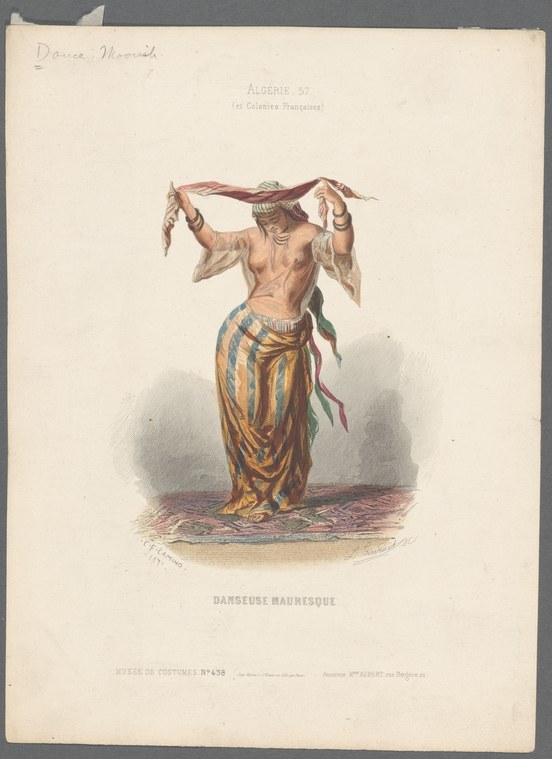
A single female figure stands alone against a neutral background, viewed from behind and slightly to the side. She wears a richly patterned skirt or lower garment in gold, orange, and blue geometric stripes, draped and gathered at the hips with flowing fabric. Her upper body is bare or covered only minimally, with her arms raised and extended outward to shoulder height or slightly higher, holding what appears to be a long piece of red or burgundy fabric—a scarf, veil, or decorative cloth—that extends above and behind her head. The fabric catches light and creates a sense of movement and drama. The figure's posture suggests a moment of controlled extension rather than vigorous motion, with the body held upright and composed. The rendering uses soft shading to model the flesh tones and create volume in the draped fabrics, and the background is left plain to focus attention entirely on the figure and costume.
The dancing
A single standing dancer, weight evenly distributed, with both arms lifted and extended laterally at approximately shoulder height. The upper back and shoulders are visible and engaged. The arms are straight or slightly curved, and the hands grip or manipulate the long red fabric, suggesting active control of a prop or costume element. There is no visible footwork or lower-leg articulation; the focus is on the torso, shoulders, and the relationship between the body and the fabric being held aloft. The overall frame is symmetrical and frontal despite the three-quarter view, emphasizing display and presentation.
The dance depicted
This appears to depict a form of North African or Middle Eastern dance, most likely a Mauresque or Moorish-influenced dance as suggested by the French title "Danseuse Mauresque" (Moorish Dancer). The costume—the striped lower garment and the prominent manipulation of a large red fabric—is consistent with late 19th-century European representations of Maghrebi or Ottoman dance traditions. The pose suggests a moment of costume display rather than dynamic footwork, which aligns with how such dances were often depicted in European popular imagery of the period. The specific dance form cannot be definitively identified from pose alone, but the emphasis on fabric manipulation and the semi-draped upper body suggest influence from broader Mediterranean and North African movement vocabularies accessible to European audiences of the time.
How it was made
This is a hand-coloured engraving or lithograph, as evidenced by the fine linear work defining the figure and fabric, the subtle tonal gradations created by shading techniques, and the applied watercolour or gouache. The catalogue notes this comes from "Musée du Costumes No. 438," suggesting it was part of a published series documenting ethnic or historical dress and dance. The technique of hand-colouring allowed for precise rendering of both structure and decoration while maintaining the reproducibility of the printed line, making this work suitable for widespread circulation in illustrated books, encyclopedias, or costume reference materials aimed at educated middle-class audiences.
About this work
This is a hand-coloured engraving from a 19th-century costume and dance documentation series, depicting a female dancer in Moorish or North African dress. The figure is rendered in three-quarter view, her arms raised to manipulate a long red fabric, wearing a distinctly patterned striped skirt. The work belongs to a European tradition of representing non-Western dance and costume, often appearing in illustrated encyclopedias, costume books, and albums intended to record or exoticize global dance practices for metropolitan audiences. It is both a document of how European artists imagined North African dance and a record of how such dances were actually performed or adapted in European entertainment contexts of the era.
How to look at it
Observe the precise balance between the standing figure and the manipulated fabric—the artist has chosen a moment of stasis rather than motion, suggesting presentation or display rather than kinetic dance. Note the careful attention to costume detail (the striped skirt, the draping, the colour choices) relative to the minimal indication of footwork or leg position. The raised arms and extended fabric create a vertical emphasis that dominates the composition, directing attention to upper-body control and the dramatic potential of the costume element rather than to dance technique per se.
The artist
Unknown. The work is catalogued as part of a costume and dance series ("Musée du Costumes"), suggesting it was created by a commercial engraving workshop or fashion illustrator working in the mid-to-late 19th century. Such series were typically produced by multiple hands and sold to the educational and decorative markets rather than attributed to individual artists.
The period
This image dates to the period of heightened European interest in non-Western cultures, coinciding with imperial expansion and the popularity of ethnographic exhibitions, world's fairs, and orientalist painting. Dance documentation in the 19th century often conflated costume, ethnicity, and exoticism; depictions of North African or Middle Eastern dance frequently appeared in fashion plates, encyclopedias, and theatrical publicity. The emphasis on fabric and pose over dynamic movement reflects both the limits of static visual media and the preference in European entertainment for spectacle and display over technical mastery.
Where it lives
This work is held as part of the New York Public Library's print collection and is catalogued as a hand-coloured engraving from "Musée du Costumes No. 438," a 19th-century series documenting ethnic and historical costume and dance. The series appears to have been a commercial product sold as loose plates or bound volumes for reference and decorative purposes.
Dance in this work
Questions about this work
Is this a real dance or a European invention?
Almost certainly a hybrid. North African and Middle Eastern dances do involve fabric manipulation and distinctive costume, but this image is filtered through European artistic conventions and the orientalist imagination. The pose and presentation style reflect what European audiences of the time expected to see, rather than a direct documentation of actual performance practice. The work is best understood as evidence of how Europeans saw, imagined, and marketed non-Western dance, not as an ethnographic record.
Why is the dancer shown from behind?
The three-quarter rear view allows the artist to display both the back of the costume and the upper body and arms in profile. This angle emphasizes the fabric draping and the posture of the raised arms, creating a sense of statuesque presentation that was typical of 19th-century fashion and costume illustration. It also creates a sense of the viewer observing a spectacle rather than meeting the gaze of the performer.
What does the red fabric represent?
It may represent a veil, a decorative scarf, or a costume accessory specific to the dance tradition. In European representations of North African and Middle Eastern dance, fabric manipulation was often highlighted as an exotic or erotic element. Without additional context, we cannot say whether this fabric's prominence reflects actual performance practice or European artistic preference.
More dance artwork





