49 works in this view — arrow keys or swipe to move between them.
Dance in Art
Images of ethnic dancing from illustrated books and series
Unknown artist
- Collection:
- Prints depicting dance
- Source:
- New York Public Library
- Rights:
- Public domain — free to use, share and adapt.
- Recorded as:
- Public Domain
This work is primary evidence for how nineteenth-century Europeans imagined and encountered Middle Eastern dance, and for how dance imagery circulated in popular education before photography became dominant. It documents the specific instruments and approximate movement vocabularies of Persian dance traditions at a moment when such traditions were largely unknown outside the region. The work also demonstrates how Western artists translated observed or remembered movement into the static medium of engraving, making visible the choices about which moments, poses, and relationships they deemed important enough to preserve.
What you are looking at
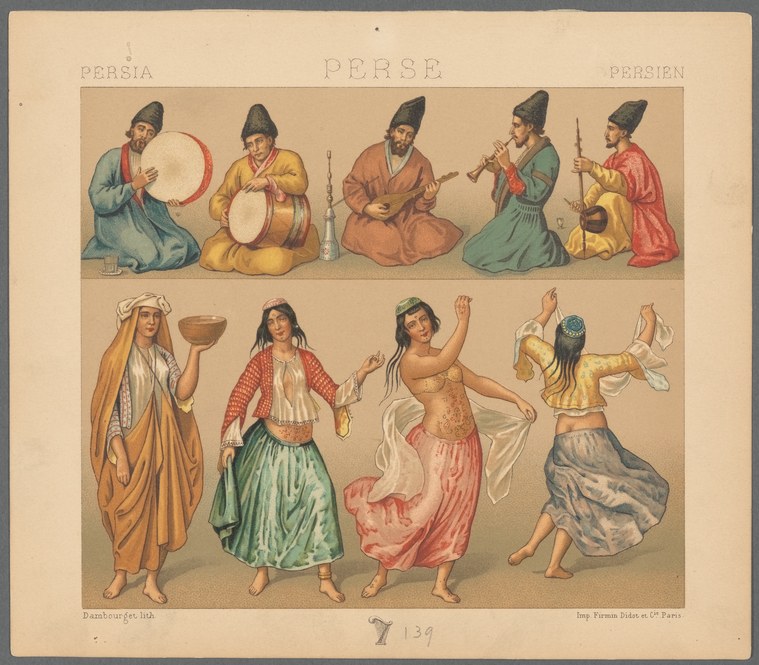
This is a colored engraving printed in at least two languages (French and German visible in the header), showing nine figures in Persian dress arranged in two rows against a neutral background. The upper row presents five seated musicians playing traditional instruments: a large frame drum, a barrel drum or davul, a stringed instrument (possibly a ney or flute), and what appears to be other wind or percussion instruments. All wear tall conical hats (likely kulah) and richly colored robes in blues, oranges, and golds. The lower row shows four dancers in various poses of movement: one woman in golden yellow with head covering and raised arms; two women in lighter fabrics performing what appear to be undulating or swaying motions with flowing scarves or veils; and a fourth figure in jeweled costume with elaborate headdress also in mid-movement. The dancers wear less structured garments than the musicians, with visible bare midriffs and flowing skirts or trousers. The lighting is even and the paper has aged to a cream tone, suggesting this is a mid-to-late nineteenth-century educational or ethnographic print.
The dancing
The dancers display postures of graceful extension and fluidity rather than rigid geometric positioning. Their arms are raised, spread, or arranged in curves suggesting continuous movement rather than a held moment. Two figures appear to be turning or swaying, with fabric caught mid-motion; another stands with arms overhead in an attitude of elevation. The weight appears distributed through the hips and lower body, with the torso moving independently. None of the dancers face the viewer directly—all are in three-quarter or profile view, suggesting the artist was documenting characteristic body positions rather than a formal arrangement. The relationship between musicians and dancers is clear but separate: the musicians are grounded and frontal; the dancers are mobile and turning.
The dance depicted
This appears to depict Persian or Central Asian social and ceremonial dance traditions, likely from the nineteenth century when such ethnographic prints were circulating widely in Europe. The presence of specific instruments—the davul, frame drum, and what appears to be a ney—suggests these are the musical accompaniments to Middle Eastern or Persian dance traditions. The loose, flowing garments, the undulating arm movements, and the evident pelvic articulation visible in several poses are consistent with early documentation of raqs sharqi (belly dance) traditions or related Middle Eastern social dances that were beginning to be represented in European popular imagery during this period. The dancers' apparent expertise in isolating different parts of the body—most visible in the turned torsos and flowing arm gestures—suggests these are not invented poses but observed or remembered movement vocabularies. However, without context or inscription, the specific regional tradition cannot be definitively established.
How it was made
This is a hand-colored engraving or lithograph, printed from a stone or metal plate and then colored by hand or in a separate process. The registration lines visible at the edges and the uniform application of color indicate commercial production. The technique allowed rapid, economical reproduction of instructional or ethnographic imagery for a European middle-class audience interested in 'exotic' cultures. The parallel text in French and German suggests distribution across Northern Europe and the Rhineland. The engraving process—with its clear contour lines and controlled modeling—was well suited to ethnographic illustration, creating an appearance of documentary accuracy even where the artist was working from imagination or received ideas. The hand coloring adds specificity to costume and suggests higher market value than uncolored prints.
About this work
This is an ethnographic print from a series depicting dancers and musicians of Persia (modern Iran), likely produced in the mid-nineteenth century for a European audience seeking visual knowledge of non-Western dance traditions. It belongs to a large body of orientalist imagery that emerged as colonial expansion and international trade made such 'documentation' commercially viable. The print presents musicians and dancers as distinct but complementary figures, establishing the instrumental accompaniment to what the artist understood as Persian dance. It is a crucial artifact of how European audiences first encountered and learned to visualize Middle Eastern dance traditions, filtered through the conventions of fine-art printmaking and the assumptions of the period about what constituted 'authentic' ethnic performance.
How to look at it
Notice the different body orientations and weight distributions between the musicians (frontal, grounded, symmetrical) and the dancers (turned, mobile, asymmetrical). Observe how the artist has rendered fabric—the drummers' robes are depicted as static volumes, while the dancers' garments are caught in the act of moving, suggesting understanding of how cloth responds to turning and swaying. Look at the arm positions: they are neither rigid nor purely decorative, but consistently arranged to suggest continuous circular or undulating motion. The choice to show musicians and dancers in the same frame, but not interacting, reflects the artist's understanding that Persian music and dance were separate specialists' crafts, not integrated performance.
The period
The mid-nineteenth century saw an explosion of ethnographic and orientalist imagery in European commercial print culture, driven by imperial expansion, international exhibitions, and amateur travel. Dance, as a marker of 'exotic' culture, was extensively illustrated in educational prints, costume books, and travel narratives. Such prints often blended careful observation with romantic invention, shaping European perceptions of non-Western dance for generations. This particular print emerges from that tradition: technically skilled in its rendering, but inseparable from the colonial gaze that framed Middle Eastern and North African dance as spectacle for European consumption. The bilateral text and mass-production methods indicate this was aimed at schools, curiosity cabinets, and household collections across French and German-speaking regions.
Where it lives
This print is part of the New York Public Library's collection of prints depicting dance, held as part of a broader ethnographic and orientalist collection. It is one of a series with parallel imagery in multiple languages, suggesting circulation as an educational or commercial product across Western Europe.
Dance in this work
Questions about this work
What instruments are the musicians playing?
From left to right, the visible instruments appear to be a frame drum (possibly a bendir or daf), a barrel drum or davul, a stringed instrument (possibly an oud or ney), and other wind or percussion instruments typical of Persian court or social music. The specific identification is difficult from the print alone, but these are consistent with documented Persian instrumental traditions of the period.
Is this belly dance?
The dancers' garments, body isolations, and movement vocabulary are consistent with early documentation of raqs sharqi traditions, though the print predates the term and reflects nineteenth-century European interpretation of Middle Eastern dance. The flowing fabrics, visible torso articulation, and undulating movements suggest traditions related to raqs sharqi, but the print cannot confirm a specific regional or stylistic identity without additional context.
Who made this print?
The artist is not recorded in the catalogue. The signature or maker's mark, if present, is not legible in the available image. The print was produced commercially, likely in France or Germany, but the individual engraver or lithographer remains unknown.
Why are musicians and dancers shown separately?
In Persian cultural contexts of this period, music and dance were often distinct professional specialties. The artist's choice to show them in separate registers may reflect this understanding, or simply the conventions of ethnographic illustration, which often presented 'types' rather than integrated scenes.
More dance artwork





