49 works in this view — arrow keys or swipe to move between them.
Dance in Art
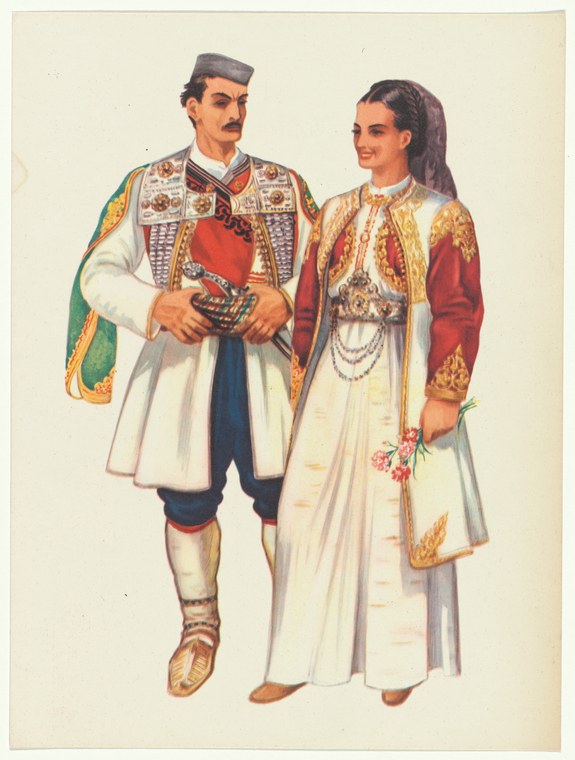
National costumes of Yugoslavia
Unknown artist
- Collection:
- Prints depicting dance
- Source:
- New York Public Library
- Rights:
- Public domain — free to use, share and adapt.
- Recorded as:
- Public Domain
For historians of Balkan dance and costume, this image documents the formal dress worn in folk traditions, even if it does not show those traditions in motion. The level of ornamental detail—the geometric patterning, the colour vocabulary, the construction of the jacket—is invaluable evidence for understanding the material culture of regional dance practice. For historians of ethnographic imagery, the print exemplifies how European folk culture was visually codified and circulated in the nineteenth century, establishing visual conventions for national identity.
What you are looking at
Two figures in folk costume stand against a plain cream background, posed formally and facing slightly toward each other. The man, positioned on the left, wears a striking embroidered jacket—white linen with a red front panel covered in geometric and floral patterns in red, gold, and blue—over blue knickers and cream leg wraps that extend to embroidered shoes. A grey cap sits on his head, and he holds a decorative belt or sash across his body. The woman, on the right, wears a long cream linen dress with a red bodice and a matching short embroidered jacket in red with gold ornamental details. Her dark hair falls loose down her back, and she wears simple shoes. Both figures are presented as upright, dignified specimens of national dress rather than captured in motion; this is ethnographic illustration in the nineteenth-century mode, designed to document costume and cultural identity.
The dancing
Both figures stand in static, formal poses—no weight shift, no active gesture beyond the man's holding of his belt. Their bodies are frontal or turned very slightly; there is no closed hold, frame, or connection between them. The man's arm position is neutral; the woman's arms hang at her sides. If this depicts a dance moment at all, it is a moment of stillness or presentation rather than active movement. There is no footwork visible; the focus is on the completeness and detail of the costume.
The dance depicted
The catalogue title identifies this as 'National costumes of Yugoslavia,' and the embroidered garments and style are consistent with Balkan folk dress, most likely Serbian or a neighbouring region of the former Yugoslav space. Whether these figures are posed as dancers is ambiguous. The formal, static presentation suggests ethnographic documentation of costume rather than a scene of folk dance in progress. If the image does depict a dance tradition, it would belong to the Balkan folk-regional category, but the image itself shows no active dancing—no footwork, no body weight, no partnering. This appears to be a costume plate rather than a dance scene.
How it was made
This is a hand-coloured print, most likely a lithograph or colour lithograph based on the flat colour fields, soft gradations, and the characteristic appearance of the medium from the late nineteenth or early twentieth century. The technique allowed for rapid reproduction and circulation of ethnographic imagery; this work belongs to a tradition of costume and folk-life illustration that served both educational and commercial purposes. The quality and finish suggest this was intended for a published ethnographic or costume album, likely distributed to schools, museums, or a cultivated general audience interested in European folklore.
About this work
This is a costume documentation print from the ethnographic and folk-life illustration tradition of the nineteenth and early twentieth centuries, depicting two figures in Serbian or South Slavic national dress. The work is historically interesting as evidence of how European folk culture—including dance traditions—was visually recorded and distributed during this period. The precise formal presentation and the absence of any dynamic movement suggest this is dress documentation rather than a scene of dance in action, though the garments themselves (particularly the man's decorated jacket and both figures' embroidered elements) are inseparable from the dance traditions of the region. The print records a moment of cultural representation rather than a moment of choreographic practice.
How to look at it
Pay attention to the precision of the embroidery pattern and colour in both the man's jacket and the woman's bodice and jacket—these details are what the print was made to preserve and communicate. Notice the static quality of the pose: there is no sense of a moment captured mid-movement, but rather a moment of presentation, as if the figures are standing for inspection. The background is blank and neutral, directing all attention to the dress itself. Consider what is absent: no setting, no other figures, no suggestion of social context, music, or the actual practice of the dance tradition these clothes belong to.
The artist
The artist is not recorded in the catalogue. The work belongs to a large tradition of ethnographic costume illustration that flourished in Europe during the nineteenth and early twentieth centuries, produced by both named and anonymous illustrators, often in collaboration with publishers specialising in folk-life documentation. Without additional documentation, no specific artist can be credited.
The period
This print emerges from the nineteenth-century European fascination with national folk traditions, driven by Romantic nationalism, the collecting impulse, and the rise of ethnographic study. During this period, costume documentation became a standard tool for recording and standardising 'national' dress, often with the effect of freezing fluid, regional traditions into fixed visual forms. In the Balkan context specifically, the late nineteenth and early twentieth centuries were marked by complex nationalist movements and the documentation of folk culture as evidence of ethnic and national identity—a documentation that had both scholarly and political stakes. The formal, dignified presentation of these two figures reflects the valorisation of folk culture as a source of national authenticity.
Where it lives
The work is held in the New York Public Library's Prints collection, categorised under 'Prints depicting dance.' The collection description does not provide date, publisher, or artist information, suggesting this is either a late accessioning or a work for which such documentation was unavailable at the time of cataloguing.
Dance in this work
Questions about this work
Is this a picture of people actually dancing?
No. The figures are posed statically against a blank background. This is a costume documentation plate—a visual record of how folk dress was constructed and ornamented—rather than a scene of dance in action. The formal presentation and the focus on complete, detailed costume suggest ethnographic or educational purpose rather than choreographic documentation.
What region is this costume from?
The embroidered jacket, knickers, and the style of the woman's bodice and dress are consistent with Serbian or broader South Slavic folk costume, most likely from the Balkan region. The catalogue title identifies it as 'Yugoslav,' reflecting the twentieth-century geopolitical frame in which the work was catalogued, though the costume tradition is much older.
Why would a dance collection hold a costume plate?
Folk dance and folk costume are inseparable; the garments were (and are) worn during dance practice and performance. Images that document the dress document an essential material aspect of how those dances were performed and understood. This print preserves information about the visual and tactile context of the dance traditions it represents.
How old is this print?
The catalogue record does not provide a date. Based on the style of illustration, the colour lithography technique, and the ethnographic conventions at work, it was most likely produced in the late nineteenth or early twentieth century, but this cannot be confirmed without additional research.
More dance artwork





