49 works in this view — arrow keys or swipe to move between them.
Dance in Art
National costumes of Yugoslavia
Unknown artist
- Collection:
- Prints depicting dance
- Source:
- New York Public Library
- Rights:
- Public domain — free to use, share and adapt.
- Recorded as:
- Public Domain
For dancers and historians, this work documents the specific material vocabulary of Balkan folk dress—the cuts, colors, embroidery techniques, and regional variations that are inseparable from the performance and social meaning of regional dance traditions. As a published print, it also shows how folk dance was consumed by European audiences as a kind of ethnographic spectacle, part of a broader 19th-century fascination with 'national' costume and 'authentic' folk culture.
What you are looking at
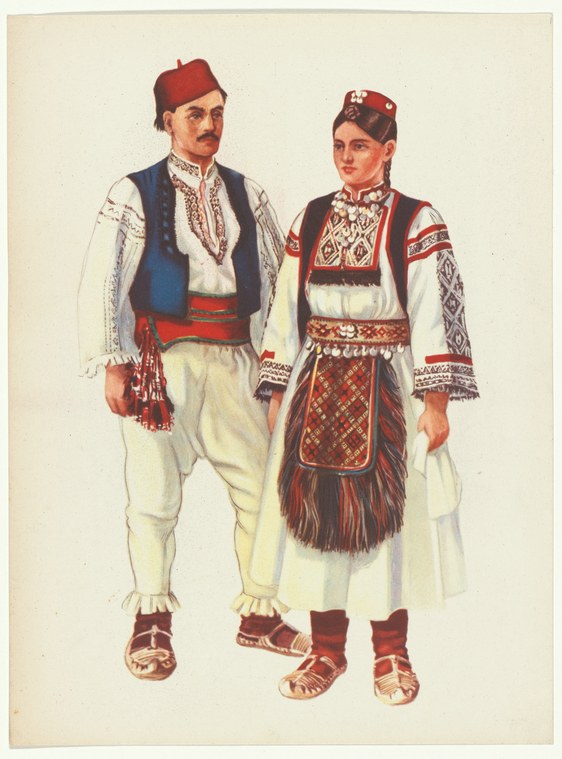
Two figures stand against a plain cream background, dressed in richly embroidered regional costume. The man on the left wears white linen breeches, a white embroidered shirt with geometric patterns on the sleeves, a dark blue sleeveless vest, and a red sash at the waist. A red fez-like cap sits on his head, and he carries a small red tassel or ornament at his hip. The woman on the right wears a white linen shift under a short dark red vest heavily decorated with geometric embroidery and white beadwork. Her skirt is cream linen, and below it hangs a dramatic fringed apron of deep red and burgundy, also embellished with geometric patterning. She wears a distinctive red headdress with white ornaments, and her feet are shod in red and cream decorated footwear. Both figures stand upright and composed, facing forward or slightly toward each other, as if presented for inspection or documentation rather than caught in movement.
The dancing
Both figures adopt a formal, stationary stance with minimal dynamic pose. They stand parallel, shoulders back, arms at their sides or hanging naturally. There is no closed hold, no apparent weight transfer, no footwork visible. The composition is entirely frontal and presentational—these are dress figures being displayed rather than dancers caught in motion. The positioning suggests a documentary or ethnographic illustration rather than a moment within a choreography.
The dance depicted
This appears to be a costume documentation plate rather than a dance scene. While folk-regional dance traditions of Yugoslavia (now the Balkans) include lively social and ceremonial forms often performed in such dress, this image captures only the garments themselves. The embroidered vests, white linen undergarments, geometric ornament, and regional variations in headdress and footwear are consistent with Balkan folk dress associated with dances like the Horo (a circle dance) or regional variants, but the image shows no dancing, no specific dance frame, and no moment of movement. It is ethnographic costume illustration rather than a record of a dance in performance.
How it was made
This is a hand-colored print, likely a chromolithograph or color lithograph given the flat, luminous application of color and the precision of the line work. The technique allowed for relatively inexpensive reproduction and distribution, suggesting this was part of a published series documenting national costumes—a common genre of popular education in the late 19th and early 20th centuries. The clean outlines, even coloring, and formal composition are characteristic of color lithography for mass circulation.
About this work
This is a documentary color print illustrating the regional costume of Yugoslavia, showing male and female dress from what is likely a specific region or ethnic group. The garments are rich in embroidered detail and regional markers—the vests, headdresses, sashes, and decorated footwear all follow identifiable patterns of Balkan folk costume. While these costumes are intimately associated with the living tradition of folk dance in the region, the print itself is not a dance image but a static display of garment construction and ornamentation. It belongs in a dance archive as evidence of the material culture surrounding dance, the visual identity of a tradition, and the way dance costume was documented and circulated to a broad European audience.
How to look at it
Attend to the precision and hierarchy of ornament: the geometric embroidery on the vests, the beadwork, the construction of the headdresses, the decorated footwear. These are not arbitrary; each element marks region, status, and sometimes occasion. Notice how the print privileges the upper body, where the most labor-intensive embroidery is concentrated. The formal frontal pose and neutral background remove these figures from any social or performance context, inviting the viewer to study the garments as objects rather than to imagine the dance they accompanied.
The period
This print reflects the late 19th- and early 20th-century vogue for ethnographic costume illustration. Following European Romanticism's interest in folk culture and national identity, publishers produced extensive series documenting the 'traditional' dress of regions across Europe and beyond. These plates served educational, aesthetic, and ideological purposes—satisfying curiosity about remote regions, providing reference for designers and artists, and asserting claims about national character and cultural authenticity. The depiction of Yugoslavia (a political entity that emerged only in 1918) suggests either a later dating or an anachronistic use of the term; the print may originally have documented Serbian, Croatian, Macedonian, or Bosnian costume under earlier regional labels.
Where it lives
Held by the New York Public Library in the Prints collection labeled 'Prints depicting dance,' this plate is part of what was likely a larger published series documenting European folk costume. The print format and color lithography technique suggest commercial publication, possibly in the late 19th or early 20th century.
Dance in this work
Questions about this work
Is this actually a dance image?
Not in the sense of showing choreography or movement in progress. It is a costume documentation plate. However, it is inseparable from dance: these garments were worn in performances, and the embroidery patterns and regional markers are legible to anyone familiar with Balkan folk traditions. For archives of dance, it serves as material evidence of how dancers presented themselves and how their traditions were visualized for outside audiences.
Can you tell what specific dance tradition this represents?
The embroidered vests, white linen garments, geometric ornament, and regional headdresses are consistent with Balkan folk dress associated with circle dances and social forms across the region. Without a caption or documented source, the exact regional origin cannot be determined from the image alone. The use of 'Yugoslavia' in the title is an anachronism (the state was formed in 1918) or an indication of later cataloguing.
Who made this print and why?
The artist is unrecorded in the catalogue. The work was likely produced by a commercial publisher as part of a series on European folk costume, a genre popular in the late 19th and early 20th centuries. Such prints were sold to satisfy cultural curiosity, to serve as reference for designers and artists, and to assert national or ethnic identity through 'authentic' costume.
More dance artwork





