49 works in this view — arrow keys or swipe to move between them.
Dance in Art
Folk and ethnic costumes
Unknown artist
- Collection:
- Prints depicting dance
- Source:
- New York Public Library
- Rights:
- Public domain — free to use, share and adapt.
- Recorded as:
- Public Domain
The work documents theatrical costume and character presentation from an era when such printed images were primary records of stage practice. It belongs in a dance gallery because it shows how dance figures were visualized, promoted, and remembered in print culture, even when the print itself does not depict action.
What you are looking at
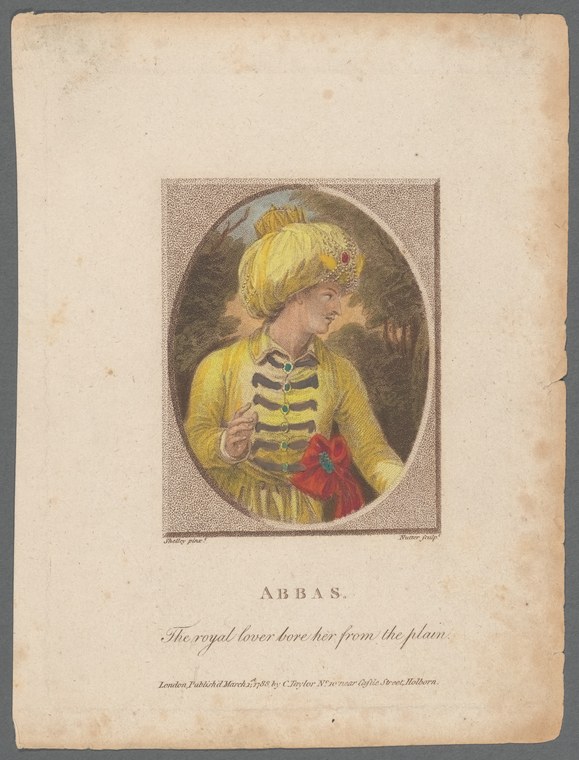
A single figure in profile, set against a dark background within an oval frame. The subject wears a bright yellow turban and a richly patterned coat of yellow with bold black horizontal stripes and red accents. The figure's face is shown in three-quarter view, with a dignified bearing and refined features. The painting is rendered in soft colors characteristic of 18th-century hand-colored engraving—flesh tones delicate and naturalistic, the fabrics rendered with careful attention to texture and sheen. Below the image is the word ABBAS in large capitals, followed by a subtitle: "The royal lover bore her from the plain." The composition is formal and heraldic, presenting a named historical or mythological figure rather than a scene of action.
The dancing
The single standing figure displays no active dance movement. The body is still and upright, slightly turned to present a three-quarter silhouette. The arms rest at the sides with no particular tension or position that would suggest a dance hold or frame. The gaze is contemplative and directed away from the viewer. This is a portrait or character study, not a depiction of movement.
The dance depicted
The image does not depict dance in progress. This is a costume study or character portrait—likely from an 18th-century theatrical production (possibly operatic or dramatic), given the titled subtitle below the figure and the formal presentation. The costume and the literary caption suggest a specific character from a named work, but the print shows only the figure at rest, not performing.
How it was made
This is a hand-colored engraving, a common form of theatrical portraiture in the 18th century. The technique allowed for reproducible prints that could circulate widely, making these images key documents of stage costume and character presentation. The careful hand-coloring—visible in the even washes of yellow, the controlled cross-hatching of the coat, and the subtle flesh tones—indicates a skilled colorist working from a professional engraved plate. Such prints were collected, sold separately, and used to promote theatrical productions and celebrated performers.
About this work
This is an 18th-century hand-colored engraving of a named figure, Abbas, presented in formal portrait format with theatrical costume and an accompanying literary subtitle. The work belongs to a genre of theatrical character prints that documented stage dress and performance in the period. Though it presents a character who may have appeared in dance or dramatic performance, the print itself captures only stillness and presentation, not movement or choreography.
How to look at it
Attend to the specificity of the costume: the tailoring of the coat, the wrapping of the turban, the small details of fastening and ornament. These tell us what an 18th-century London audience would have seen on stage. The stillness of the figure is not a limitation of the medium but a choice—this print documents appearance rather than action. The subtitle is integral; it anchors the figure to a narrative or dramatic context that is not visible in the pose itself.
The artist
The artist is not recorded in the catalogue. The signature visible on the plate is legible but has not been matched to a known printmaker. The hand-coloring may have been executed by a separate artisan. The work was published in London by Bowles & Carver, a major print house of the 18th century.
The period
This print dates to an era when theatrical portraiture was a major commercial genre, and when dance and dramatic entertainment were closely intertwined on the European stage. Character prints like this one advertised performers and kept theatrical imagery in circulation long after performances ended. The costume and presentation suggest either an exotic or historical character, consistent with 18th-century taste for orientalist and heroic subject matter in theatrical productions. Such prints were collected and displayed in homes as well as studied by performers and costume makers.
Where it lives
The print is held at the New York Public Library in a collection labeled "Prints depicting dance." The publication line reads "London: Published [date] by Bowles & Carver, N° 39 [Bow Street,] near Holborn." The work is part of a larger body of 18th-century theatrical character prints.
Questions about this work
Is this print of a real person or a fictional character?
The subtitle suggests a narrative context ("The royal lover bore her from the plain"), pointing to a theatrical character or dramatic episode. Without additional archival information, we cannot establish whether Abbas is a historical figure, a character from a named play, or a stock theatrical type. The print was made to be recognized by contemporary audiences familiar with the source material.
Why is a still portrait in a collection of dance prints?
Theatrical costume prints were collected alongside movement scenes and dance depictions because they document stage practice and performance culture. This print preserves the visual presentation of a character who may have been seen dancing, or who belonged to a theatrical tradition (opera, dramatic ballet, or pantomime) in which dance played a role.
How do we know this is from the 18th century?
The style of the engraving, the hand-coloring technique, the typeface and publication line, and the costume silhouette and tailoring are all consistent with mid-to-late 18th-century theatrical prints. The publisher Bowles & Carver was active from the 1730s to 1820s.
More dance artwork





