49 works in this view — arrow keys or swipe to move between them.
Dance in Art
National costumes of Yugoslavia
Unknown artist
- Collection:
- Prints depicting dance
- Source:
- New York Public Library
- Rights:
- Public domain — free to use, share and adapt.
- Recorded as:
- Public Domain
For dancers and historians, this image is valuable as a primary record of how bodies were dressed for Balkan folk dance in the early twentieth century. The embroidered vests, headscarves, and layered skirts visible here determined the silhouette, weight distribution, and visual rhythm of the dances performed in them—understanding the costume is part of understanding the movement. The work also shows how folk traditions were being collected and presented during a period of intense European nationalism and ethnographic interest.
What you are looking at
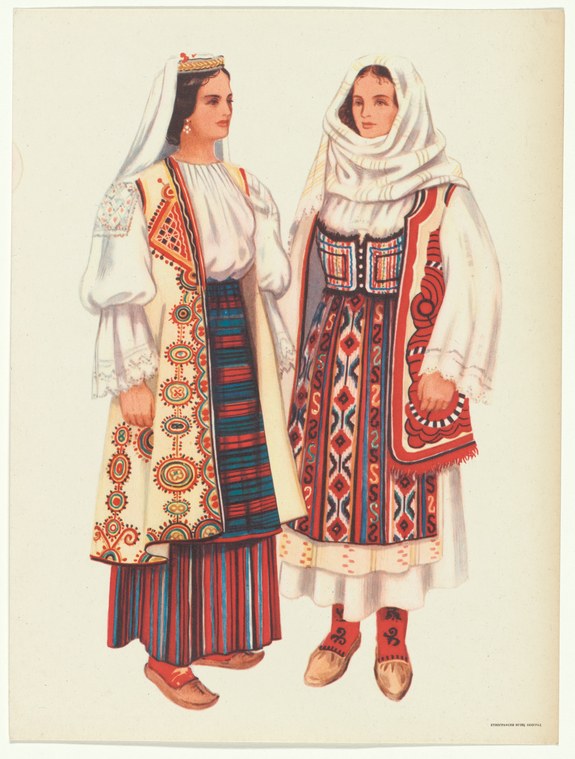
Two young women stand facing slightly toward each other against a plain cream background, each wearing distinct regional folk costumes identified as Yugoslav. The woman on the left wears an embroidered linen shift with puffed sleeves, a sleeveless overdress with geometric embroidery in cream and red, a striped skirt in blue and red, and a decorative headwrap. The woman on the right wears a similar white linen shift, a sleeveless vest in deep red with embroidered geometric patterning and border ornaments, a cream underskirt with red embroidered bands, and a large white headscarf that falls past her shoulders. Both wear embroidered or decorated footwear. The costumes are rendered in careful watercolor or chromolithographic detail, with particular attention to textile patterns, embroidered motifs, and the layering of garments. The two figures are presented as a paired comparison, suggesting regional variation within a national tradition.
The dancing
Both figures stand in relaxed, frontal or near-frontal poses with arms at their sides or held loosely before them. Neither is captured mid-movement; both are posed statically as costume displays rather than as dancers in action. Their posture is upright and dignified, with the weight distributed evenly. The presentation emphasizes the silhouette and structure of the garments rather than any dynamic gesture or step.
The dance depicted
This is a costume documentation rather than a dance representation. The print records traditional folk dress from different regions of Yugoslavia, likely worn in regional folk dances of the early twentieth century, but the figures are posed for ethnographic display rather than depicted dancing. The embroidered vests, layered skirts, and headscarves are typical of Balkan and South Slavic folk tradition, and such costumes would have been worn in circle dances, couple dances, and processional celebrations. However, the static presentation means the image does not convey how these costumes moved or how the dance was performed.
How it was made
The work appears to be a chromolithograph or fine hand-colored print, executed with the precision required for ethnographic documentation. The even application of color, the fine detail in embroidered patterns, and the neutral background are consistent with commercial color printing techniques used in the late nineteenth and early twentieth centuries for costume and ethnographic reference materials. This technique allowed for accurate color reproduction and wide distribution, suggesting the image was intended for educational or reference purposes rather than as fine art.
About this work
This is a documentary print recording traditional folk costumes from different regions of Yugoslavia, presented as a paired ethnographic comparison. It belongs in a dance gallery because these costumes are inseparable from the folk dances they clothe—the embroidery, layering, and cut of garments shaped and were shaped by movement. Yet the print itself does not show dance in action; it records costume as material culture. The work represents an important moment in European art and scholarship when folk traditions were being systematically documented before industrial modernity displaced them, and when costume was understood as a key to understanding regional and national identity.
How to look at it
Study the precision of the embroidery and the logic of the layering: the shift serves as a base, the vest and overskirt add structure and visual richness, and the headscarf frames the face and extends the vertical line of the body. Notice how the weight of the embroidered garments would have affected posture and movement—the vests are stiff with stitching, the skirts heavy and voluminous. The paired presentation invites comparison: observe the differences in embroidery style, color combinations, and vest decoration, which would have signaled regional origin and possibly social status or life stage to anyone familiar with the tradition.
The period
This print dates to an era of intense European interest in folk traditions and national identity, roughly 1890–1930. Across Europe and the Balkans, costume documentation was part of a broader ethnographic project to record and preserve regional traditions before industrialization and assimilation. In the Balkans particularly, folk costume and folk dance were central to emerging national and regional identities in the context of the Austro-Hungarian Empire's fragmentation. Such costume prints were widely distributed in educational materials, museum publications, and popular illustrated books on European peoples and traditions.
Where it lives
The work is held in the New York Public Library's collection of prints depicting dance. It is catalogued as a costume documentation rather than as a fine art print, reflecting its function as ethnographic or educational material.
Dance in this work
Questions about this work
Is this a painting or a print?
This is a chromolithograph or similar color printing technique, not a painting. The technique allowed for precise color reproduction and wide distribution, making it suitable for educational and reference purposes.
What region of Yugoslavia are these costumes from?
The record identifies the costumes as Yugoslav but does not specify region. The embroidered vests and headscarves suggest South Slavic tradition, likely from areas of present-day Serbia, Bosnia, or the former Yugoslav republics, but the print does not record which regions these two examples represent.
Why are the figures not dancing?
The print is a costume documentation, designed to record the appearance of folk dress in detail. Static display allows the viewer to see the full costume, embroidery, and construction clearly, whereas a dancer in motion would obscure much of the garment.
What does the embroidery tell us about the dances?
The elaborate embroidery suggests the costumes were worn for significant celebrations and communal events. The stiffness of embroidered fabric would have restricted certain movements and encouraged others, shaping the character of the dance—likely favoring upright posture, controlled arm movement, and steps that worked with rather than against the weight and structure of the garments.
More dance artwork





