49 works in this view — arrow keys or swipe to move between them.
Dance in Art
Folk and ethnic costumes
Unknown artist
- Collection:
- Prints depicting dance
- Source:
- New York Public Library
- Rights:
- Public domain — free to use, share and adapt.
- Recorded as:
- Public Domain
This engraving demonstrates how dance-adjacent visual culture—the costume documentation that travelled in print—shaped European understanding of regional and non-European traditions. It shows that dance history is not only the movement itself but also the material culture, the dress codes, and the ways communities chose to (or were forced to) present themselves to outsiders.
What you are looking at
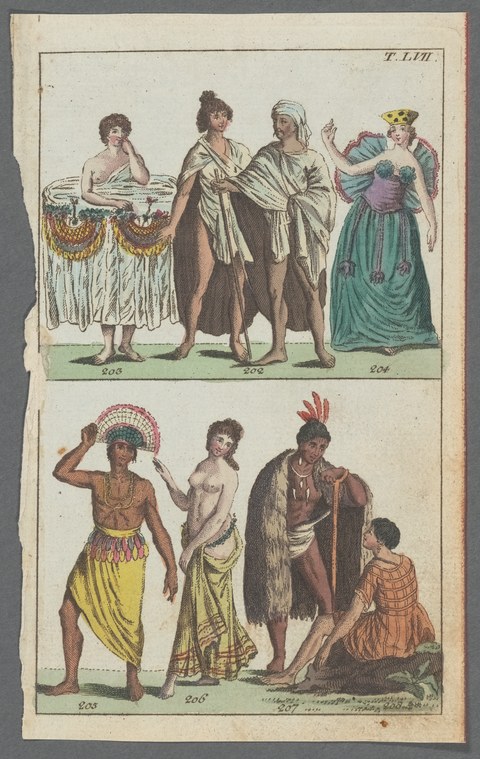
This is a hand-coloured engraving divided into two registers, depicting figures in various regional and ethnic costumes from European and non-European traditions. The upper register shows four standing figures: a woman at left seated at a draped table laden with goods (possibly a merchant or entertainer), two central figures in wrapped or draped garments suggestive of classical or Middle Eastern dress, and a crowned woman in green drapery at right, possibly representing royalty or ceremony. The lower register displays three more figures: a man at left wearing a yellow pleated skirt and elaborate headdress with feathers, a woman in the centre in classical drapery, and a man at right in furs or heavy wrapping with feathers in his hair; a small child sits at his feet. The figures are rendered with careful attention to textile pattern and ornament—the draping, pleats, embroidery, and jewellery all receive distinct treatment. The setting is minimal: a simple ground line and neutral background allow the costumes and poses to dominate.
The dancing
The figures stand or sit in posed attitudes rather than in active movement; they display their dress to the viewer with the stiffness of a costume parade or ethnographic chart. Most hold a frontal or three-quarter stance. The crowned woman at upper right gestures with one hand upraised in a manner suggesting address or benediction. The figures do not engage with one another but are arranged to showcase individual costume traditions. Body language is formal and presentational rather than participatory or narrative.
The dance depicted
This engraving does not depict dance in action. It is a costume study or ethnographic reference work, presenting the dress of different peoples and regions—likely European folk traditions alongside exoticised representations of African, Asian, or indigenous peoples. The posed stiffness and the focus on textile detail rather than movement indicate this is a didactic or reference document rather than a record of actual dancing. The feathered headdresses and exotic dress in the lower register suggest these may be ceremonial or festive costumes, but they are frozen in display, not captured in motion.
How it was made
This is a hand-coloured engraving, identifiable by the fine parallel lines (hatching) visible in the drapery and shaded areas, which is characteristic of engraving technique. The figures are outlined in black line and the costume details filled in with careful watercolour or gouache in muted tones—ochre, green, pale blue, and earth tones—with gold leaf or gilding evident on crowns and ornaments. The technique allowed for precise rendering of textile pattern and wide circulation as a print. The hand-colouring indicates this was a relatively expensive or prestigious object, likely aimed at collectors, scholars, or nobility interested in ethnographic or costume documentation.
About this work
This is a costume reference engraving, probably from the 18th century, presenting figures in regional and exotic dress as a visual encyclopædia of peoples and their attire. Rather than depicting dance as lived practice, it uses the posed figure to document costume tradition. It belongs in a dance gallery not because it records movement, but because festive dress, regional costume, and the visual markers of cultural identity are inseparable from the history of dance; these are the garments dancers wore and the visual codes by which their communities were recognised. The work is evidence of how European print culture classified and exoticised non-European peoples through the optic of costume.
How to look at it
Attend to the precision of the costume rendering: the pleats, the layering, the jewellery and feathered ornament, the way fabric folds. Notice that no two figures wear the same garment or gesture in the same way—this is a visual inventory. Observe the scale and dignity given to each figure despite the exoticising intent. The formal poses and neutral ground allow the garments themselves to carry meaning; there is no narrative moment, no interaction, only display.
The period
Costume studies and ethnographic engravings were popular in 17th- and 18th-century Europe, circulating as reference works for painters, tailors, and scholars. This engraving sits within a long tradition of comparative costume documentation that reached back to Renaissance travel narratives and forward into the Enlightenment appetite for cataloguing human diversity. Such prints were often compiled into bound volumes or folios and sold to educated collectors. The exoticisation and formal presentation here—the absence of any narrative or cultural context, the reduction of living peoples to dress—is typical of this period's approach to ethnographic material.
Where it lives
This work is held by the New York Public Library as part of a collection of prints depicting dance and theatrical subjects. It is catalogued only as 'Folk and ethnic costumes' with no recorded artist, date, or medium, suggesting it may be part of a larger unbound collection or have been separated from its original context.
Questions about this work
Is this a dance image?
Not of dance in motion. It is a costume reference engraving, a didactic work showing the dress of different regions and peoples. Dance history includes the material culture and visual codes that surrounded dance, and this document is part of that archive—it shows us what dancers wore and how their dress marked cultural identity.
What period is this from?
The style, technique, and subject matter are consistent with 18th-century European printmaking, though the catalogue record does not provide a date. The hand-colouring, the quality of the engraving, and the ethnographic interests on display are all typical of the Enlightenment era.
Who are these figures meant to represent?
The upper register appears to show European or Mediterranean dress (classical or merchant costume, possibly Italian or Greek); the lower register presents figures in costumes coded as 'exotic'—African, indigenous, or Asian. The feathered headdresses and the style of dress suggest ceremonial or festive garments, but without text or attribution the specific cultures represented cannot be confirmed from the image alone.
More dance artwork





