49 works in this view — arrow keys or swipe to move between them.
Dance in Art
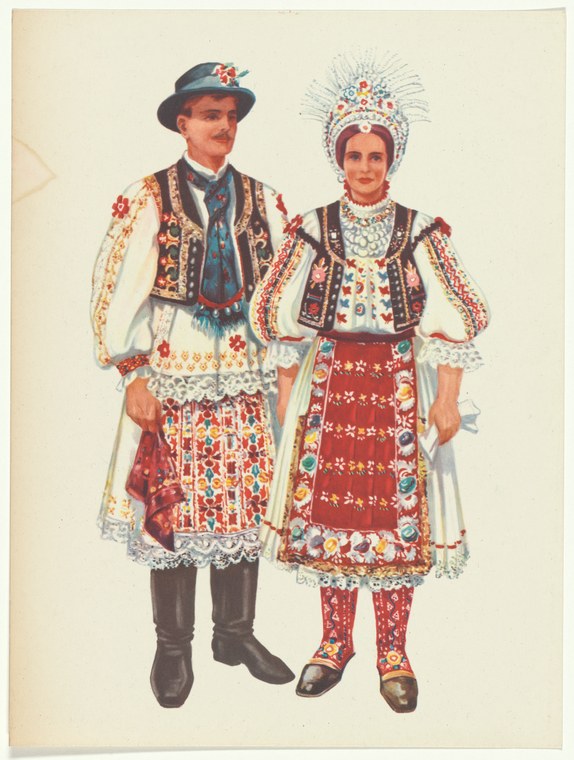
National costumes of Yugoslavia
Unknown artist
- Collection:
- Prints depicting dance
- Source:
- New York Public Library
- Rights:
- Public domain — free to use, share and adapt.
- Recorded as:
- Public Domain
Dance historians and ethnographers rely on costume documentation to understand regional dance traditions, movement possibilities, and cultural identity. This print, though static, is part of the visual genealogy through which folk dances of southeastern Europe entered Western consciousness and were preserved during the modern period. The specificity of the embroidery and construction reveals how dance dress encoded regional and ethnic identity in Yugoslavia before the nation's dissolution.
What you are looking at
Two figures stand against a pale background in formal folk dress, positioned as though for documentation or display rather than mid-movement. The man on the left wears a dark felt hat adorned with a colored ribbon and ornament, a white linen shirt with bold red and black embroidered patterns across the chest and sleeves, a dark embroidered vest laced at the front, and a red-patterned skirt-like lower garment with white lace trim, completed by dark stockings and boots. The woman on the right wears an elaborate tall white headdress with radiating ornaments and a crown-like crest, a white embroidered chemise, a dark embroidered vest matching the man's in style, and a red patterned skirt with dense white floral embroidery and white lace cuffs at the ankles, with dark shoes. Both figures are positioned frontally and upright, displaying their costumes to full advantage. The embroidery on both garments is dense, colorful, and clearly the work of considerable skill, featuring geometric and floral patterns in red, green, yellow, and black thread on cream and red ground fabrics.
The dancing
Neither figure is captured in active dance movement. Both stand in relaxed upright postures with arms at rest, facing the viewer directly. The poses suggest the subjects are presenting their dress for scrutiny rather than performing; there is no weight shift, no extension, no hold or partnering gesture. The woman's posture is symmetrical and still; the man's weight appears evenly distributed. The headdress on the woman is so elaborate and top-heavy that it would govern movement considerably, yet she displays it static and stable.
The dance depicted
This is not an image of dancing, but of costume documentation—specifically, national or regional folk dress of Yugoslavia (as the title states). The garments themselves derive from European folk tradition, likely Balkan or Central European in origin, and such costumes were worn at celebrations, festivals, and ceremonial occasions where dance would occur. The tailoring, embroidery techniques, and construction suggest late 19th or early 20th-century folk dress. However, the figures are modeled and posed for documentation rather than captured in the act of dancing. The print appears to be instructional or ethnographic in purpose, showing the viewer what the dress looks like when worn, not how it moves.
How it was made
This is a color lithograph or hand-colored print, as evidenced by the soft palette, the even application of color within defined areas, and the characteristic appearance of lithographic line work. The technique allowed for relatively inexpensive mass production of ethnographic and cultural documentation materials in the late 19th and early 20th centuries. The quality of registration (color alignment) and the delicacy of the line work suggest professional commercial printing. Such prints were commonly circulated in illustrated journals, educational collections, and travel books aimed at a general audience interested in European ethnography and costume.
About this work
This is a documentary print showing the formal folk dress of Yugoslavia—male and female costume presented in static display rather than in use or in motion. It belongs in a gallery about dance in art not because the figures are dancing, but because folk costume is inseparable from the history of folk dance, and because such prints are part of the visual archive through which dance traditions were documented, understood, and preserved in the pre-film era. The garments shown here—with their precise embroidery, structured cuts, and regional specificity—are the material evidence of a living dance culture. The print represents a moment when European folklore was being systematically recorded and displayed for a literate public, often through costume documentation that served as a proxy for the dances themselves.
How to look at it
Attend to the embroidery: the density, color range, and technical precision of the work reveal the skill and time invested in each garment. Notice how the headdress on the woman is constructed—it is architecturally complex, suggesting that movement while wearing it would be constrained and deliberate. Observe the white lace trim on the skirts: this was a luxury element that marked formal or celebratory dress, suggesting these garments were worn at important occasions. The careful symmetry and frontality of the pose tell you this is documentation, not artistry—the goal is to show, not to suggest movement or narrative.
The artist
The artist is unrecorded in the catalogue. The print's commercial quality and format suggest it was produced by a professional lithographic printing house, likely based in a major European city with access to both Yugoslav cultural materials and a market for ethnographic imagery. Such prints were often produced by firms specializing in costume and folk art documentation for educational and leisure markets.
The period
This print dates to an era (likely 1880s–1920s) when European nationalism and tourism were driving intense interest in regional folk cultures. Photography was becoming established, but lithography remained the dominant medium for illustrating costume and ethnographic material in books and periodicals. The presentation style—frontal, static, carefully lit to show detail—is characteristic of ethnographic documentation of the period, influenced by museum practice and anthropological illustration. In the Balkans specifically, this was a moment of political transformation and emerging national consciousness, making the documentation and preservation of folk culture a matter of cultural significance.
Where it lives
The print is held in the NYPL's Prints collection under the category 'Prints depicting dance.' It is catalogued as 'National costumes of Yugoslavia' with no artist, date, or medium recorded. The work is representative of an extensive holding of ethnographic and costume documentation prints from the late 19th and early 20th centuries.
Dance in this work
Questions about this work
Why is this in a dance collection if the figures aren't dancing?
Costume is primary evidence for understanding how dances were performed. The cut, weight, and construction of these garments directly shaped the movement possible in them. Folk dress documentation is a key source for reconstructing historical dances, and prints like this were how dance traditions were preserved and circulated before film.
What region of Yugoslavia is this dress from?
The catalogue record does not specify, and the print alone does not provide enough context to identify the exact region. The style of embroidery and construction suggests Central or Southeast European folk tradition, but a regional attribution would require expert analysis or supporting documentation.
How old are these garments?
These are not antique garments being documented; they are representations of folk dress tradition. The print likely dates to the late 19th or early 20th century, but the costume styles themselves evolved over generations. The print shows how such dress looked when worn in that period, not when the tradition began.
Could you reconstruct a dance from this image?
Not directly. The image shows what the costume looks like on the body, which constrains and shapes movement, but it does not show the dance itself. To reconstruct movement, you would need video, notation, or eyewitness accounts. This print is a necessary piece of evidence but not sufficient on its own.
More dance artwork





