49 works in this view — arrow keys or swipe to move between them.
Dance in Art
Carlotta Grisi
Unknown artist
- Collection:
- Prints depicting dance
- Source:
- New York Public Library
- Rights:
- Public domain — free to use, share and adapt.
- Recorded as:
- Public Domain
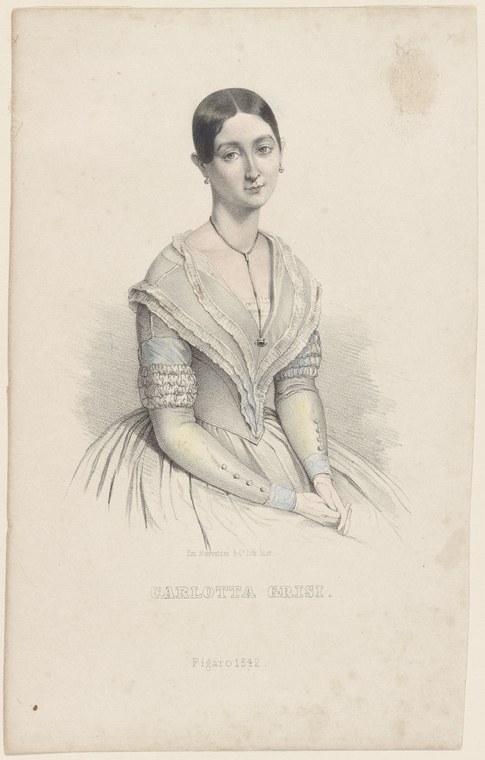
Carlotta Grisi was one of the greatest Romantic ballerinas and a muse to the choreographers of her era. This portrait, though it shows her in repose rather than in the act of dancing, documents the machinery of fame that made her and her contemporaries into icons, and tells us how 19th-century audiences experienced ballet dancers—often through still images rather than live performance.
What you are looking at
A three-quarter-length portrait of a young woman posed in formal dress against a plain background. She wears a pale silk or satin dress with short puffed sleeves decorated with ornamental beading or embroidery, and a shawl-like wrap or fichu draped over her shoulders. Her dark hair is parted in the center and smoothed back plainly, in the fashion of the 1840s. Her posture is upright and composed, one hand resting on her lap or skirt, the other visible at her side. The engraving is delicately worked, with fine cross-hatching to suggest the texture of fabric and the modeling of her face. The woman's expression is calm and direct, meeting the viewer's gaze in the manner of a formal portrait.
The dancing
A single standing figure in a pose of dignified repose. Her weight appears to rest evenly, her shoulders are level, and there is no suggestion of active movement or balletic position. The arms are held in a relaxed, naturalistic manner rather than in any theatrical or dance frame. This is a portrait pose, not a dance pose.
The dance depicted
The image does not depict dance in motion. It is a formal portrait of an individual, likely created for circulation and recognition. However, the inscription below the image reads 'CARLOTTA GRISI,' identifying the subject as a celebrated ballet dancer of the Romantic era. Grisi (1819–1899) was one of the finest ballerinas of her time, known for roles in *Giselle* and other Romantic ballets. This print appears to be a promotional or commemorative portrait rather than a depiction of her dancing, a common format for disseminating images of celebrated performers to a wide public.
How it was made
This is a steel engraving, a reproductive process that allowed fine detail and fine lines to be achieved and replicated across many impressions. The technique was ideal for portrait work and the dissemination of likenesses, particularly of theater and opera stars in the 19th century. The date is not recorded, but the dress and the style of the engraving are consistent with the 1840s. Steel engravings of this kind were relatively affordable and widely distributed, making them important tools for building the cult of celebrity that surrounded Romantic-era performers.
About this work
This is a formal portrait engraving of the ballet dancer Carlotta Grisi, created during or shortly after the height of her career in the mid-19th century. It documents not dance itself, but the commodification and public image of a Romantic ballet star—how she was presented to audiences who might never see her perform on stage. The print belongs in a gallery of dance in art because it captures a crucial moment in dance history: the emergence of the individual virtuoso dancer as a celebrity figure, and the use of reproductive prints to create and sustain that celebrity. Grisi's image circulated among a public hungry for intimate glimpses of the performers they admired, and this engraving is a artifact of that appetite.
How to look at it
The portrait presents Grisi in a moment of stillness and composure: this is how a celebrated dancer wished to be remembered off-stage, in formal dress and refined demeanor. The engraver's attention to the delicate texture of her silk dress and the subtle modeling of her face reflect the values of Romantic portraiture—beauty, gentility, and an almost melancholic grace. There is no hint of the exertion, flexibility, or technical virtuosity that Grisi displayed on stage; instead, we see the cultivated image of a woman of the theater, presented for admiration and consumption by a fashionable public.
The artist
The engraver is not recorded in the catalogue. The style and quality of the work suggest a professional reproductive engraver of the mid-19th century, working in the commercial theater-portrait trade. These prints were often unsigned or credited only to the original artist (usually a painter) from which the engraver worked.
The period
This portrait dates to the height of Romanticism in ballet, a moment when the art form had shifted focus from the elaborate spectacles of the neoclassical court ballet to the ethereal, otherworldly female soloist. Carlotta Grisi embodied this new aesthetic: she danced the role of Giselle in the ballet's 1841 premiere and became one of a small constellation of "Romantic ballerinas"—Fanny Elssler, Marie Taglioni, Lucile Grahn—whose images were disseminated across Europe through engravings like this one. The 1840s were also a period of rapid expansion in commercial theater and in the technologies of image reproduction, making possible the mass circulation of celebrity portraits.
Where it lives
The work is held in the Prints collection at the New York Public Library, cataloged under the heading 'Prints depicting dance.' It is a reproductive steel engraving, one of many similar prints produced in the 19th century for commercial distribution.
Questions about this work
Was Carlotta Grisi actually a ballet dancer?
Yes. Grisi (1819–1899) was an Italian-born ballerina who became one of the greatest performers of the Romantic era. She created the role of Giselle in the 1841 premiere of the ballet and was celebrated across Europe for her artistry, technique, and stage presence. She also acted in plays and performed in other theatrical genres, but ballet was her principal art.
Why is this a portrait and not a picture of her dancing?
Portrait engravings of this kind were the primary way that theater-goers could own and display images of their favorite performers. They were inexpensive, easy to frame and hang, and widely collected. This print served as a keepsake and a memento of Grisi's celebrity, much as a printed photograph of a modern star might today. It also advertised her to people who might never attend a live performance.
What does her dress tell us about the date?
The style of the dress—with the short puffed sleeves, the draped fichu, and the overall cut and fit—is consistent with women's formal wear of the 1840s. This date aligns with Grisi's years of peak fame and visibility as a ballet star.
What is a steel engraving?
Steel engraving is a reproductive printmaking technique in which a design is incised onto a steel plate with a sharp tool (burin), then inked and printed. Steel was favored over copper because it was harder and could withstand more impressions, allowing prints to be produced in larger editions. This made them economical for commercial theater portraits.
More dance artwork





