49 works in this view — arrow keys or swipe to move between them.
Dance in Art
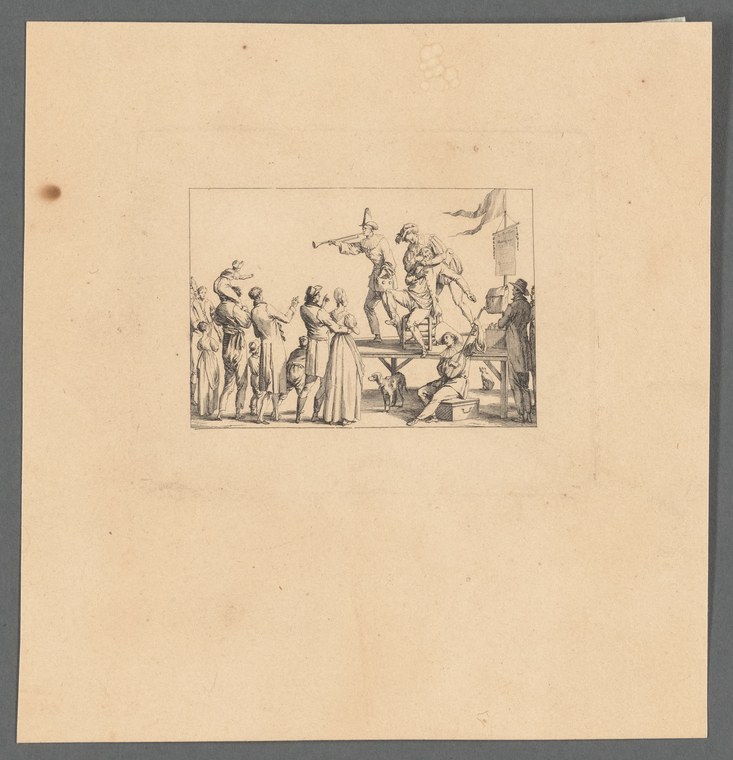
Outdoor performance by actors in costumes suggesting the commedia dell'arte, watched by adults, children, and dogs
Unknown artist
- Collection:
- Prints depicting dance
- Source:
- New York Public Library
- Rights:
- Public domain — free to use, share and adapt.
- Recorded as:
- Public Domain
This image captures a crucial but under-documented intersection of theatre and dance: the physical language of commedia dell'arte, which shaped European movement practice far beyond the stage. For dance historians, it is evidence that theatrical movement in the early modern period was more varied, more physically inventive, and more rooted in improvisation than the formal court dances that typically dominate the historical record. The presence of children and dogs in the audience also reminds us that commedia was popular culture, not elite entertainment, and that its influence on how bodies moved in everyday European life may have been as significant as its influence on courtly or balletic practice.
What you are looking at
A troupe of actors in loose, draped costumes performs in an open-air setting, watched by an intently gathered audience. On the right, a simple booth or platform structure with flags suggests an improvised stage. The performers occupy the central and left portions of the composition, some elevated, some at ground level, creating a dynamic hierarchy of movement and stillness. The audience—adults in period dress, children, and at least one small dog—stands or sits closely gathered on the left, their attention fixed on the action. The print is executed in fine pen lines with minimal shading, creating a sketch-like immediacy. The composition suggests a moment of theatrical excitement: one figure points or gestures expansively toward the crowd, while others around him gesture, respond, and move in various attitudes of performative energy. The setting is bare and outdoor, with no elaborate scenery—the focus is entirely on the human figures and their interaction.
The dancing
The performers display the exaggerated, open body language characteristic of commedia dell'arte stock characters: broad arm gestures, twisted torsos, and legs in asymmetrical positions suggesting physical comedy and rapid movement. Several figures adopt theatrical pointing, reaching, and expansive arm throws. One central figure stands elevated with arm extended toward the crowd, a typical commedia posture of direct address or challenge. The bodies are loosely articulated rather than formally controlled, suggesting agility and playfulness rather than balletic precision. The audience members include both seated and standing figures, some leaning forward in engagement, creating a clear visual distinction between performers and spectators.
The dance depicted
This is most likely a depiction of commedia dell'arte performance, the Italian improvisational theatre tradition of the 16th–18th centuries. Commedia troupes were known for combining dialogue, acrobatic movement, and rhythmic physical comedy into hybrid performances that sat somewhere between theatre and dance. While the print does not capture codified dance steps, the physical language—the exaggerated gestures, the agile repositioning of bodies, the rapid transitions between stillness and movement—points to the kind of movement vocabulary commedia performers cultivated. Whether specific dances (such as galliards, which were sometimes incorporated into commedia scenes) were performed here cannot be determined from the image alone, but the physical culture depicted is inseparable from early modern dance practice.
How it was made
This is an engraving or etching, executed with fine parallel lines and minimal cross-hatching to suggest volume and shadow. The technique allows for crisp detail in costume, facial expression, and gestural nuance while maintaining a light, sketch-like quality. The careful delineation of figures and the precision of line work suggest this was a finished print suitable for circulation and collection, likely created to document or advertise commedia performances or to circulate knowledge of the tradition among educated audiences. The print's tonal subtlety—achieved through line density rather than tone—indicates skilled reproductive work, possibly after a drawn design.
About this work
This print documents an outdoor performance by a commedia dell'arte troupe, capturing both the performers in their characteristic exaggerated, physically expressive postures and the mixed audience of adults, children, and animals gathered to watch. Commedia was Europe's most influential popular theatre form in the early modern period, and its movement vocabulary—part improvisation, part physicalized comedy, part incipient choreography—shaped how theatrical bodies moved for centuries. The image records not a formal dance but the physical culture from which formal dances emerged: a space where gesture, rhythm, and the social negotiation between performer and spectator were inseparable. The print's documentary quality and careful execution suggest it was created to preserve knowledge of a living, mobile tradition that left few permanent records.
How to look at it
Look first at the asymmetry and openness of the performers' bodies: this is not the closed, symmetrical carriage of courtly dance, but the exploitative, mobile physicality of actors trained in rapid transitions and exaggerated expression. Notice the elevation of some figures and the grounding of others—the artist has used the vertical plane to create a sense of dynamic action. The inclusion of the audience—their turned heads, their closeness to the performers, the child and dog at the margins—is not incidental; it documents the social intimacy of popular theatre and the way commedia audiences were interpellated into the performance. The fine, sketch-like quality of the line work suggests spontaneity and immediacy, matching the improvisational ethos of the tradition being depicted.
The period
Commedia dell'arte flourished from the mid-16th century through the 18th century, originating in Italy and spreading rapidly across Europe. The tradition emerged from a combination of late medieval folk theatre, classical dramatic texts, and the improvisational skills of professional performers. By the 17th century, when this print likely dates, commedia had become a complex, widely documented phenomenon: it influenced court ballet (particularly in France), inspired literary satire, and was circulated through printed images, descriptions, and the networks of touring companies. The outdoor, public nature of the performance shown here—the improvised booth, the mixed audience, the energetic gestures—reflects commedia's roots in popular entertainment and its persistence as a street and fair-ground tradition even as elements of it were absorbed into more formal theatrical and balletic contexts.
Where it lives
The print is held in the New York Public Library's Prints collection, part of a series documenting dance imagery. The sparse catalogue record suggests it may have been accessioned as a historical document of theatrical practice rather than as a primary work of art, reflecting an older archival practice of valuing images primarily for their documentary content.
Questions about this work
Is this actually a dance performance, or just theatre?
Commedia dell'arte occupied a fluid space between theatre and dance. Performers were trained in physical expressiveness, rapid movement, and rhythmic timing as core skills. While this print does not show codified dance steps, the movement vocabulary on display—the exaggerated gestures, the agility, the play with weight and balance—was continuous with early modern dance practice. The distinction between 'theatre' and 'dance' is a modern one; in this period, they were inseparable.
What does the booth on the right tell us about where and how commedia was performed?
The simple, portable structure with flags suggests a makeshift stage, likely erected in a public square, fair, or street. This reflects commedia's origins in popular, traveling entertainment. Troupes moved from town to town, setting up in whatever public spaces were available. The improvised architecture matches the improvisational nature of the performance itself.
Why would a dance gallery include a print of theatre rather than formal dance?
Because commedia dell'arte was a major source of movement innovation in the early modern period, and because the history of dance includes more than ballet and courtly forms. Popular theatrical movement—the way performers trained in physical comedy and quick action used their bodies—shaped broader European movement culture and influenced the development of formal dance techniques. Understanding what audiences watched and enjoyed in public spaces is as important as understanding court dance.
More dance artwork





